
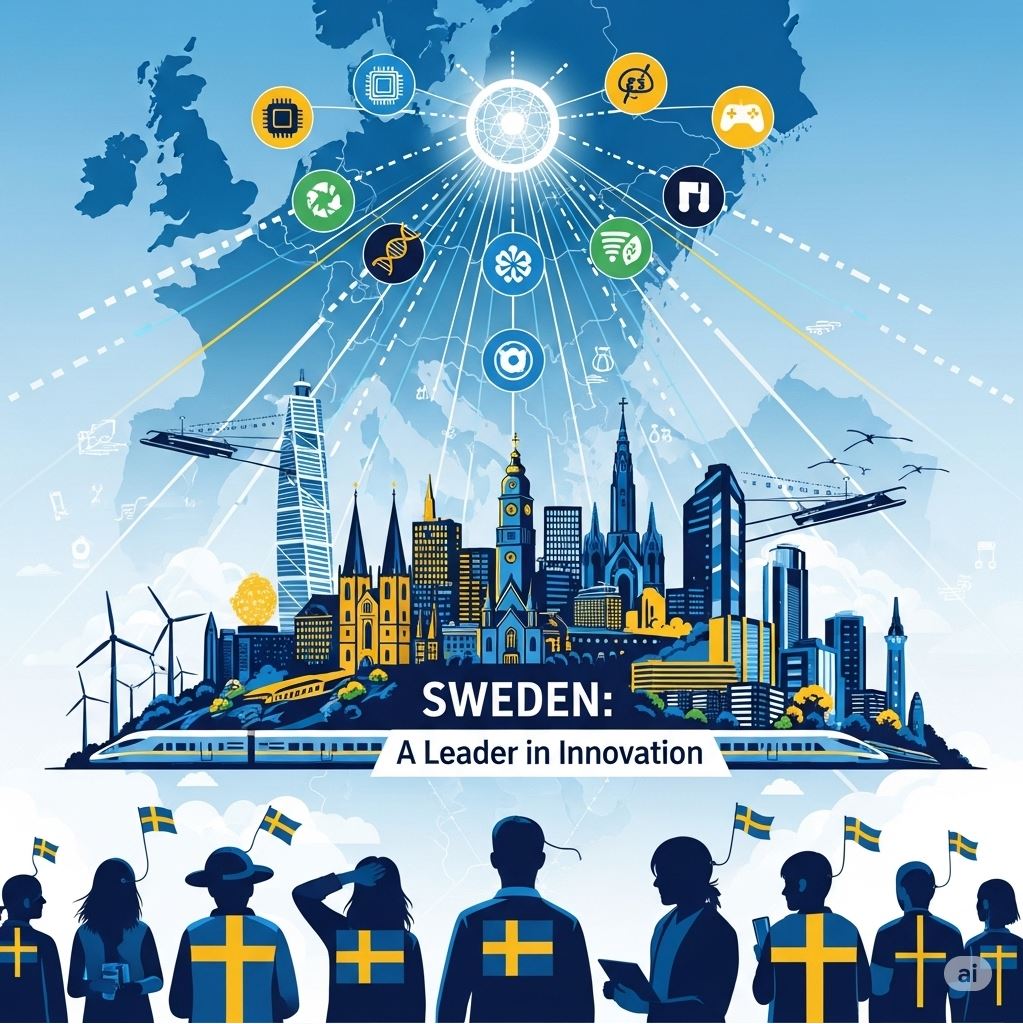
For the first time since the European Commission began publishing the European Innovation Scoreboard, Sweden has overtaken Denmark to become the bloc’s most innovative country. The 2025 edition shows Sweden’s innovation capacity at 145 % of the EU average, edging Denmark out of the top spot it had occupied for the past four years.
Key findings in the 2025 Scoreboard
- Sweden leads on 32 of 34 indicators, including business R&D investment, high-growth enterprises, and digital infrastructure.
- Denmark drops to second place (140 %), the Netherlands stays third (136 %), and Finland remains fourth (128 %).
- All four countries are classed as “Innovation Leaders” (performance above 125 % of the EU average).
- The overall EU score rose only marginally, from 110 % to 112 %, underscoring Sweden’s out-performance.
What tipped the balance
- Research intensity. Sweden now spends 3.49 % of GDP on R&D—well above the EU average of 2.2 %.
- Digitalisation. 5G coverage reached 98 % of populated areas, and 80 % of SMEs use cloud services, the highest share in the EU.
- Fast-growing firms. Sweden recorded the largest share of scale-ups (enterprises with >20 % annual turnover growth for three years).
- Clean-tech patents. Sweden leads in battery, hydrogen and carbon-capture inventions, reflecting a decade of green-industry subsidies.
Why Denmark slipped
Denmark’s absolute score actually improved, but Sweden’s acceleration was faster. Denmark lost relative points on two fronts:
- A slowdown in venture-capital investment compared with 2024.
- Fewer international co-publications, a metric that accounts for 10 % of the composite index.
What Sweden did differently
Policy shift: In 2023 the government merged innovation, digital and climate funds into a single “Deep Tech Initiative,” cutting application times for companies from nine months to four.
Talent pipeline: Universities doubled industry PhD placements, and tax incentives for private R&D staff were expanded.
Infrastructure: National fibre rollout was completed two years ahead of schedule, enabling rapid 5G adoption.
Sector spotlight
- Automotive & battery: Northvolt’s gigafactories in Skellefteå and Borlänge have generated 5 000 new research jobs.
- Life sciences: AstraZeneca’s SEK 2.6 bn expansion in Gothenburg pushed Sweden’s pharma R&D intensity above Switzerland’s.
- Gaming & XR: Stockholm hosts 40 % of the EU’s AR/VR start-ups, buoyed by generous tax credits for digital content creation.
Policy lessons for the rest of the EU
- Bundle funding streams to reduce administrative load on companies.
- Link research grants to demonstrable private co-financing (Sweden’s ratio is 70 % private to 30 % public).
- Prioritise digital backbone as a public good; Sweden’s 5G rollout was treated as critical infrastructure with simplified permits.
Outlook
Commission officials caution that Sweden’s lead is narrow: the gap to Denmark is just five percentage points. Maintaining momentum will depend on sustaining high R&D intensity once pandemic-era stimulus is phased out and on avoiding bottlenecks in skilled labour. For now, however, Sweden’s combination of deep research capacity and rapid digital adoption has put it back on the EU’s innovation throne.