
On paper, India should be an AI superpower. It’s home to 5.4 million tech workers, the largest exporter of IT services in the world, and a seemingly endless supply of engineers filling Silicon Valley’s leadership ranks. Google, Microsoft, Adobe, and IBM all have Indian-born CEOs. Yet when it comes to producing world-class AI products—the kind that dominate headlines and global markets, like China’s DeepSeek—India is conspicuously absent.
This is not about talent. It’s about history, economics, and strategic intent.
The Service-First Legacy
India’s modern tech rise began in the 1990s, fuelled by the outsourcing boom. Western companies discovered that Indian engineers could deliver software, customer service, and back-office work at scale, for a fraction of the cost.
It was a winning formula. Companies like Infosys, TCS, and Wipro became global giants, building a services industry worth over $245 billion annually. But this model rewarded flawless execution on someone else’s blueprint—not risky, capital-intensive innovation. Indian IT learned to solve problems quickly and cheaply, but the problems belonged to other people.
By the 2010s, this “service-first” DNA was deeply embedded. Young engineers saw stability and status in joining Accenture, Google, or Microsoft—not in quitting to build a risky AI startup. The safest path was to become indispensable to global tech, not to compete with it.
China’s Different Game
While India was optimizing the outsourcing model, China was making AI a matter of national strategy.
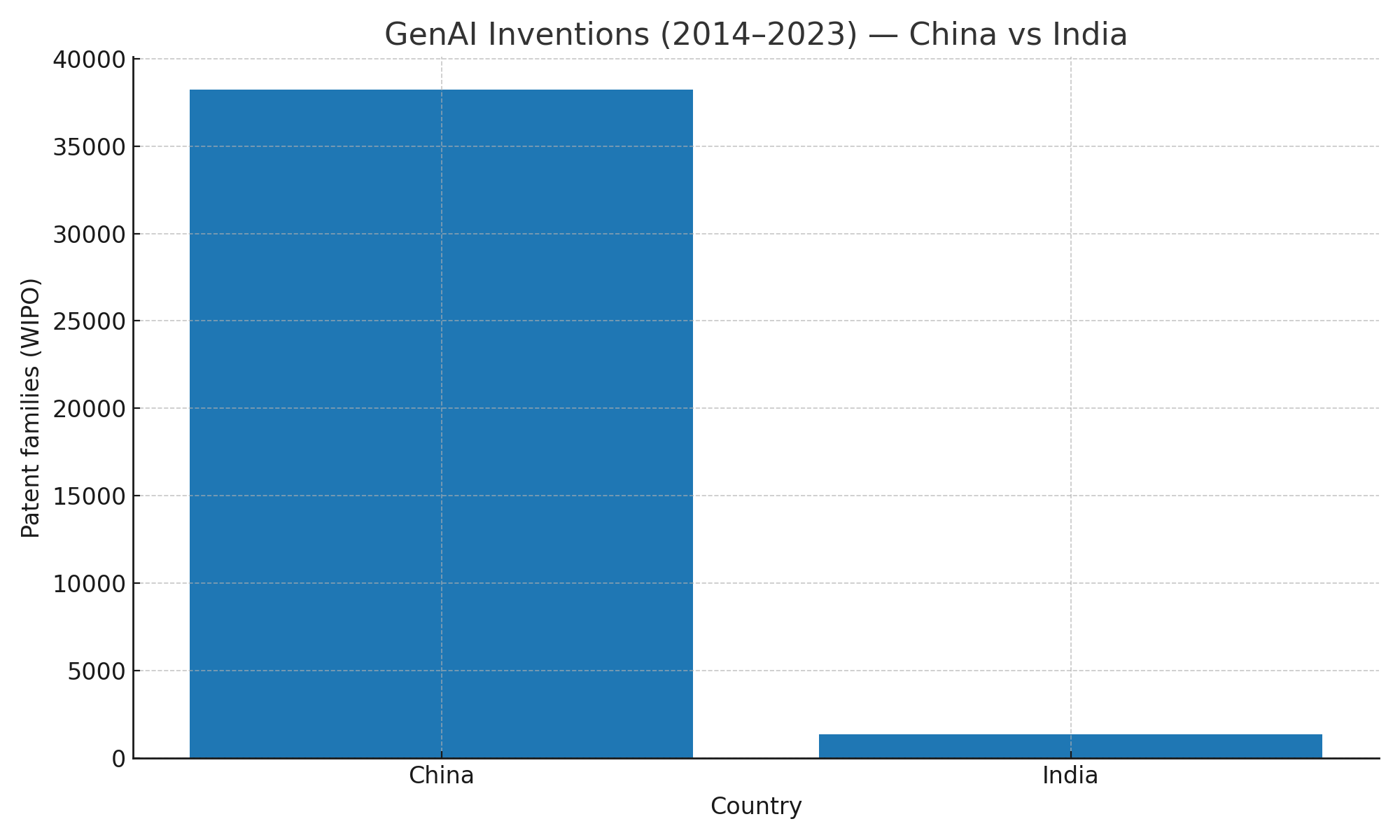
In 2017, Beijing announced its ambition to become the world leader in AI by 2030. This wasn’t a press release—it was a directive. Billions in state funds poured into AI labs, semiconductor plants, and cloud data centres. National “champion” firms like Baidu, Tencent, and Alibaba moved in lockstep with government goals, blending commercial ambition with strategic necessity.
China also had a critical advantage: data. With 1.4 billion people and loose privacy restrictions, it could centralize and analyse enormous datasets to train AI systems. And because the country controls much of its own supply chain—from chip design to cloud hosting—it can build AI at scale without depending on foreign infrastructure.
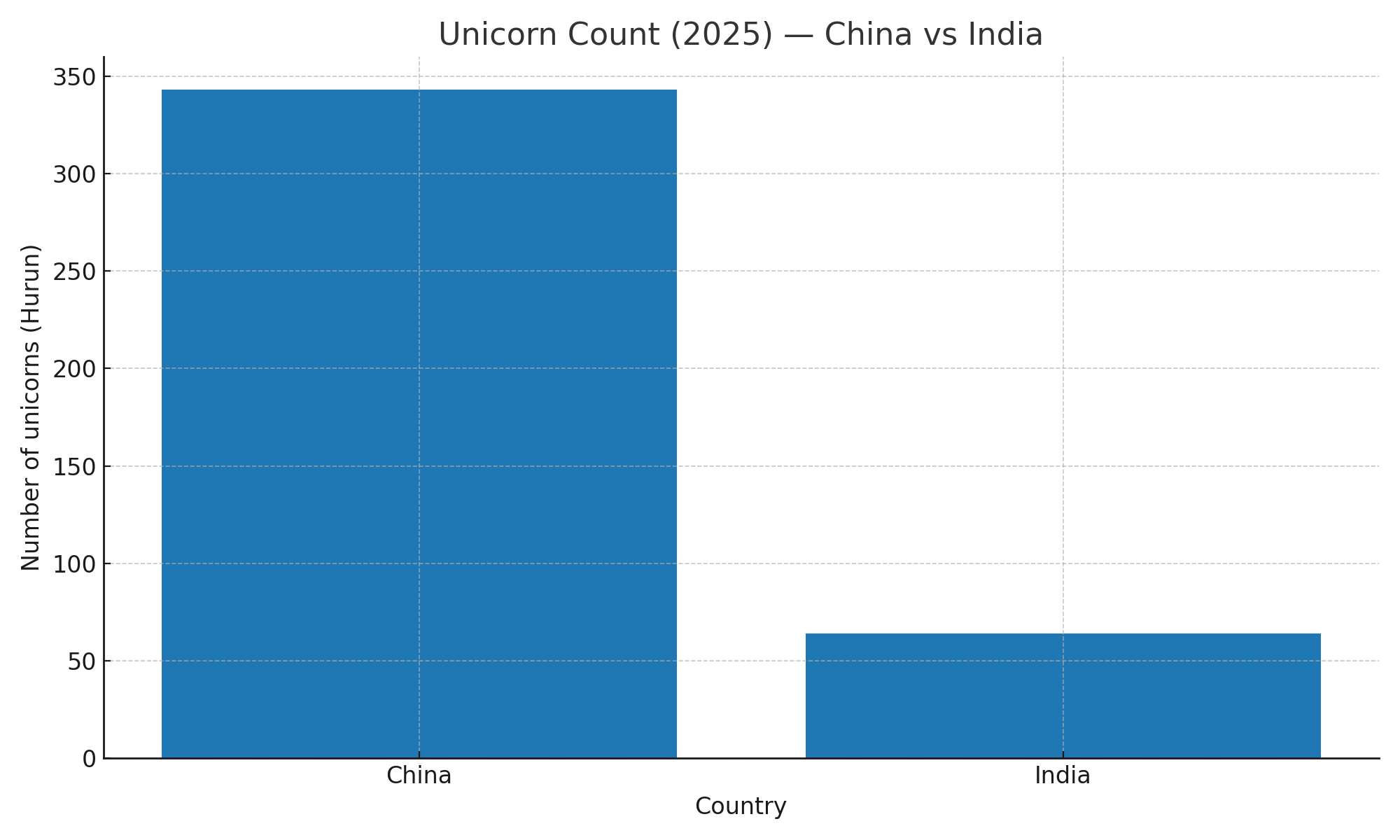
The results speak for themselves: an explosion of AI unicorns, from SenseTime to DeepSeek, that are now shaping global markets.
India’s Constraints
India’s absence from that list is not for lack of brains. It’s a question of conditions.
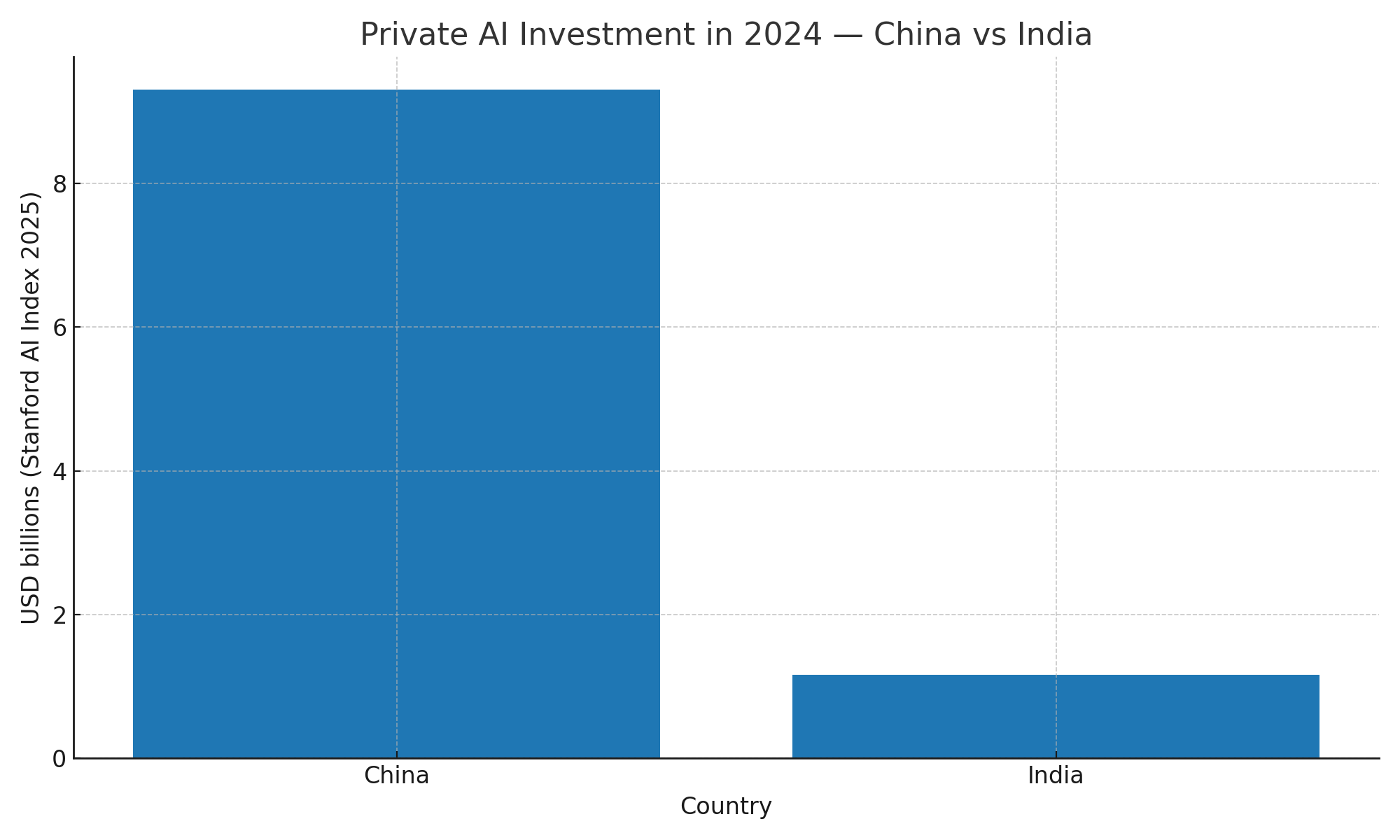
- Capital: For most of the past two decades, Indian venture capital favoured quick-scaling consumer apps like Flipkart, Zomato, and Ola over deep tech. AI platforms need years of expensive R&D before seeing returns.
- Brain Drain: Many of India’s best AI researchers are hired directly into Google, Meta, or DeepMind labs abroad. Their breakthroughs belong to those companies, not to India.
- Infrastructure: High-end chip manufacturing remains minimal. AI compute capacity is growing, but still far behind the scale needed for cutting-edge model training.
- Data Fragmentation: India’s population is as large as China’s, but its data is split across states, languages, and systems, and governed by stricter privacy laws in some areas.
- Risk Culture: Socially and economically, the safest path for an engineer is to work for a global tech giant. The moonshot startup founder is still the exception.
Signs of Change
This may not last forever. In the past three years, Indian AI startups have started to emerge with global ambitions. Sarvam AI, Krutrim, and Reverie are building large language models tuned for Indian languages. The government’s IndiaAI Mission is funding domestic AI research and compute infrastructure. Venture capital is warming to deep tech, and public–private partnerships are expanding.
But China’s head start is significant. Its AI industrial base was already in motion while India’s was still primarily servicing foreign contracts.
Two Models, Two Futures
China’s AI success is the product of centralization, scale, and aggressive strategic coordination. This brings speed, but also rigidity and political risk. India’s slower, market-driven approach has been better at producing adaptable, globally integrated talent—but that adaptability hasn’t yet translated into homegrown global AI platforms.
For Nordic readers, the lesson is not that one model is simply “better” than the other. It’s that infrastructure, capital, and strategic clarity matter just as much as raw talent. If you want to lead in a frontier field, you can’t rely on market forces alone—you need to set the course and back it with both money and will.
Closing Thought
India’s crown in IT is real—but it was forged in the service of others’ visions. Whether it can claim a crown in AI will depend on whether it can shift from being the world’s most trusted builder to being the world’s most daring inventor. China has shown what coordinated ambition can achieve. The question is whether India is willing to play the same game.