
COPENHAGEN — As Finance Minister Nicolai Wammen (S) unveiled Denmark’s latest Finance Act two weeks ago, buried among line items on kindergarten subsidies and energy tax cuts was a quiet milestone — one that speaks volumes about Denmark’s evolving relationship with the European Union.
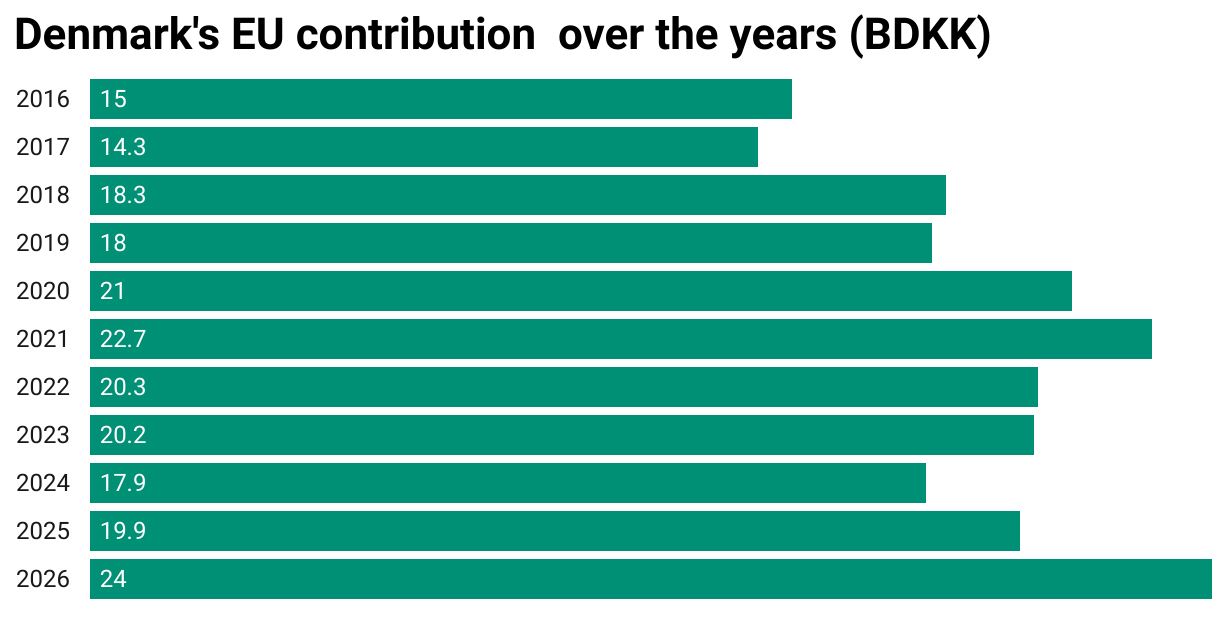
For the first time in history, Denmark will send 24 billion Danish kroner (approx. €3.2 billion) to the EU budget in 2025 — a record contribution that marks a 60% increase from just a decade ago. While supporters hail it as proof of Denmark’s deepening commitment to European solidarity, critics are sounding the alarm: at a time of rising food prices and cost-of-living pressures, is this money better spent at home?
A Contribution in Context
The jump from 15 billion kroner in 2015 to 24 billion in 2025 didn’t happen overnight. According to the Ministry of Finance, much of the increase is tied to the accelerated rollout of the EU’s structural funds — long-delayed programs now gaining momentum to rebuild infrastructure, support green transitions, and bolster security across the bloc.
“The implementation of structural funds has picked up speed after years of delays,” reads a statement from the Ministry. “An updated budget proposal will be issued this autumn, which may include revised forecasts.”
But for many Danes, especially those feeling the pinch at the supermarket checkout, the timing feels off.
“Spend It Here, Not There,” Says the Opposition
The Danish People’s Party (DF) isn’t mincing words. Finance spokesman Peter Kofod calls the record contribution “a clear no” — arguing that domestic needs should come first.
“The government needs to solve problems here in Denmark before it tries to fix the world,” Kofod told Copenhagen Weekly. “You can’t tell people the EU needs more money while Danes are struggling to afford groceries.”
His critique taps into a broader populist sentiment: that Brussels is a black hole for Danish kroner, with little tangible return. Kofod also took aim at Prime Minister Mette Frederiksen, accusing her of flip-flopping — from calling EU budget increases “complete nonsense” in 2019 to now presiding over the largest payout in history.
“She doesn’t dare draw a red line. The government prioritizes friends in Brussels over families in Ballerup,” Kofod charged.
Government Pushback: “It Evens Out Over Time”
The government, however, insists the numbers are misleading. Social Democrat finance spokesman Benny Engelbrecht explains that the EU operates on a seven-year budget cycle (2021–2027), and Denmark’s contributions are pre-agreed and fixed within that framework.
“In 2024 and 2025, we actually sent less than usual. Now we’re catching up. Over the full period, we’re spending exactly what was negotiated — no more, no less,” Engelbrecht said.
He also emphasized that the structural funds Denmark helps finance aren’t lost abroad — they return in the form of grants for Danish municipalities, green energy projects, and even security initiatives that benefit Danish interests.
“These funds support peace and stability in Europe — which, in turn, protects Denmark,” Engelbrecht added.
Public Opinion: Surprisingly Supportive
Ironically, while political debate rages, public sentiment may be shifting in the EU’s favour. Recent polling shows a steady uptick in Danish support for the EU project — likely fuelled by Russia’s war in Ukraine, uncertainty around U.S. leadership under Trump, and a growing recognition of Europe’s strategic importance.
For many Danes, contributing more to Brussels isn’t a loss — it’s an investment in collective security, economic stability, and influence on the global stage.
The Bigger Picture: What’s Next?
Negotiations for the EU’s 2026 budget — which could push Denmark’s contribution even higher — are expected to conclude in November under Denmark’s rotating EU presidency. That means Copenhagen will be at the table, not just writing checks, but helping shape Europe’s financial future.
Will the government hold the line? Or will domestic pressure force a renegotiation?
One thing is certain: as Denmark’s EU bill climbs to historic levels, the conversation isn’t just about kroner and cents — it’s about identity, sovereignty, and where Danes believe their priorities should lie.
The Question Remains: Is It Worth It?
Supporters say yes — that in an unstable world, pooling resources with neighbours isn’t charity, it’s strategy. Critics say no — that every billion sent to Brussels is a billion not spent lowering food prices, improving hospitals, or cutting taxes.
As Denmark stands at this fiscal crossroads, one truth emerges: the EU is no longer a distant bureaucracy. It’s a mirror — reflecting not just how much Denmark gives, but what kind of country it wants to be.
What do you think? Should Denmark continue increasing its EU contributions — or bring the money home? Share your thoughts with us at info@Nordic BusinessJournal.com