
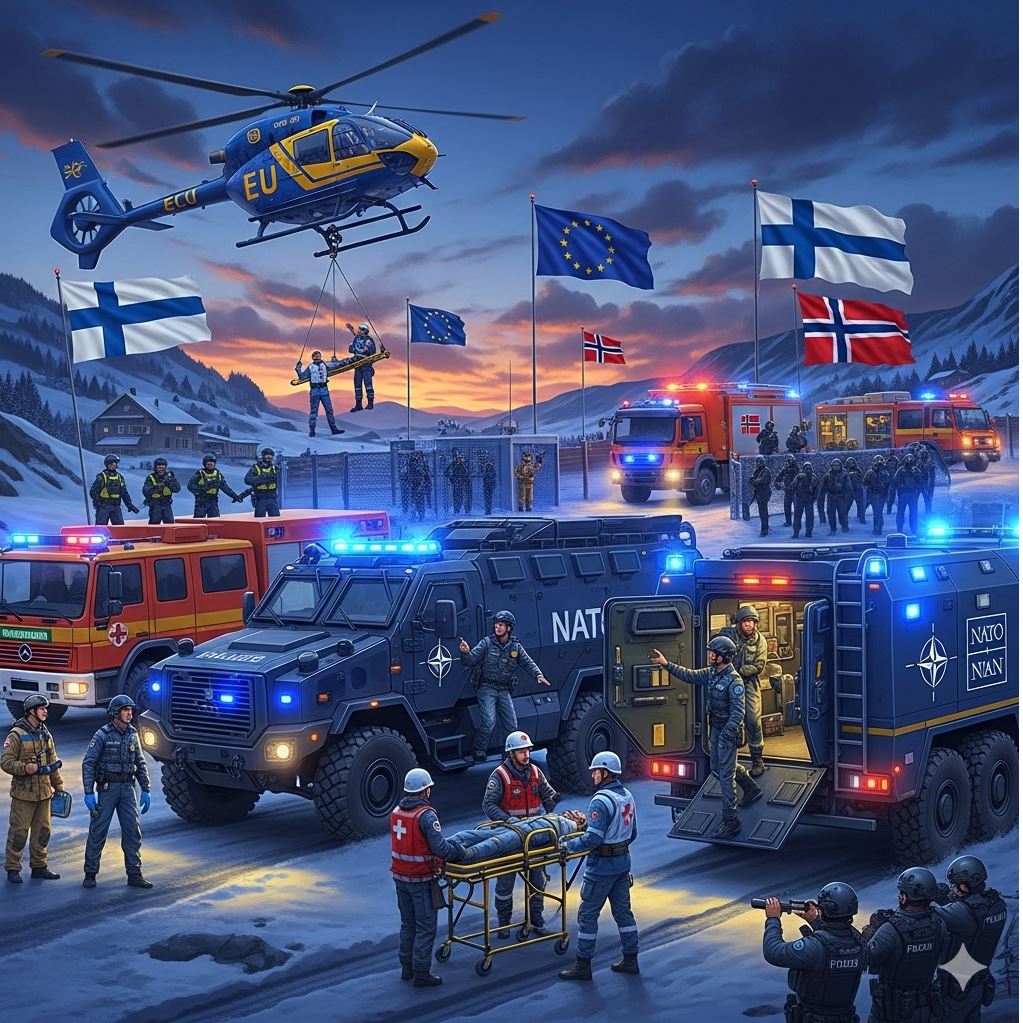
Helsinki, Finland – In an unprecedented collaboration, Finland and Norway recently conducted a joint, cross-border response drill, simulating a large-scale medical crisis to test the robustness of their preparedness for a range of threats, including medical, chemical, biological, radiological, and nuclear (CBRN) emergencies. This exercise, though fictional, highlights the critical role of international cooperation in managing potential disasters, as well as the vital resources stored within the European Union’s emergency stockpiles.
The Scenario: A Fictional Medical Crisis
The drill, dubbed “Nordic Shield,” involved hundreds of first responders, medical teams, and military personnel from both nations, who were tasked with managing an outbreak of a highly contagious biological agent in a fictional border town near the Finnish-Norwegian frontier. The scenario escalated rapidly, testing not only the countries’ ability to contain a health emergency but also their coordination across borders in the face of a transnational threat.
The exercise took place across multiple sites, including Helsinki and Oslo, with simulation hubs in smaller border towns. It was designed to mimic a worst-case scenario, where both nations’ emergency services would be overwhelmed, necessitating the urgent delivery of medical supplies and the establishment of specialized treatment centres.
EU Stockpiles: A Strategic Safety Net
Finland’s role in the exercise is crucial, as the country serves as a key location for the EU’s emergency medical stockpiles. The European Union maintains a strategic reserve in Finland, which includes critical medical supplies, equipment, and materials intended to respond to a wide range of emergencies. This includes everything from life-saving medications and medical devices to specialized gear for chemical, biological, radiological, and nuclear (CBRN) events.
These stockpiles are part of the EU’s broader strategy to ensure rapid mobilization in the event of crises that transcend national borders. Finland’s strategic location in the Arctic Circle also makes it an ideal hub for these supplies, as it can swiftly support Nordic nations and beyond in the face of a regional or global disaster.
The Scale of the Response
During the exercise, participants utilized a combination of EU stockpiled materials and national resources to respond to the crisis. Finland’s state-of-the-art logistical network, including air and rail transport, played a pivotal role in ensuring that medical supplies reached Norwegian border points swiftly and efficiently. The exercise revealed the strengths of Finland’s cross-border cooperation mechanisms, which are fine-tuned for rapid deployment during both natural and man-made emergencies.
“Today’s exercise demonstrates the importance of collaboration between nations, especially in times of emergency,” said Sanna Marin, Finland’s Prime Minister, addressing participants after the simulation. “With our shared resources and coordinated planning, we ensure that we are prepared for whatever challenges the future may hold. It’s about the safety and well-being of our citizens, and we are committed to ensuring that no border stands in the way of a life-saving response.”
A Shared Vision of Preparedness
The cross-border response drill also underscored the importance of public health and safety frameworks that transcend national borders. Norwegian Prime Minister Erna Solberg noted the deepening ties between Finland and Norway in the realm of emergency preparedness, emphasizing that the health of one nation is inextricably linked to the other in a rapidly globalizing world.
“Emergencies do not recognize borders, and that’s why exercises like these are so vital,” Solberg said. “By working together, we ensure that our citizens are better protected from the many challenges that may arise, from pandemics to CBRN threats.”
The partnership also speaks to the broader efforts by the European Union to foster a cohesive, multinational approach to disaster preparedness. The EU Civil Protection Mechanism (EUCPM) supports cooperation in disaster management, enabling cross-border collaboration through shared resources, expertise, and coordinated planning.
Looking Forward: Strengthening EU Readiness
The Nordic Shield exercise has raised the bar for crisis response preparedness in the region. Following the successful simulation, both nations are already planning to expand future drills to include even more scenarios, further integrating new technologies such as artificial intelligence (AI) in decision-making processes during crises.
The EU stockpile in Finland, one of the largest in Europe, remains a central pillar in this ongoing effort. European Union officials are closely monitoring the stockpile’s capacity and readiness to ensure it is adaptable to emerging threats. While the focus remains on medical supplies, the expanding role of CBRN preparedness underscores the region’s commitment to comprehensive crisis management.
Beyond the Drill: Real-World Implications
Though this was only a drill, its implications are far-reaching. The collaboration between Finland and Norway, paired with the strategic resources available through the EU’s stockpiles, demonstrates a model for other nations to follow in building comprehensive, cooperative disaster response systems.
In an era of global instability—marked by health crises, environmental disasters, and geopolitical tensions—the readiness of nations to respond swiftly and effectively will be paramount. Exercises like Nordic Shield not only ensure that these countries can meet such challenges but also set the standard for international cooperation in addressing complex emergencies.
As the global community continues to face growing uncertainties, the lessons learned from such drills could very well determine how quickly nations respond and recover when the unthinkable happens. The collaboration between Finland and Norway stands as a shining example of what is possible when nations unite for the common good.