
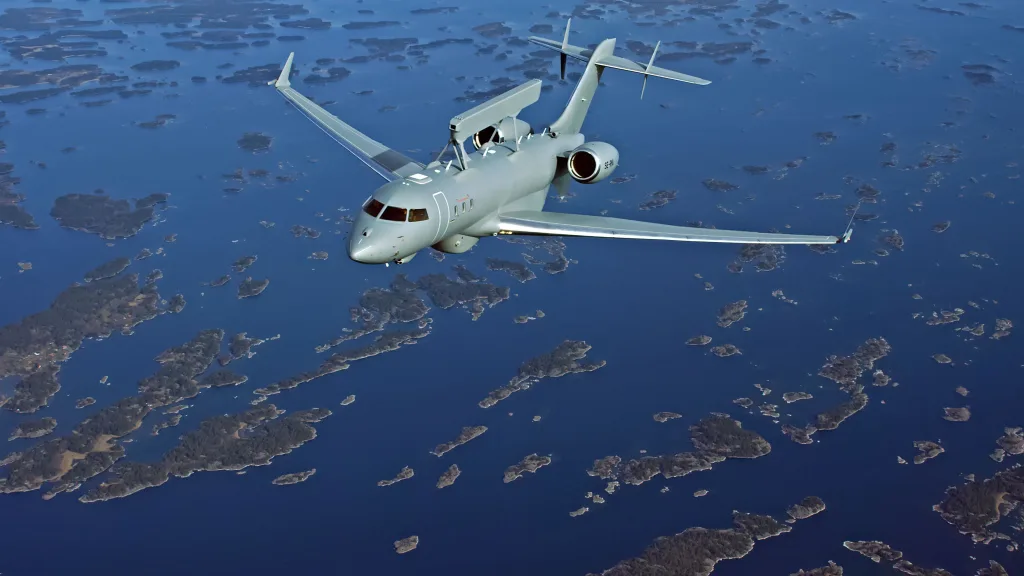
Germany is seriously considering Saab’s GlobalEye reconnaissance aircraft as a replacement for its retiring AWACS fleet, with Defence Minister Boris Pistorius highlighting that GlobalEye is “in pole position” among candidates for acquisition.
The Strategic Context
Facing persistent Russian provocations and a shifting NATO security environment, Germany is in the process of retiring its Boeing AWACS surveillance planes. Saab’s GlobalEye, a multi-domain reconnaissance platform, has emerged as a leading candidate for replacement. Pistorius underscored German caution amid Russian airspace infringements, noting the importance of robust and non-provocative defence. Speaking alongside Swedish Defence Minister Pål Jonson, he stressed the need for “solidarity and practical action” in reinforcing NATO’s eastern flank, confirming GlobalEye as an active candidate: “We have not yet made a decision, but I would say it [GlobalEye] is in pole position, to put it cautiously”.
Arguments in Favor of GlobalEye
- Saab’s GlobalEye offers simultaneous surveillance across air, sea, and land domains, outperforming traditional platforms in both detection range and operational persistence.
- The platform employs active and passive sensors, providing real-time information for faster threat response and enhanced situational awareness—key advantages given the current security climate.
- Endurance and adaptability: GlobalEye can operate for over 11 hours without refuelling, covering broader sectors and deeper missions than legacy AWACS.
- Recent procurement moves by France, which signed a declaration to acquire GlobalEye, underline the aircraft’s growing reputation and interoperability among Europe’s leading militaries.
Criticisms and Concerns
- Some German commentators question the cost-effectiveness and necessity of GlobalEye, suggesting existing Eurofighter and drone assets could deliver adequate surveillance for less.
- Sceptics stress that rapid technological changes and integration challenges—especially with NATO systems—may complicate procurement and deployment timelines.
- The political backdrop, including calls for broader European defence investments amidst a potential reduction of US troop presence, puts extra scrutiny on large-scale purchases like GlobalEye.
Strategic Debate
- Proponents highlight how GlobalEye would bolster Germany’s—and broader NATO’s—capacity to counter Russia’s evolving aerial and hybrid threats.
- Critics argue Germany should diversify its investments in surveillance and early-warning technology, and not rush into a procurement that could limit flexibility or overextend budgets.
Conclusion
Germany’s openness to acquiring Saab’s GlobalEye signals a crucial juncture in European defence modernization. With security stakes rising and allies like France buying into the same technology, the “pole position” of GlobalEye reflects both a strategic shift and a lively debate about the future shape of European intelligence capabilities.