
EU leaders have floated the idea of a “drone wall” along the bloc’s eastern border with Russia. It is being sold as a bold defence initiative, but among military planners and researchers the mood is far less confident. They see a political slogan racing ahead of technical and operational reality.
“The need for stronger defences is obvious, but building a drone wall across such a vast frontier will be a huge challenge,” says Michael Gunnerek, head of the Swedish Armed Forces’ UAS Centre in Karlsborg.
The project remains vague. For officers who work daily on counter-drone systems, that vagueness matters. Per Olsson, lieutenant colonel and project manager for Sweden’s drone development efforts, describes the wall more as a framework for cooperation than a viable barrier. Drones can certainly be detected—installing masts along the 1,600 km border is technically possible—but neutralizing them is far harder. “It’s a delicate task,” he says.
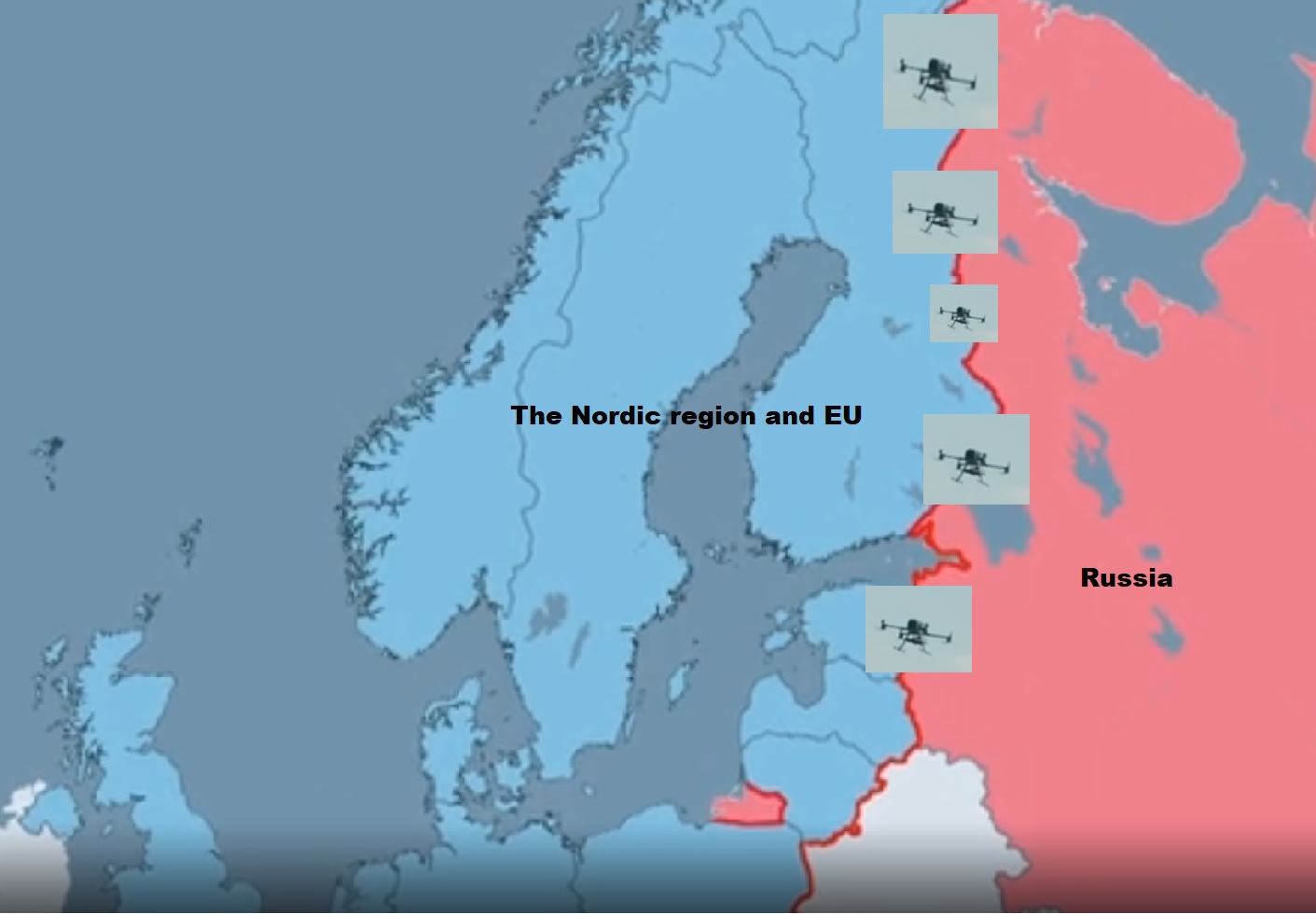
Gunnerek draws a parallel to Israel’s Iron Dome. Even in a much smaller geographic area, with years of investment and constant upgrades, hostile drones and rockets still get through. Europe’s geography is far less forgiving, and the economics skew against defence: drones are cheap to produce, counter-systems are costly and manpower-intensive.
“We should build protection, of course,” Gunnerek says. “But believing you can create something that completely blocks the other side—it won’t happen.”
Lars Forssell, a researcher at the Swedish Defence Research Institute (FOI), adds that while effective anti-drone systems exist, they all have limited range. Covering an entire border would demand thousands of installations, huge budgets, and trained operators in the field. “The biggest challenge isn’t only cost,” he notes. “It’s people—recruiting, training, and sustaining the personnel needed to manage such a network.”
The political impulse to act is easy to understand. Russia’s war in Ukraine has turned drones into both a battlefield staple and a symbol of asymmetric power. For EU leaders, announcing a continent-wide defence effort signals resolve. But military reality suggests expectations need to be tempered.
Bottom line: a drone wall may be useful as a shared project that strengthens cooperation, accelerates research, and deploys incremental defences along the border. What it cannot be is what the phrase implies—a total shield. “You’ll always be one step behind the attacker,” Forssell says. “That’s the nature of the game.”
Meanwhile
All Ten Missing Norwegian Soldiers Found After Large-Scale Search in Finnmark
A full-scale rescue operation unfolded in Øst-Finnmark, northern Norway, on Thursday after ten soldiers failed to return from a military exercise.
The soldiers were expected back at 7 a.m., but by the evening they were still unaccounted for. That triggered a coordinated search involving police, the Armed Forces, rescue services, the Red Cross, dogs, drones, and a helicopter.
By 7:45 p.m., five soldiers had been located—two by rescue helicopter and three who made it to the original meeting point. The remaining five were harder to trace due to poor mobile coverage and the nature of the exercise itself, which involved remaining hidden and navigating to a rendezvous point.
The search carried on overnight. Early Friday morning, the police confirmed the last group had been found. None required medical attention.
“The Armed Forces are working to establish a full overview of the situation,” said spokesperson Brage Wiik-Hansen.
According to Norwegian media, the extended delay was simply due to the exercise running longer than expected.