
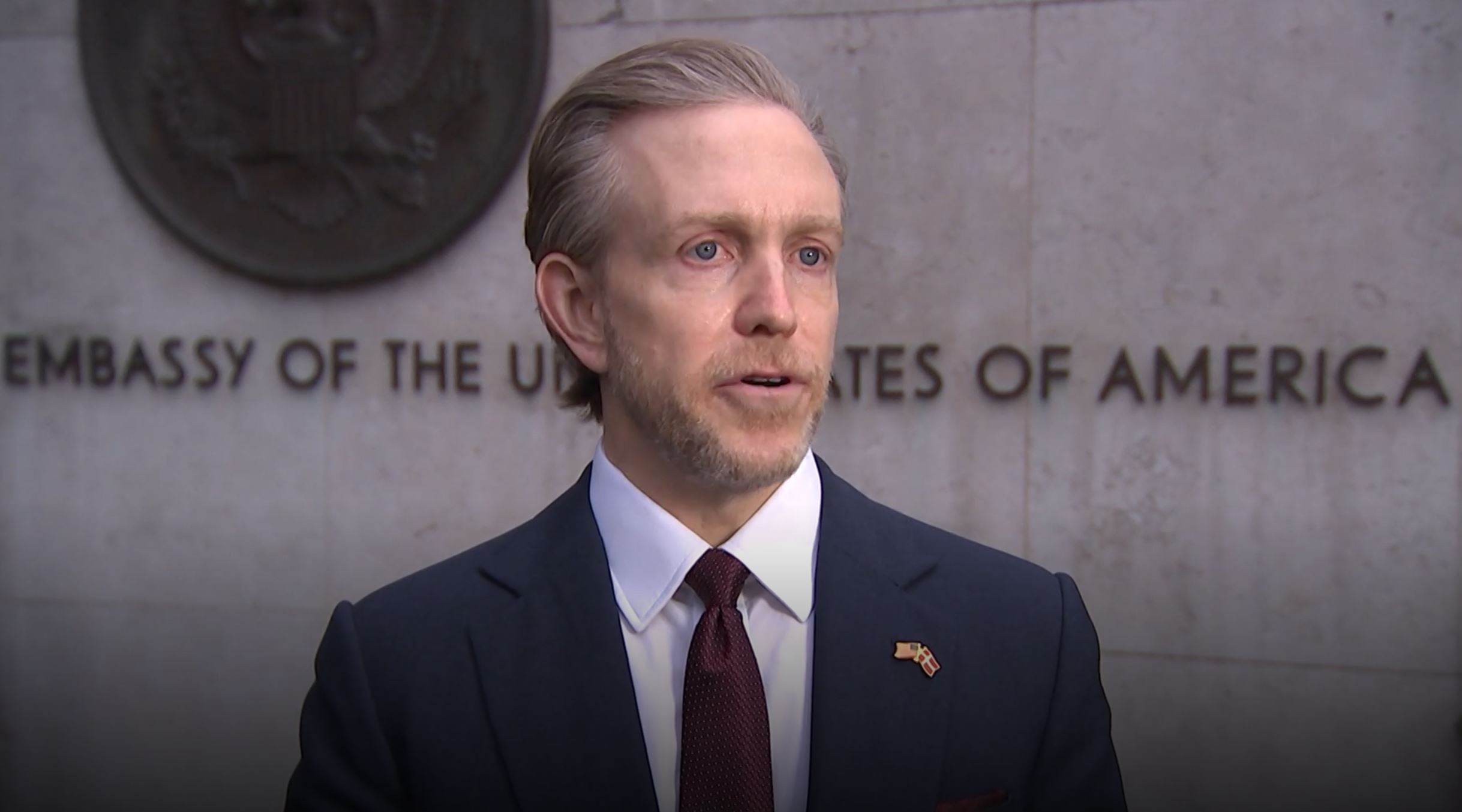
The newly appointed U.S. Ambassador to Denmark, Ken Howery, did not unequivocally rule out the possibility of the United States acquiring Greenland by force — despite repeated questioning.
On his first day in Copenhagen, Howery met King Frederik X at Christiansborg Palace. He is a notable figure: co-founder of PayPal, former U.S. Ambassador to Sweden, and a business executive turned diplomat.
In the face of pointed questions about U.S. intentions toward Greenland, his responses followed the same pattern: reference to the U.S. President’s statements, emphasising respect for Greenland’s self-determination, but stopping short of a direct denial of U.S. territorial ambitions.
What was said, and what wasn’t
When asked whether his role included ensuring U.S. control of Greenland, Howery said the United States “respects the right of the Greenlandic people to determine their own future” and remains focused on the security challenges posed by Russia and China in the Arctic.
When asked if the U.S. would refrain from using force to acquire Greenland, the ambassador declined to answer directly and repeatedly deferred to the President’s previous remarks.
Why this matters
There are three key dimensions Nordic business readers should note:
- Arctic geopolitics and economic stakes
Greenland is rich in strategic value: a vast Arctic landmass, potential access to mineral and rare-earth resources, and a key node for military and early-warning systems. The U.S. has recently signalled renewed interest in the Arctic region. For instance, Danish-Greenlandic cooperation on Arctic security is deepening, which aligns with U.S. concerns about Russia, China and the increasing geostrategic competition in the region.
For Nordic businesses this means that Greenland may become a more contested arena — both politically and in terms of investment and infrastructure — which could impact supply chains, mining projects or energy/logistics development. - Danish sovereignty and kingdom cohesion
Greenland is an autonomous territory of the Kingdom of Denmark. Any U.S. interest in ownership or control (even if currently speculative) stresses the Danish–Greenlandic relationship and raises questions for Danish policymakers. Denmark has publicly expressed concern over alleged U.S. intelligence or influence operations in Greenland.
For Nordic businesses, this means increased regulatory and diplomatic risk: projects in Greenland could face delays, new oversight, or political backlash if the territory’s status becomes a flashpoint. - Ambassador Howery’s role and signal
Howery’s background — entrepreneur, co-founder of a major fintech company, politically appointed diplomat — signals a more transactional, business-minded U.S. approach to the region. His deferral to presidential statements suggests his personal role is more to execute strategy than shape it. As one commentary notes, his posting “has been framed from the start as an Arctic power play”.
For Nordic companies, this means Washington may view Nordic Arctic states as partners or strategic stepping stones in its global competition, and thus business environments may evolve faster under U.S. strategic impetus.
Bottom line
While Ambassador Howery did not admit that the U.S. plans to “take Greenland by force,” neither did he rule it out. He consistently referred back to President Donald Trump’s statements: that the U.S. “respects the right of the Greenlandic people” but also considers Greenland strategically necessary.
For the Nordic business community, this isn’t just diplomatic theatre. It means:
- A possible uptick in U.S. activity in Greenland (security, mining, infrastructure)
- A heightened strategic dimension to doing business in the Arctic, especially within the Kingdom of Denmark
- Political risk embedded in investments and partnerships in Greenland — from both state and private actors
Companies with interests in Greenland or the wider Arctic should monitor not just market conditions but also political-military dynamics, alliance posture, and regulation. In short: the Greenland question may increasingly become a business question.