
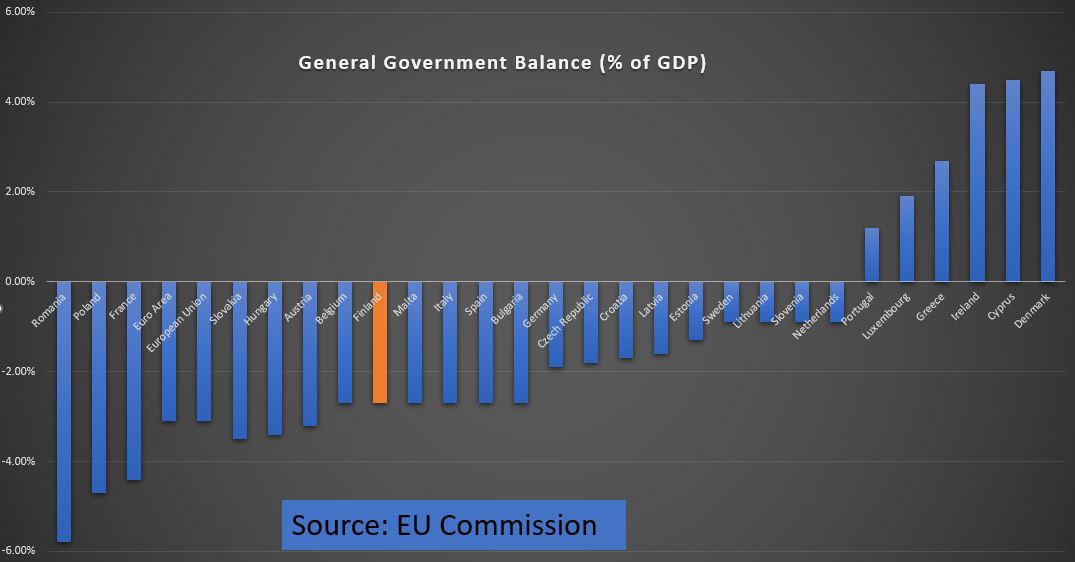
Helsinki’s long-standing reputation as a bastion of fiscal discipline within the European Union is now under serious threat. Today, the European Commission is expected to formally recommend initiating an Excessive Deficit Procedure (EDP) against Finland—a move that would place the Nordic nation under intensified EU economic surveillance. For a country that once championed budgetary prudence and served as a model for sound public finances, the recommendation marks a dramatic reversal of fortunes and a sobering moment of reckoning.
From Exemplar to Watchlist: A Credibility Crisis
The EDP is not a mere bureaucratic formality. Under the Stability and Growth Pact, it triggers mandatory corrective actions, strict deadlines, and—if unaddressed—potential financial sanctions. More significantly, it signals to markets, partners, and citizens that Finland’s public finances have strayed into dangerous territory.
“This fundamentally undermines Finland’s credibility,” warns Eero Heinäluoma, a veteran Social Democratic MEP and former finance minister. “For decades, we were the country others looked to when discussing responsible economic governance in Europe. Now, we risk being grouped with nations that have struggled to manage their budgets.”
Aura Salla of the National Coalition Party (Saml) echoes the concern, stressing that without immediate and substantial reforms, Finland could remain under EU scrutiny for years. “We cannot afford complacency. Structural reforms and fiscal consolidation are no longer optional—they are existential.”
Anna-Maja Henriksson of the Swedish People’s Party (SFP) adds a note of historical irony: “It damages our standing when we’ve long been held up as an example, only to now require supervision from Brussels.”
Root Causes: A Mix of Long-Term Neglect and Policy Missteps
While political blame is being apportioned across party lines, there is broad consensus on the underlying drivers of Finland’s fiscal deterioration:
– Chronic underinvestment in growth engines: Heinäluoma points to systemic underfunding in innovation, labour market activation, and infrastructure—areas critical to boosting productivity and tax revenues.
– Austerity-driven stagnation: Jussi Saramo of the Left Alliance argues that successive rounds of public spending cuts, particularly under the current Orpo-led centre-right government, have strangled domestic demand and deepened unemployment. “Finland went from being among the EU’s fiscal best to one of its most troubled economies—not because of external shocks alone, but due to self-inflicted policy choices,” he asserts.
– Multi-generational policy failure: Elsi Katainen of the Centre Party cautions against partisan finger-pointing. “This decline didn’t begin with one government. Over the past decade, successive administrations have failed to modernize our economy or address demographic pressures. Now, the bill is coming due.”
Indeed, Finland’s structural challenges are profound: an aging population, sluggish productivity growth, a shrinking workforce, and an overreliance on a few volatile export sectors—most notably forest products and legacy tech—have left the economy vulnerable. The Russia-Ukraine war further disrupted key trade flows, but analysts agree that deeper structural weaknesses were already in place well before 2022.
Charting a Path Forward: Growth, Reform, and Political Unity
Despite political divisions, Finnish MEPs converge on the need for a dual-track strategy: immediate fiscal consolidation paired with strategic investments in future competitiveness.
Salla insists that “hoping for organic growth to fix our deficit is naïve. We need difficult but necessary decisions—pension system reform, labour market liberalization, and smarter public spending.”
Henriksson emphasizes human capital as Finland’s greatest asset: “Our future lies in education, R&D, and digital upskilling. Cutting these areas would be catastrophic. We must invest in people to rebuild trust and competitiveness.”
Katainen adds that short-term cuts alone will backfire: “We’ve reached the limits of austerity. Now, we must pivot toward growth-oriented policies—green transition, circular economy, and AI-driven innovation—that can generate sustainable revenue.”
Saramo warns against repeating past mistakes: “If we double down on cuts without stimulating demand or protecting welfare, we’ll only accelerate the downward spiral. Economic policy must serve people, not just balance sheets.”
The Broader Implications for the EU
Finland’s predicament also raises questions about the EU’s economic governance framework. As one of the original Stability and Growth Pact advocates—and a key voice in favour of fiscal rules during the Eurozone crisis—Finland’s fall from grace could weaken the moral authority of northern EU states in budgetary debates. Moreover, with several member states (including Germany and France) also facing fiscal stress, the Commission’s enforcement credibility is on the line.
Conclusion: A Defining Moment for Finland
The impending EDP is more than a technical procedure—it is a wake-up call. Finland now stands at a crossroads: it can treat this as a temporary embarrassment and return to old habits, or it can seize the moment to enact the deep reforms needed for long-term resilience.
The stakes could not be higher. The country that once symbolized Nordic economic virtue must now prove it can reinvent itself—not just to satisfy Brussels, but to secure prosperity for its own citizens in an increasingly volatile global economy.
—Reporting by Nordic Business Journal. Additional analysis by Dr. Liisa Ranta, Senior Economist, Helsinki Institute for Economic Policy.