
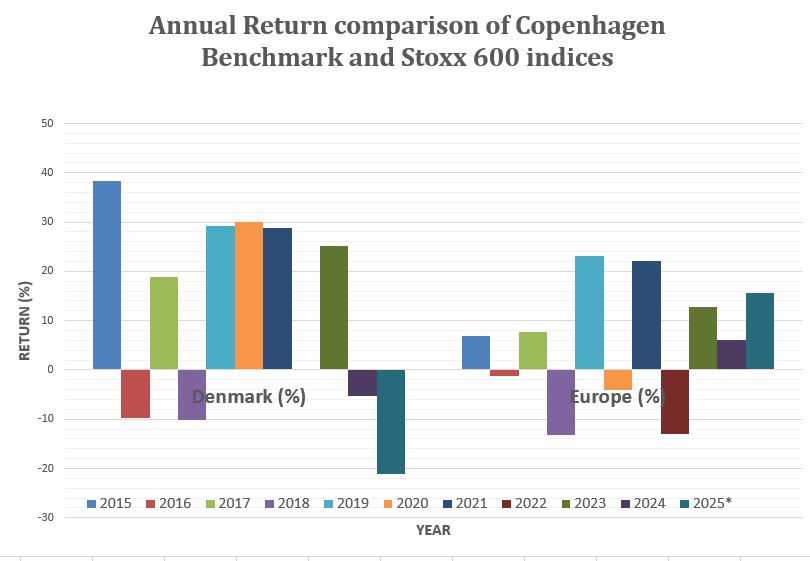
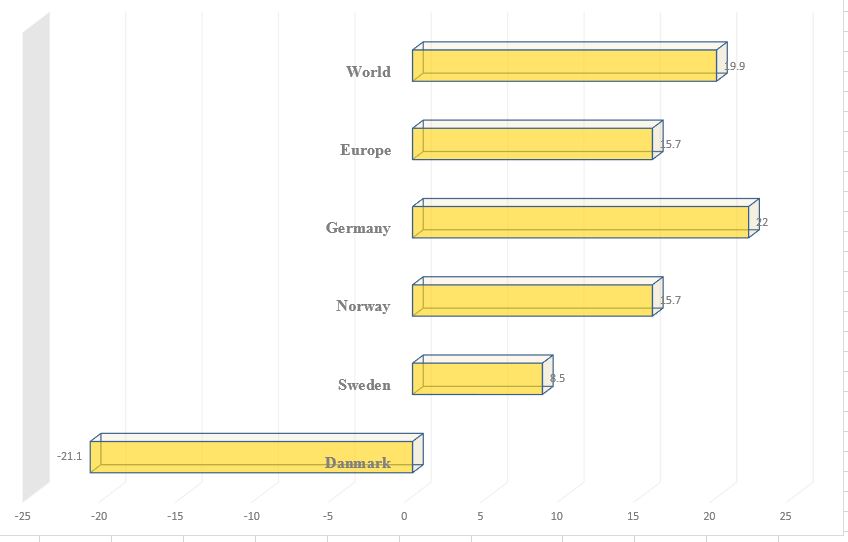
Copenhagen, December 22, 2025 — For Danish investors, 2025 will be remembered not as a year of innovation or growth, but as a sobering correction. The OMX Copenhagen 25 index—Denmark’s primary equity benchmark—plunged by over 20% this year, marking its worst annual performance since the global financial crisis of 2008. This downturn is especially jarring given the broader global market context: the MSCI World Index rose nearly 20% in the same period, driven by strong U.S. tech performance and resilient European earnings.
The anomaly lies not in global headwinds, but in one towering domestic factor: Novo Nordisk.
The Novo Nordisk Effect: A Market Distorted by One Giant
Once the golden child of Danish equities—a global leader in obesity and diabetes therapeutics—Novo Nordisk’s stock plummeted by nearly 50% in 2025 alone, erasing more than DKK 3 trillion in market value. Its dominance in the Danish equity landscape (accounting for roughly 40% of the OMXC25’s weighting) meant that its stumble dragged the entire national index into negative territory.
“This isn’t just a stock correction—it’s a structural vulnerability,” says Jacob Pedersen, Head of Equity Research at Sydbank. “When one company represents such a disproportionate share of a national index, the market ceases to be diversified. It becomes a proxy for that single firm’s fortunes.”
Beyond Novo: A Tale of Two Markets
Strip Novo Nordisk from the equation, and the story flips dramatically. According to internal analyses by Sydbank and PFA Pension, a Novo-adjusted Danish equity index actually posted gains of approximately 18% in 2025—closely mirroring performance across the broader European market.
Companies like Vestas, ISS, and Denmark’s major banks delivered solid returns, buoyed by green energy tailwinds, global facility services demand, and stable interest margins. Even struggling names like Ørsted and Coloplast showed signs of stabilization in H2 2025.
“The real issue isn’t Danish competitiveness—it’s concentration risk,” explains Tine Choi Danielsen, Chief Strategist at PFA Pension. “Danish firms are global players with strong fundamentals. But when nearly half your market cap hinges on one biopharma giant facing patent cliffs, pricing pressures, and unexpected clinical setbacks, volatility becomes inevitable.”
Why Did Novo Stumble in 2025?
While Novo Nordisk’s long-term pipeline remains robust, 2025 brought a perfect storm:
- U.S. pricing pressure: The Inflation Reduction Act’s drug pricing provisions began impacting GLP-1 manufacturers more severely than anticipated.
- Supply chain bottlenecks: Global demand for Wegovy and Ozempic outstripped production capacity, leading to rationing and lost revenue.
- Competitive threats: Eli Lilly accelerated its tirzepatide rollout, while new entrants from China signalled future price competition.
- Valuation reset: After tripling in value between 2021 and 2023, Novo’s stock was due for a correction—2025 simply delivered it with force.
A Wake-Up Call for Danish Investors
For years, Danish retail and institutional investors enjoyed outsized returns from a compact, high-quality equity market. But 2024–2025 has broken that illusion. “We’ve entered a new regime,” says Danielsen. “The era of ‘buy Denmark and hold’ is over. Diversification isn’t optional—it’s essential.”
Her advice is clear:
“If you held a globally diversified portfolio—including U.S. healthcare, European industrials, and even emerging markets—you likely cushioned Novo’s fall. The lesson isn’t to abandon Danish equities, but to stop treating them as a monolith.”
Pedersen echoes this, adding:
“There’s significant pessimism baked into Danish valuations now. If companies deliver even modestly in 2026—particularly in green tech, medtech, and fintech—there’s real upside potential. The market may be pricing in perpetual weakness that doesn’t reflect underlying business resilience.”
Looking Ahead: Beyond the Headlines
As we close 2025, Denmark’s equity market stands at a crossroads. The nation’s corporate strengths—sustainability leadership, precision engineering, and life sciences innovation—remain intact. But the index structure is outdated for a modern investment landscape.
Regulatory discussions are already underway in Copenhagen about reweighting the OMXC25 to prevent single-stock dominance, while pension funds are quietly expanding their international allocations.
What’s Next?
In our follow-up article next month, The Nordic Business Journal will examine Denmark’s plan to modernize its equity benchmarks, profile rising mid-cap innovators outside the pharmaceutical sector, and assess whether 2026 could mark a “great re-rating” for overlooked Danish exporters.
We invite our readers to share their views: Are you rethinking your Danish equity exposure? Have you diversified beyond the OMXC25? Connect with us on LinkedIn, email insights@nordicbusinessjournal.com, or join our exclusive investor roundtable in January 2026.
— The Nordic Business Journal: Illuminating the Future of Nordic Capital.