
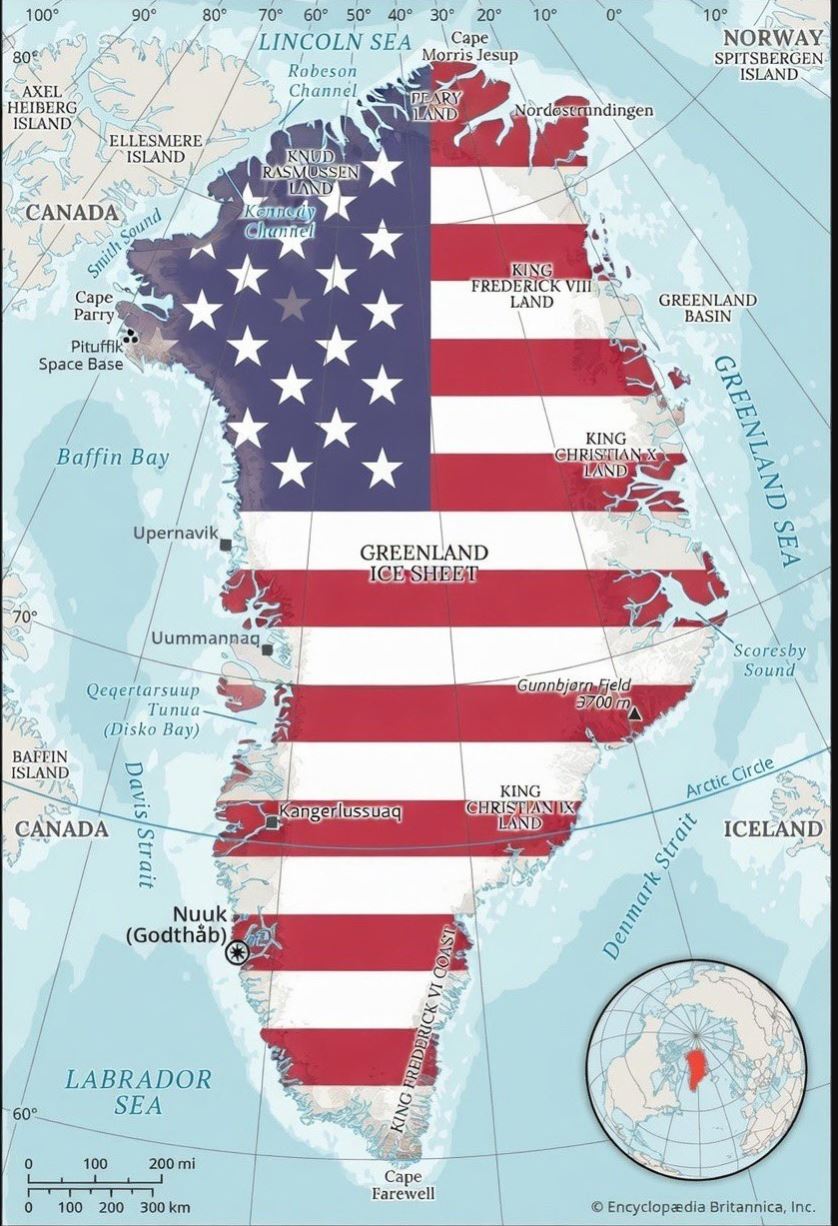
A cryptic post on X—once Twitter—has reignited international speculation about U.S. ambitions in the Arctic. “Soon,” wrote Katie Miller, wife of Stephen Miller, one of Donald Trump’s most influential and ideologically hardline advisors. Accompanying the message was an image of Greenland draped in the American flag.
The post, which has since garnered over two million views, arrives amid heightened U.S. military activity in Venezuela—a reminder that America’s strategic calculus under a potential second Trump administration may be more assertive than ever. But does this symbolic gesture signal a real shift in U.S. Arctic policy, or is it merely political theatrics?
From Symbolism to Strategy
Katie Miller’s post is not just online noise. As a former Republican communications director and host of a widely followed political podcast, she remains closely connected to Trumpworld. Her husband, Stephen Miller, architect of Trump’s immigration policies and national security messaging, continues to shape the former president’s worldview—particularly on sovereignty, national interest, and resource control.
“Greenland is important for U.S. security, and therefore the U.S. must have Greenland,” said Kim Bildsøe Lassen, DR’s veteran U.S. correspondent. “That has been Trump’s consistent position—not just as a quip, but as strategic doctrine.”
Indeed, Trump first publicly floated the idea of purchasing Greenland in 2019, calling it a “large real estate deal.” Though then-Danish Prime Minister Mette Frederiksen dismissed the notion as “absurd,” the underlying strategic logic hasn’t vanished—it’s evolved.
The New Arctic High Stakes
Fast forward to 2026, and the Arctic is no longer a geopolitical backwater. It’s a front line in a multipolar resource race. Greenland sits atop vast reserves of rare earth elements critical for clean tech, defence systems, and AI infrastructure. Its strategic location—midway between North America and Europe—makes it indispensable for missile defence and undersea cable routing.
Recognizing this, Denmark has dramatically increased its Arctic commitment. In 2025 alone, the Kingdom pledged $13.7 billion to bolster security and infrastructure across Greenland and the North Atlantic—a clear signal to allies and rivals alike that Copenhagen takes Arctic sovereignty seriously.
Jesper Møller Sørensen, Denmark’s Ambassador to the U.S., responded directly to Miller’s post:
“Greenland is already part of NATO. The U.S. and Denmark are close allies, and we expect full respect for the territorial integrity of the Kingdom.”
His message was diplomatic—but firm. And it reflects a broader Nordic shift: from viewing Arctic security as a distant concern to treating, it as a national priority.
Greenland’s Dilemma: Ally or Asset?
In Nuuk, the mood is watchful. While social media buzzes with dark humour—“Today Venezuela, tomorrow Greenland”—there’s a genuine undercurrent of anxiety. Kassaaluk Kristensen, digital editor at Sermitsiaq, notes that many Greenlanders are drawing parallels between U.S. actions in Caracas and rhetorical gestures toward their homeland.
Yet, as she rightly emphasizes, the comparison is deeply flawed.
“Greenland is a self-governing democracy within the Kingdom of Denmark, with full political legitimacy. Venezuela is a sanctioned authoritarian regime. The contexts are not comparable.”
Still, the fear is not about invasion—it’s about influence. With Greenland inching toward possible independence, and its mineral wealth attracting global investors (including from China and the EU), the island finds itself caught in a quiet but intense great-power competition.
The U.S., through the Pituffik Space Base (formerly Thule Air Base), already maintains a significant military presence in northern Greenland. Any expansion—or renegotiation—of that footprint could become a flashpoint, especially if framed as “protecting democratic interests” or “securing critical minerals.”
What a third Trump Term Might Mean
Should Trump return to the White House in January 2028, Arctic policy could shift dramatically. His administration has already signalled that resource nationalism and military assertiveness will define his foreign policy. In this context, Greenland isn’t just “real estate”—it’s a strategic linchpin.
Yet unlike Venezuela—where U.S. intervention is justified (however controversially) through counter-narcotics and regime-change rhetoric—Greenland enjoys strong legal protections under international law, NATO frameworks, and Danish sovereignty. A coercive move would fracture transatlantic trust and alienate key Nordic partners at a time when unity against Russian and Chinese Arctic ambitions is essential.
The Nordic Imperative
For Nordic businesses and policymakers, this moment demands clarity:
– Investors in Greenlandic mining, renewable energy, or logistics must factor geopolitical risk into their models—not just environmental or regulatory ones.
– Governments should deepen coordination through the Arctic Council and NORDEFCO, ensuring that security and economic development proceed in lockstep.
– Denmark and Greenland must accelerate co-determination on foreign and security policy, especially as Greenland’s autonomy grows.
The Arctic is no longer neutral ground. It’s a contested zone of strategic value—and Greenland sits at its heart.
What’s Next?
In our next feature, “Rare Earths and Sovereignty: Can Greenland Control Its Own Resources?”, we’ll examine the legal, economic, and diplomatic frameworks shaping Greenland’s path toward resource independence—and what it means for Nordic-EU-U.S. alignment.
Stay informed. Stay connected.
Follow Nordic Business Journal on LinkedIn and X (@NordicBizJrnl), or email insights@nordicbusinessjournal.com to join our Arctic Strategy Briefing group for executives and policymakers.
— Reporting from Copenhagen and Nuuk. Additional analysis by the NBG Geopolitical Desk.