
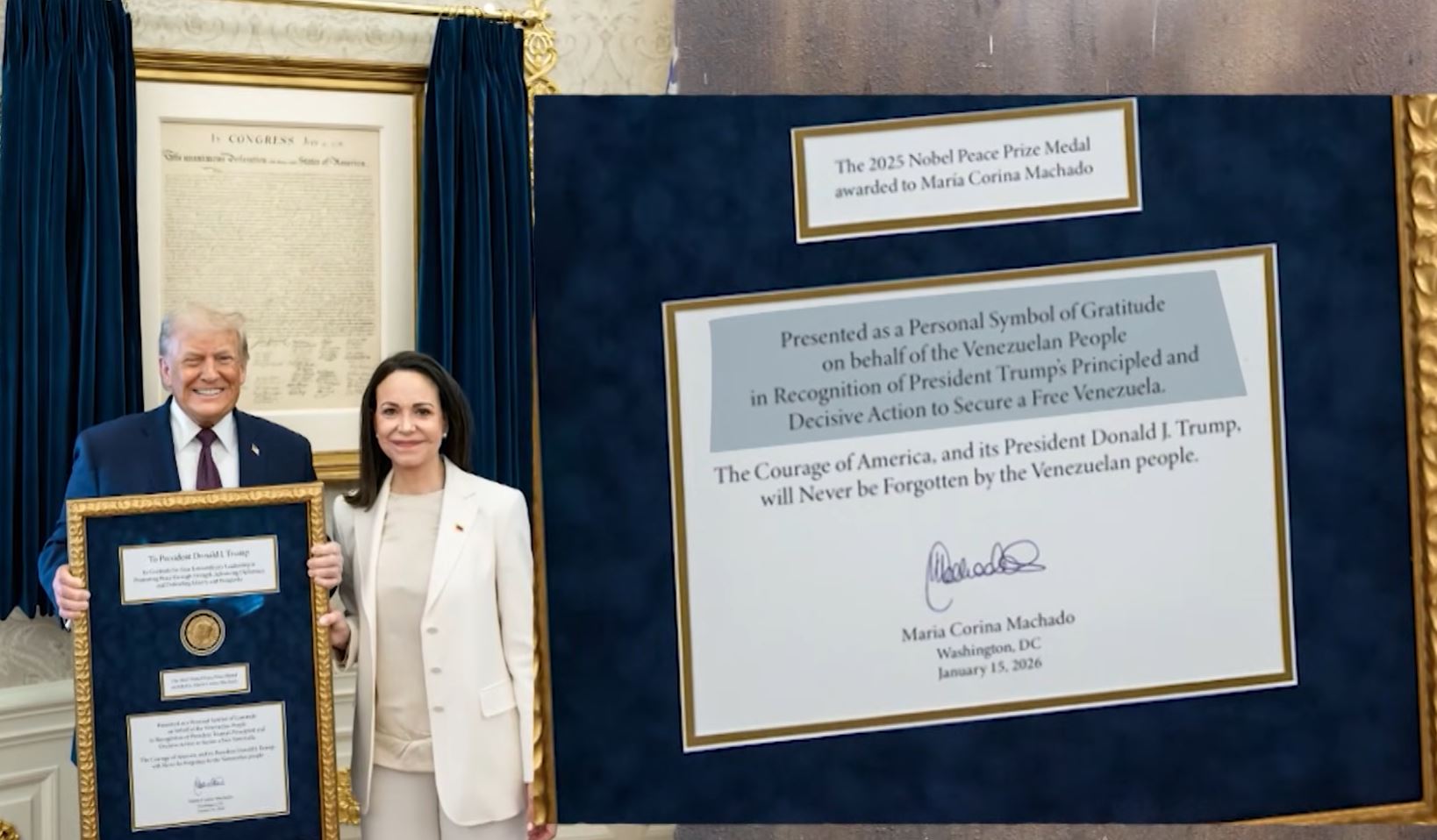
In an era where global diplomacy increasingly resembles performance art, the boundaries of symbolic gestures are being tested—nowhere more dramatically than in the recent spectacle of 2025 Nobel Peace Prize laureate María Corina Machado presenting her medal to former U.S. President Donald Trump in the Oval Office. The act, broadcast globally on January 15, has ignited a fierce debate not only in Norway but across the Nordic region and beyond: Is the Nobel Peace Prize still a moral beacon—or has it become a tool of geopolitical branding?
A Ceremony That Shook Oslo
Machado, awarded the prize for her “non-violent struggle for democracy in Venezuela,” stood beside Trump just weeks before the official launch of his 2026 presidential campaign. With cameras rolling, she placed the 18-carat gold medal into his hands, declaring: “I dedicate this medal to President Trump for his decisive support of the Venezuelan people.”
Trump, visibly elated, responded: “This is a bigger honour than if I had won it myself.” Within hours, the medal was displayed next to a “TRUMP 2026” baseball cap on the Resolute Desk—a visual juxtaposition that many Norwegians found jarring, if not outright offensive.
The Institutional Response: Clarifying the Unthinkable
The Norwegian Nobel Institute moved swiftly. Director Christiane Mork issued a rare public statement emphasizing a foundational principle: the Nobel Peace Prize is non-transferable. While the physical medal belongs to the laureate, the honour itself is permanently tied to their name in the historical record.
“María Corina Machado remains the 2025 Nobel Peace Prize laureate. No symbolic gesture—however theatrical—can reassign that distinction.”
This clarification, however, did little to quell the storm. Public outrage in Norway was immediate and visceral. Social media erupted with HandelMedFred (“Trading Peace”), while a Facebook group calling for the revocation of Machado’s award gathered over 180,000 members in under 24 hours. Talk radio buzzed with accusations of betrayal, commodification, and even sacrilege against Alfred Nobel’s legacy.
Beyond Outrage: A Strategic Realignment?
Yet beneath the emotional backlash lies a deeper strategic question—one particularly relevant to Nordic business and policy leaders navigating an increasingly fragmented international order: What happens when moral authority becomes a transactional asset?
Machado’s gesture may be unprecedented in its physicality, but it reflects a broader trend: the instrumentalization of soft power by political actors seeking legitimacy or leverage. From climate awards used to greenwash corporate reputations to human rights accolades deployed in diplomatic bargaining, symbols of virtue are increasingly treated as strategic capital.
Professor Benedicte Bull of the University of Oslo, a leading expert on Latin American politics and global governance, puts it bluntly:
“When a laureate uses the prize as currency in a geopolitical relationship, it signals contempt for the ideals the award is meant to embody.”
But others argue that Machado’s move was less about gifting and more about amplification. In a world where attention is the scarcest resource, aligning the moral weight of the Nobel with a figure like Trump—however controversial—ensures that Venezuela’s democratic struggle remains visible on the global stage. It’s a high-stakes gamble: leveraging polarising platforms to sustain relevance.
Historical Precedents—and New Frontiers
The Nobel Peace Prize has long weathered controversy. Henry Kissinger’s 1973 award during the Vietnam War, Barack Obama’s 2009 prize before any concrete peace achievements, and Aung San Suu Kyi’s fall from grace after the Rohingya crisis all tested the award’s credibility. Yet none involved the literal handover of the medal to a foreign leader for political gain.
Historian Øivind Stenersen captured the mood in Aftenposten:
“The medal is now a prop in someone else’s reality show. That tarnishes not just Machado, but the entire brand of the Nobel institution.”
his incident marks a qualitative shift—from awarding flawed individuals to enabling the repurposing of the award itself as a diplomatic token. If unchecked, it risks transforming the Nobel from a normative standard into a negotiable asset.
What’s Next for the Nobel Committee?
he fallout is already unfolding:
– The Norwegian Parliament, which funds the Nobel Institute, has summoned Director Mork for an emergency hearing.
– Cross-party calls are growing for a formal ethics framework governing laureate conduct post-award—potentially including clauses on misuse of the prize’s symbolic value.
– Meanwhile, the Institute maintains it cannot reclaim the medal, citing private ownership—but the pressure to assert greater stewardship over the prize’s integrity is mounting.
Notably, this episode arrives at a delicate moment for Norway’s soft-power diplomacy. As the Nordic region seeks to position itself as a neutral broker in global conflicts—from Arctic security to digital governance—the perceived politicization of its most prestigious international instrument could undermine its credibility.
Why This Matters to Nordic Business Leaders
For our readers in business, finance, and public policy, this controversy is more than a diplomatic scandal—it’s a case study in reputational risk, brand dilution, and the volatility of symbolic capital. Companies investing in ESG (Environmental, Social, Governance) credentials, for instance, face similar challenges when partnerships or endorsements backfire. The Nobel incident underscores a critical lesson: moral authority, once monetized or weaponized, loses its universal appeal.
Moreover, as Nordic firms expand into politically sensitive markets—particularly in Latin America, where democratic backsliding and U.S.-China rivalry intersect—understanding the interplay between ethics, optics, and influence will be essential. Machado’s move may have been personal, but its ripple effects touch every institution that relies on trust as its core asset.
Looking Ahead
The Nobel Peace Prize was conceived by Alfred Nobel as a corrective—a way to balance the destructive potential of his inventions with a force for good. Today, that vision is being stress-tested in real time. The question is no longer just who deserves the prize, but how its meaning can be safeguarded in an age of performative politics.
Next in Our Series:
In our upcoming feature, “Guardians of the Prize: Can the Nobel Committee Reinvent Its Ethics for the 21st Century?”, we’ll examine proposed reforms, interview former committee members, and explore whether other global awards—like the Right Livelihood Award or the Sakharov Prize—are facing similar pressures.
We Want to Hear From You:
How should institutions protect the integrity of moral symbols in a hyper-polarized world? Are ethical guidelines enough—or is structural reform needed? Connect with us on LinkedIn, email insights@nordicbusinessjournal.com, or join our exclusive roundtable on Nordic Soft Power in February 2026.
The Nordic Business Journal—where values meet strategy.