
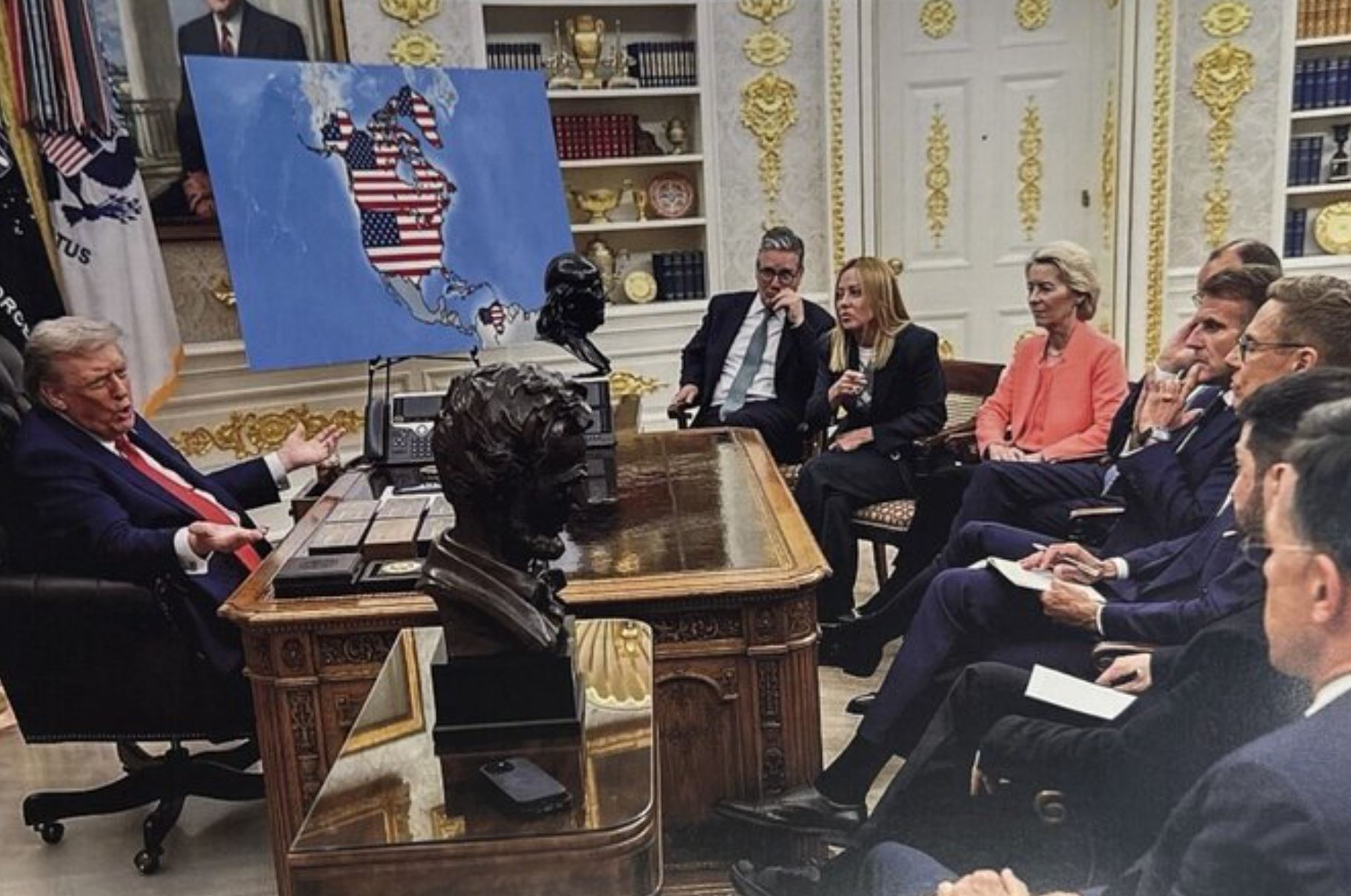
As the U.S. President Donald Trump continues with this quest to maintain his long-standing ambition to acquire Greenland, this week, he posted AI-generated images on Truth Social depicting himself planting an American flag on Greenlandic soil, accompanied by Vice President JD Vance and Secretary of State Marco Rubio, with a sign declaring “American territory established in 2026.” A second image showed European leaders—including Emmanuel Macron, Alexander Stubb, Giorgia Meloni, Keir Starmer, Volodymyr Zelenskyy, and Ursula von der Leyen—gathered submissively around his Oval Office desk beneath a map redrawing North America to include both Canada and Greenland as U.S. possessions.
While clearly satirical in execution, the posts signal a serious—and increasingly assertive—U.S. posture toward the Arctic. In accompanying remarks from Mar-a-Lago, Trump told reporters, “I don’t think they’re going to object that much. We have to have it. We have to get this sorted.” He claimed to have spoken with Dutch Prime Minister Mark Rutte, asserting that “everyone agrees” Greenland is vital to global security and that only the United States possesses the strength to guarantee peace.
But European leaders are far from acquiescent. Behind closed doors, emergency consultations have been underway across Brussels, Copenhagen, and Paris. Denmark, which holds sovereignty over Greenland under its 1953 constitution (though the island enjoys extensive home rule), has categorically rejected any notion of sale or cession. Prime Minister Mette Frederiksen called Trump’s rhetoric “unacceptable” and reaffirmed that “Greenland belongs to the Greenlandic people.”
Meanwhile, Macron has proposed an emergency G7 summit in Paris this Thursday—a direct response to what French officials describe as “a destabilising act of digital diplomacy.” The agenda would reportedly include not only Arctic security but also invite representatives from Russia, Ukraine, Syria, and Denmark, signalling Europe’s intent to frame the issue within broader geopolitical negotiations.
Notably, Trump also shared screenshots of purported text messages from Rutte and Macron praising his handling of Syria—but expressing reservations about Greenland. Whether authentic or fabricated, these messages underscore the growing tension between rhetorical alignment on some global issues and deep divergence on matters of sovereignty and territorial integrity.
Why Greenland Matters—Now More Than Ever
This isn’t just about real estate. Greenland sits at the epicentre of the new Arctic frontier. With climate change accelerating ice melt, previously inaccessible shipping lanes, rare earth mineral deposits, and strategic military positioning are becoming viable. The U.S. already operates Thule Air Base in northern Greenland—a critical node in its missile defence and space surveillance systems. But China and Russia have also increased their Arctic ambitions, with Beijing declaring itself a “near-Arctic state” and investing heavily in Greenlandic infrastructure before being rebuffed by local authorities in 2023.
For Nordic and European businesses, the implications are profound. Greenland’s untapped reserves of neodymium, dysprosium, and other rare earth elements—essential for electric vehicles, wind turbines, and defence technologies—are estimated to meet up to 25% of global demand. Danish and EU-backed mining ventures are already underway, and any U.S. attempt to exert control could disrupt supply chains, investment frameworks, and environmental safeguards carefully negotiated under Greenland’s self-governance model.
Moreover, Trump’s threat of 10% tariffs on European nations that support Denmark risks reigniting trade tensions at a time when the EU is seeking deeper strategic autonomy. The European Commission has signalled it may respond with countermeasures targeting U.S. tech and energy exports—sectors already under scrutiny in Brussels.
A Calculated Provocation—or a Trial Balloon?
Analysts suggest Trump’s actions may be less about immediate acquisition and more about testing European unity and asserting U.S. dominance in an era of multipolar competition. By framing Greenland as a national security imperative, he appeals to his domestic base while pressuring allies to choose between loyalty to Washington or adherence to international norms.
Yet the gamble carries significant risk. Alienating Denmark—a NATO ally—and undermining the EU’s Arctic policy could push Copenhagen closer to alternative partnerships, including with the EU’s own Arctic strategy or even cautious engagement with non-Western actors. It also risks galvanizing Greenlandic independence movements, which have gained momentum in recent years.
As the world watches whether this digital provocation escalates into diplomatic rupture or fades as political theatre, one thing is clear: the Arctic is no longer a frozen periphery—it is a contested core of 21st-century geopolitics.
What’s Next?
In our upcoming feature, “The Race for the Arctic: How Nordic Firms Are Securing the Future of Critical Minerals,” we’ll explore how Swedish, Finnish, and Norwegian companies are positioning themselves in Greenland’s emerging resource economy—and what strategies can safeguard European interests without triggering a new Cold War in the North.
We invite our readers—especially policymakers, investors, and business leaders engaged in Arctic affairs—to share insights, concerns, or questions with us at editor@nordicbusinessjournal.com. Your perspective will help shape our ongoing coverage of this pivotal region.
— The Nordic Business Journal is committed to delivering incisive analysis of the economic and geopolitical forces shaping Northern Europe and beyond.