
How a single 2012 island visit triggered a leadership resignation—and what it reveals about Nordic governance in the age of hyper-transparency
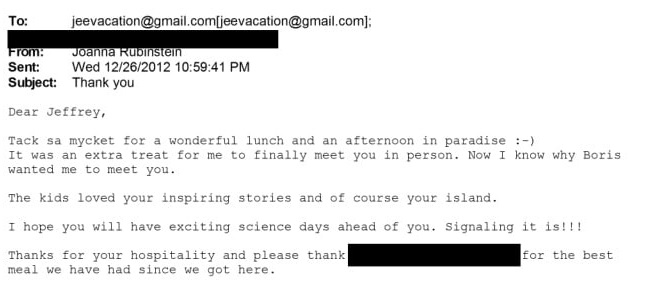
When newly declassified U.S. court documents released in late January 2026 revealed that Johanna Rubinstein had visited Jeffrey Epstein’s private Caribbean Island with her family in 2012—thanking him afterward for “a wonderful lunch in paradise”—the Swedish chairwoman of Sweden for UNHCR made a swift calculation familiar to Nordic boardrooms: reputation precedes revenue, and values are non-negotiable assets.
Within 48 hours, Rubinstein resigned her position leading the Swedish fundraising foundation for the UN Refugee Agency, stating the decision was entirely her own. “She chose to leave her position to ensure that the organisation’s work would not be affected by a situation that occurred long before she became involved,” confirmed Daniel Axelsson, UNHCR Sweden press officer. The board had been unaware of the Epstein connection until the document release.
Beyond the Headlines: A Governance Case Study
While international media framed this as another Epstein casualty, Nordic business leaders should view it through a sharper lens: proactive reputational risk management in stakeholder-oriented governance models.
Rubinstein’s case exposes three critical tensions facing Nordic institutions today:
1. The “Known Association” Liability Gap
Rubinstein acknowledged meeting Epstein once through her husband during a 2012 vacation near his island, noting she was aware of his 2008 conviction for soliciting prostitution from a minor but claimed ignorance of his broader trafficking operation. Yet in today’s governance environment—where the 2025 Swedish Corporate Governance Code explicitly mandates boards to assess how sustainability issues impact organizational risk—willful ignorance is no longer a defensible position. Nordic boards now operate under what governance experts’ term “constructive knowledge” standards: if red flags existed (a convicted sex offender with a private island hosting powerful figures), directors bear responsibility for due diligence.
2. The Nordic Premium on Moral Capital
Sweden’s nonprofit sector—particularly organizations tied to humanitarian causes—operates on what researchers call “moral capital”: public trust that enables fundraising and policy influence. With one in five Swedish nonprofits forced to cut operations despite increased public giving following the 2022 government shift, organisations cannot afford reputational contamination. Rubinstein’s resignation wasn’t merely damage control—it was preservation of the organization’s most valuable asset: credibility among Swedish donors who expect alignment with lagom (moderation) and jämställdhet (equality) values.
3. The Accelerating Velocity of Historical Accountability
The Epstein document releases of December 2025 and January 2026—part of ongoing U.S. Department of Justice disclosures—demonstrate that digital archives have eliminated statute of limitations on reputational risk. Ghislaine Maxwell’s failed Supreme Court appeal in October 2025 has intensified global scrutiny of all Epstein associates. For Nordic leaders, this signals a new reality: board vetting must now include deep-dive historical association mapping, not just current compliance checks.
The Broader Nordic Context
This incident arrives as Sweden positions itself as a governance innovator on the global stage. In October 2025, the Swedish government nominated former IKEA CEO Jesper Brodin for UN High Commissioner for Refugees—explicitly championing Nordic private-sector accountability models to reform international humanitarian leadership. Rubinstein’s resignation, while painful, actually reinforces Sweden’s credibility in this campaign: it demonstrates that Nordic institutions enforce ethical standards even when legally permissible associations surface years later.
This stands in stark contrast to governance approaches in other regions where “technical compliance” often shields leaders from accountability. The Nordic model—increasingly codified in ESG frameworks across Denmark, Norway, and Sweden—treats ethical breaches as material risks requiring immediate remediation.

Looking Forward: The Governance Imperative
For Nordic business leaders, the Rubinstein case offers three actionable insights:
– Implement “association audits” for all C-suite and board candidates, scanning not just direct relationships but secondary connections through spouses, investment circles, and social networks.
– Adopt sunset clauses in leadership contracts specifying resignation triggers for historical ethical breaches revealed post-appointment.
– Recognise that in stakeholder capitalism, public trust is a balance sheet item—and its depreciation demands immediate corrective action.
NEXT STEPS FOR NORDIC LEADERSHIP
This is the first in our Nordic Governance Integrity Series. Our next article will examine how Danish and Norwegian boards are implementing AI-driven association mapping tools to pre-empt reputational risks—featuring exclusive interviews with risk officers at Maersk, Equinor, and the Norwegian Sovereign Wealth Fund.
How is your organization navigating the new era of historical accountability? Share your governance challenges and innovations with our editorial team at insights@nordicbusinessjournal.com. We’re curating a special report on Nordic ESG leadership in 2026—and your experience belongs in the conversation.
— Nordic Business Journal: Where Values Meet Value Creation