
As winter deepens across Eastern Europe, Sweden and Denmark have successfully delivered their jointly procured TRIDON Mk2 short-range air defence systems to Ukraine—a milestone procurement that exemplifies the Nordic region’s maturing defence industrial strategy and offers valuable lessons for Nordic businesses navigating Europe’s security-driven economic transformation.
The SEK 2.6 billion (approximately €240 million) procurement—comprising SEK 2.1 billion from Sweden and SEK 500 million from Denmark—represents more than a humanitarian gesture. It signals a strategic recalibration of Nordic defence policy where industrial capability, regional security, and allied support converge into a single operational framework. Developed by BAE Systems Bofors in Karlskoga, Sweden, the TRIDON Mk2 integrates a modernized 40mm autocannon with advanced fire control systems mounted on a Scania Gryphus 6×6 chassis, optimized specifically for countering the drone and loitering munition threats that have defined Ukraine’s winter 2025–2026 defensive challenges.
The Business Case Behind Nordic Joint Procurement
For Nordic business leaders, this collaboration offers three critical insights:
First, joint procurement is becoming a competitive necessity. With European defence spending surging 42% in 2024 to €106 billion and procurement reaching €88 billion, fragmented national approaches no longer suffice. Sweden and Denmark’s TRIDON order follows their landmark $2.5 billion joint CV90 infantry fighting vehicle contract with BAE Systems, demonstrating a pattern of coordinated acquisition that reduces unit costs, accelerates delivery timelines, and strengthens bargaining power with defence primes. Nordic firms participating in such frameworks gain preferential access to technology transfer agreements and offset arrangements—critical advantages in an increasingly protectionist global defence market.
Second, short-range air defence has emerged as Europe’s highest-growth defence segment. The EU’s anti-drone market alone is projected to reach €1.86 billion by 2025 with a 28.5% compound annual growth rate, driven by Ukraine’s battlefield validation of drone-centric warfare. Russia’s intensified campaign against Ukrainian energy infrastructure throughout winter 2025–2026—including devastating strikes on combined heat and power plants in January 2026—has elevated short-range air defence from a tactical asset to a strategic imperative for civilian resilience. Nordic defence contractors specialising in counter-UAS technologies, radar integration, and AI-powered threat discrimination now operate in a seller’s market with multi-year visibility.
Third, Nordic defence industrial policy is shifting from export restriction to strategic enablement. Sweden’s 2026 defence budget increase of SEK 26.6 billion (18% year-over-year) brings spending to 2.8% of GDP—the highest level since the Cold War. Crucially, this expansion includes explicit provisions for dual-use technology development and Ukrainian co-production initiatives. In August 2025, Sweden formalised agreements enabling joint Ukrainian-Swedish production of defence materiel, recognizing that industrial partnerships with Kyiv create both immediate battlefield relevance and long-term market positioning as Ukraine transitions toward NATO interoperability.
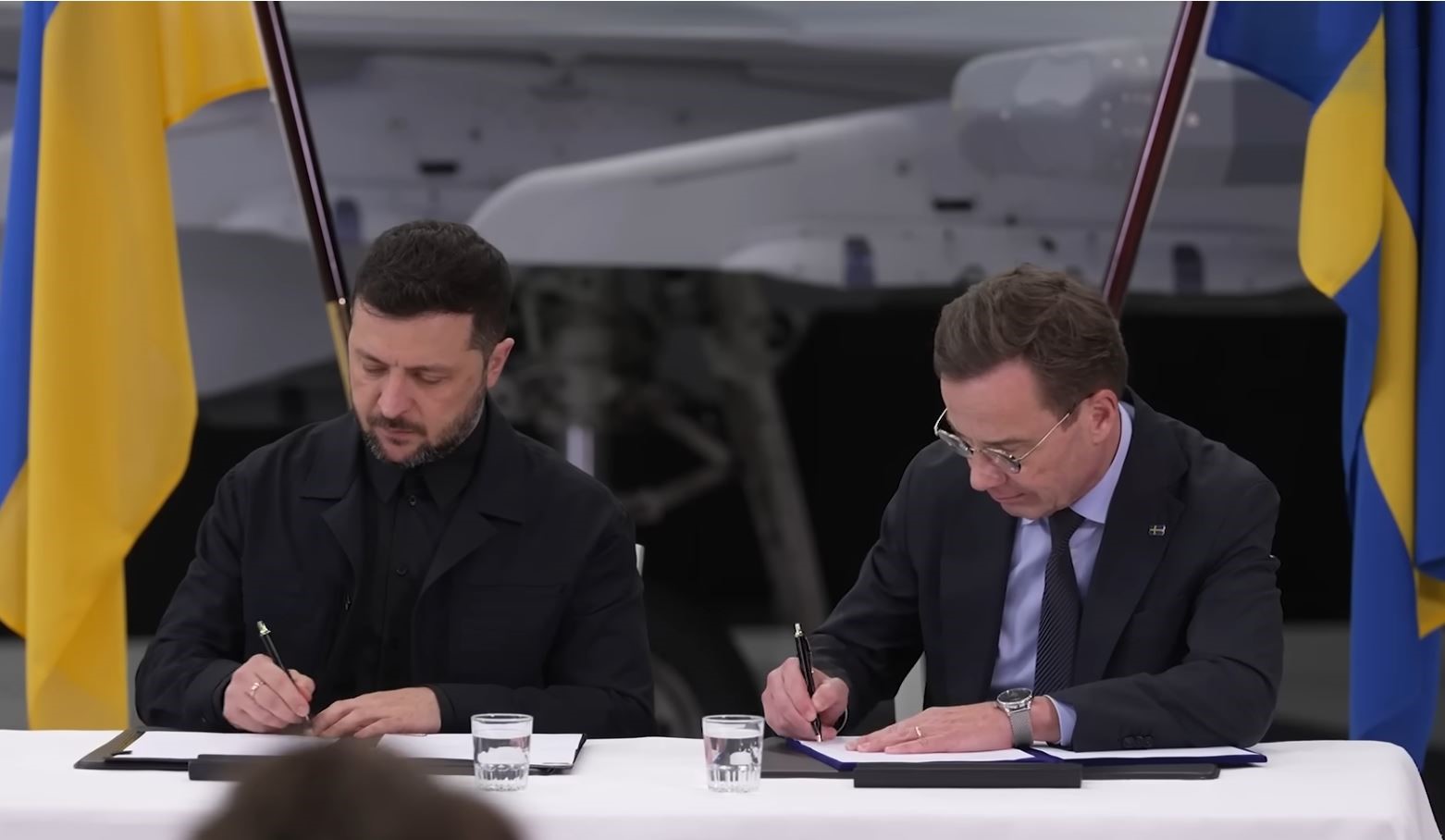
The Evolving Battlefield Context: Why TRIDON Matters Now
The timing of these deliveries could not be more critical. As Ukraine enters its third winter of war, Russian forces have refined their strategy of “winterization warfare”—systematic targeting of energy generation, transmission infrastructure, and district heating systems to erode civilian morale. Simultaneously, Ukraine’s own drone production is scaling exponentially, with plans to manufacture over 7 million unmanned systems in 2026 alone. This creates a paradoxical battlefield reality: both sides are flooding the airspace with low-cost aerial threats, making affordable, high-volume short-range air defence systems like TRIDON operationally indispensable.
Unlike high-altitude systems such as Patriot or SAMP/T, TRIDON fills the crucial “last mile” defence gap—engaging threats at ranges under 4 kilometres where larger systems prove economically inefficient. With each Shahed-136 drone costing Russia an estimated $20,000–50,000 versus millions for interceptor missiles, cost-exchange ratios have become decisive. The TRIDON’s 40mm programmable ammunition offers a financially sustainable engagement model—a consideration increasingly central to European defence planners facing multi-year attritional conflicts.
Strategic Implications for Nordic Business
The TRIDON procurement illuminates three emerging opportunities for Nordic enterprises beyond traditional defence contractors:
1. Dual-use technology transfer: Companies specializing in AI-powered computer vision, RF jamming, fibre-optic sensing, and autonomous target recognition are finding defence applications for commercial R&D investments. The Nordic Defence Cooperation (NORDEFCO) framework now actively facilitates such transfers under Finland’s 2025 chairmanship.
2. Resilience infrastructure: As energy security becomes national security, Nordic engineering firms with expertise in distributed generation, microgrid architecture, and rapid infrastructure repair are securing contracts across Eastern Europe. Sweden’s Vattenfall and Denmark’s Ørsted have already deployed teams to support Ukraine’s grid stabilization efforts.
3. Defence logistics innovation: The compressed delivery timeline for TRIDON systems—moving from order to battlefield deployment in under six months—required unprecedented supply chain coordination. Nordic logistics specialists who mastered just-in-time delivery under sanctions constraints are now exporting these capabilities to other European defence programs.
Looking Forward: The Nordic Security-Industrial Complex
With Finland and Sweden now fully integrated into NATO’s command structure, the Nordic region has transformed from a security periphery into Europe’s northeastern frontline. This geopolitical repositioning is catalysing industrial consolidation: BAE Systems’ Swedish operations (formerly Bofors and Hägglunds) have secured over $2.5 billion in Nordic contracts since 2024, while Saab continues expanding its Gripen E/F and GlobalEye programs with Norwegian and Finnish participation.
Yet challenges remain. European defence industrial capacity still lags behind demand, with ammunition production rates requiring 3–5 years to reach wartime requirements. Nordic policymakers must now decide whether to prioritise sovereign production capacity or deepen integration within European defence value chains—a strategic choice with profound implications for regional industrial policy.
Next Steps For Nordic Business Leaders
This analysis represents the first in our Nordic Security Economy series. Our next article will examine how Nordic SMEs are navigating export control reforms and dual-use technology regulations to participate in Europe’s defence industrial base expansion—featuring case studies from Swedish AI startups, Danish maritime security firms, and Finnish cyber defence specialists.
We invite Nordic business leaders, defence industry executives, and policy experts to connect with our editorial team at insights@nordicbusinessjournal.com to share perspectives on defence-industrial cooperation opportunities, supply chain resilience strategies, or emerging dual-use technology applications. Your insights will shape our ongoing coverage of Europe’s most significant economic transformation since the post-Cold War era.
— The Nordic Business Journal Editorial Board