
STOCKHOLM — In a move that reshapes the Nordic digital infrastructure landscape, French AI champion Mistral AI announced yesterday (February 11, 2026) a €1.2 billion commitment to build sovereign AI compute capacity at EcoDataCenter’s Borlänge site—a strategic play that positions Sweden as Europe’s emerging backbone for regulated AI workloads while intensifying competition among Nordic nations for the continent’s AI future.
Unlike generic cloud capacity, this investment delivers a vertically integrated stack: purpose-built data centres optimized for high-density AI workloads, NVIDIA’s latest Vera Rubin GPUs (Mistral’s first deployment outside France), and the company’s proprietary “Mistral Compute” platform offering APIs and managed services—all with data processed and stored within EU jurisdictional boundaries. Operations are scheduled to commence in 2027, precisely as the EU AI Act’s high-risk provisions take full effect on August 2, 2027.
Why Sweden—and Why Now?
For Nordic business leaders, three strategic imperatives explain Mistral’s timing:
1. Regulatory arbitrage under the AI Act
With Sweden’s government allocating SEK 479 million in its 2026 budget specifically for AI and data initiatives—the nation’s first earmarked AI investment—Swedish-hosted infrastructure offers enterprises a compliance advantage. As the AI Act’s high-risk classification triggers mandatory conformity assessments starting August 2026, Nordic financial institutions, healthcare providers, and critical infrastructure operators now have a credible European alternative to US hyperscalers for workloads requiring data localization and auditability.
2. The heat reuse economy
EcoDataCenter’s Borlänge facility isn’t merely cooled by Nordic air—it actively monetizes waste heat through district heating integration, a model gaining traction across Swedish municipalities facing decarbonization mandates. For industrial users, this transforms a cost centre (cooling) into potential revenue, improving total cost of ownership by an estimated 15–20% versus conventional designs—a margin advantage that matters as GPU power densities exceed 100 kW per rack.
3. Energy security amid Nordic divergence
While Norway leverages hydropower and Finland pursues nuclear expansion, Sweden offers grid stability with a balanced mix of hydro, nuclear, and wind—critical for AI workloads demanding 99.999% uptime. With Nordic electricity prices experiencing volatility in 2025 due to German interconnection constraints and Norwegian reservoir drawdowns, Sweden’s diversified generation portfolio provides predictability that hyperscalers increasingly price into location decisions.
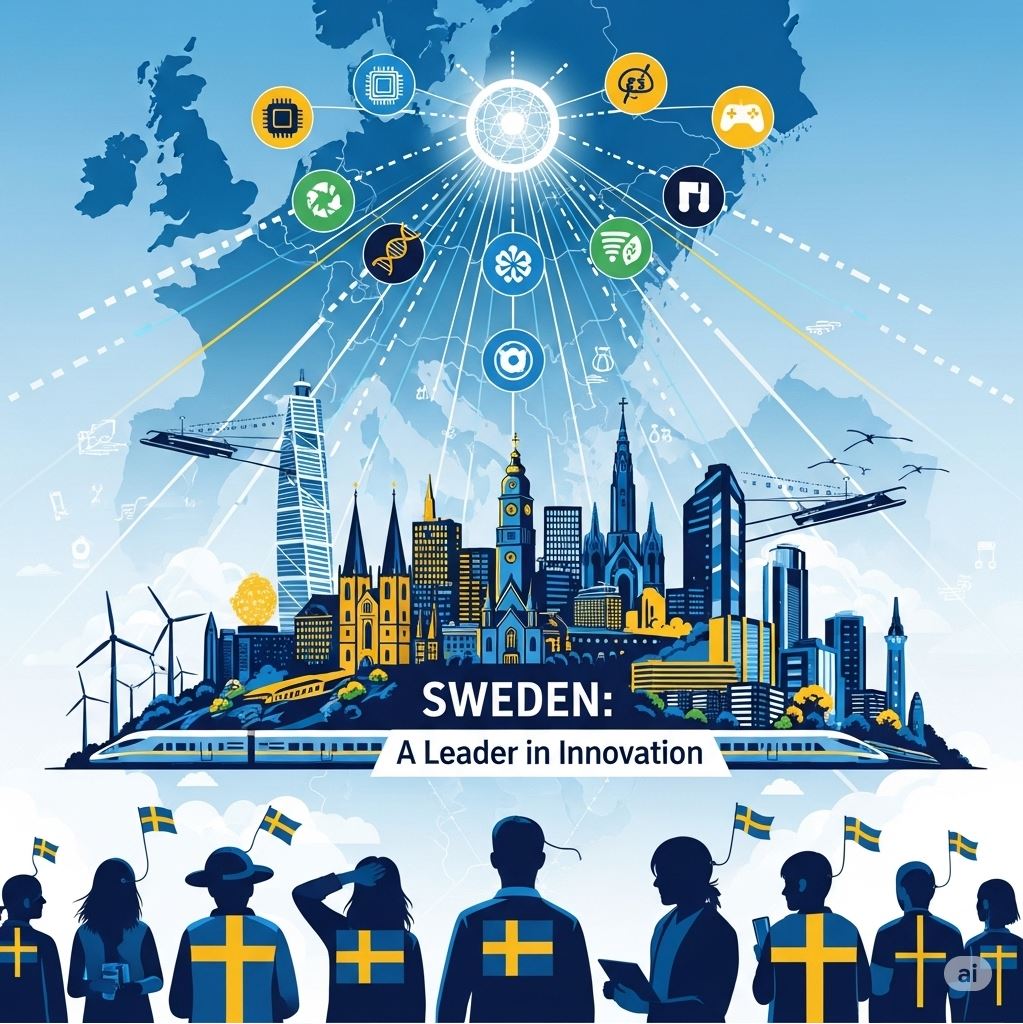
The Nordic Competitive Landscape
This investment accelerates a quiet race among Nordic capitals:
– Sweden now hosts dual anchors: Mistral’s sovereign AI stack and Brookfield’s Strängnäs hyperscale campus, reinforcing Stockholm’s ambition as the region’s AI services hub.
– Finland counters with Nokia-backed AI infrastructure plays and strong semiconductor design talent—but lacks Sweden’s depth in regulated-sector AI adoption.
– Denmark leverages proximity to German markets but faces higher energy costs and land constraints.
– Norway offers pristine hydropower but struggles with grid interconnection bottlenecks limiting rapid scale-up.
For Nordic enterprises, the stakes are operational: companies in finance, defence, and healthcare can now access European-hosted AI training and inference without navigating US CLOUD Act jurisdictional risks—a growing concern after 2025’s transatlantic data transfer turbulence.
Business Implications Beyond the Headline
Supply chain realities: Despite the €1.2 billion commitment, GPU availability remains the binding constraint. With NVIDIA lead times extending through 2026 amid persistent supply chain bottlenecks, Mistral’s actual compute capacity ramp may lag facility completion—a risk Nordic enterprises should factor into AI adoption roadmaps.
Talent dynamics: The project will require approximately 300–400 specialised roles in AI infrastructure engineering and operations by 2028. While this creates high-value employment in Dalarna County, it also intensifies competition for scarce Nordic AI talent already courted by Stockholm’s Scaleway, Copenhagen’s Corti, and Oslo’s Ducky.
Local supplier opportunity: Swedish industrial firms specializing in precision cooling, power distribution, and heat recovery systems should position now for procurement cycles beginning Q3 2026. The Borlänge campus represents phase one; EcoDataCenter’s site scalability suggests follow-on investment if Mistral meets its €1 billion revenue target this year—a milestone CEO Arthur Mensch confirmed is on track during January’s World Economic Forum.
The Bottom Line for Nordic Executives
Mistral’s Swedish bet transcends infrastructure—it signals that Europe’s “technological sovereignty” narrative has matured into capital allocation reality. For Nordic enterprises, this means:
– Regulated sectors gain a credible alternative to US cloud providers for high-risk AI applications under the AI Act
– Energy-intensive industries should evaluate heat reuse partnerships with data centre operators as a decarbonisation lever
– Board-level risk committees must reassess transatlantic data governance frameworks amid accelerating European infrastructure sovereignty
Sweden isn’t merely hosting servers—it’s anchoring a European AI value chain where data residency, regulatory alignment, and energy economics converge. The question for Nordic business leaders is no longer if sovereign AI infrastructure matters, but how quickly they can integrate it into their digital transformation roadmaps before competitors lock in preferred access.
What’s next? In our follow-up analysis, we’ll examine the hidden bottleneck in Europe’s AI sovereignty push: the continent’s critical shortage of AI infrastructure engineers and whether Nordic universities’ new specialised degree programs can close the talent gap before 2028. We’ll also benchmark total cost of ownership for Swedish-hosted AI training versus US cloud alternatives under realistic regulatory compliance scenarios.
Connect with us: How is your organisation navigating the trade-offs between AI performance, data sovereignty, and cost in the post-AI Act era? Share your strategic challenges with our editorial team at insights@nordicbusinessjournal.com we’re profiling Nordic enterprises building competitive advantage through thoughtful AI infrastructure decisions.