
Sweden’s Vulnerable Areas: Strategic Context for Investment and Operations
Sweden’s urban landscape presents distinct operational challenges for businesses, investors, and policymakers. The Swedish Police Authority’s classification system identifies 65 “vulnerable areas” (utsatta områden) nationwide as of December 2025—a net increase from 59 in 2023, driven primarily by refined geographic boundaries and the reclassification of former “risk areas”. These zones represent locations where low socioeconomic status intersects with significant criminal network influence, creating complex environments for commercial activity, workforce management, and supply chain logistics.
The classification framework operates on a severity spectrum. The most critical 19 “particularly vulnerable areas” (särskilt utsatta områden)—up from 17 in 2023—are characterized by parallel social structures, systematic threats against witnesses and victims, and conditions where police operations face severe constraints. The 2025 assessment eliminated the intermediate “risk area” category entirely, consolidating all designated zones into the two-tier system.
Regional Market Analysis
Stockholm Region: The Nordic Segregation Paradox
Stockholm exhibits the sharpest socioeconomic and ethnic segregation among Nordic capital cities, presenting both risks and opportunities for business operations. The December 2025 police assessment identified several critical zones requiring strategic attention:
Particularly Vulnerable Areas (Critical Risk):
– Rinkeby/Tensta (Järva district): Now separately classified (previously combined), both maintain “particularly vulnerable” status with entrenched criminal networks and parallel governance structures.
– Husby (Järva): Persistent criminal activity continues to challenge community stability.
– Botkyrka cluster (Alby, Fittja, Hallunda/Norsborg): Deteriorating conditions noted in recent assessments, with expanding criminal influence affecting local commerce.
Vulnerable Areas (Elevated Risk):
– Hagsätra/Rågsved, Bredäng, Vårberg: Inner-city zones with sustained socioeconomic challenges.
– Hagalund (Solna) and Rissne/Hallonbergen (Sundbyberg): Suburban commercial hubs requiring enhanced security protocols.
– Södertälje complex (Fornhöjden, Hovsjö, Ronna, Geneta): Historically significant crime hotspots; Ronna and Geneta now separately classified as particularly vulnerable.
Notable Change: Granängsringen (Tyresö) was added to the 2025 list as a new vulnerable area, indicating geographic expansion of socioeconomic stressors beyond traditional urban cores.
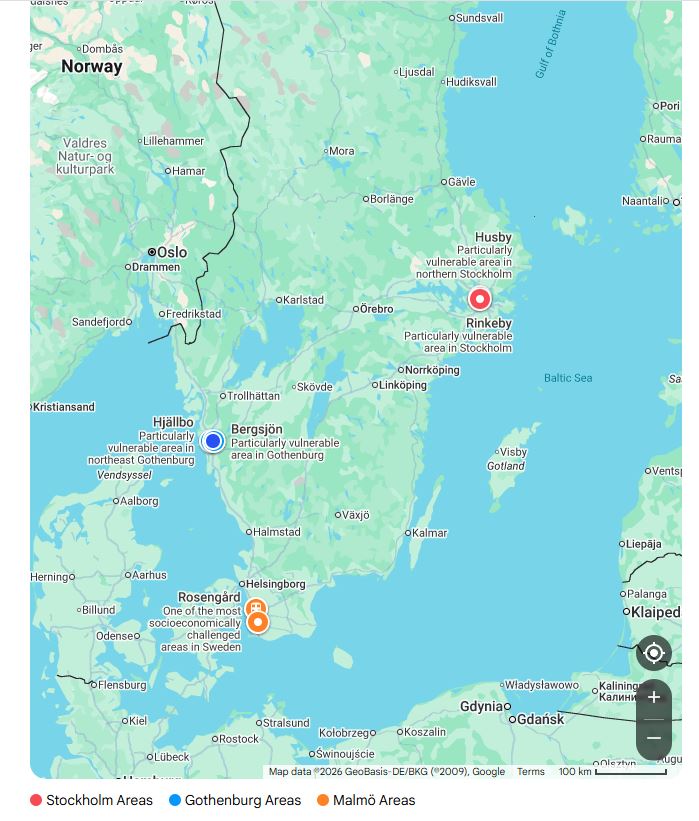
Göteborg (Gothenburg) Region: Deteriorating Trajectory
Sweden’s second-largest commercial hub shows concerning trends, with police assessments indicating worsening conditions through 2025:
Particularly Vulnerable Areas:
– Bergsjön: Consistently ranked among Sweden’s most socioeconomically challenged districts.
– Northeast cluster (Hammarkullen, Hjällbo, Lövgärdet): High gang presence affecting local business environments and workforce safety.
Vulnerable Areas:
– Biskopsgården (Hisingen): Notable for positive trajectory—downgraded from “particularly vulnerable” to standard vulnerable status, demonstrating that targeted interventions can yield measurable improvements.
– Tynnered/Grevegården/Opaltorget and Hisings Backa: Persistent challenges requiring continued monitoring.
Malmö Region: Structural Economic Weakness
Malmö’s historically weaker economic development compared to Stockholm and Gothenburg correlates with concentrated vulnerability:
Particularly Vulnerable Areas:
– Rosengård: Frequently cited as Sweden’s most deprived area; conditions deteriorated further in 2023 with ongoing gang entrenchment.
– Southern Malmö cluster (Nydala, Hermodsdal, Lindängen): Sustained high-risk environment.
Vulnerable Areas:
– Holma and Kroksbäck: Now separately assessed after the 2025 split of the former combined zone.
– Södra Sofielund (Seved): Downgraded from “particularly vulnerable” in late 2023, representing a rare positive trajectory—though still requiring risk management protocols.
Business Implications and Strategic Considerations
Operational Risk Management: The 2025 assessment reveals mixed progress—12 of 46 standard vulnerable areas showed positive development, while 4 deteriorated. Among the 19 particularly vulnerable areas, 3 improved while 2 worsened. This volatility necessitates dynamic risk assessment protocols for facilities, logistics, and workforce deployment.
Workforce and Talent: Research indicates that residential segregation in Sweden has intensified since the 1990s, with Stockholm demonstrating the most pronounced patterns in the Nordic region. Businesses operating in or near designated areas should anticipate challenges in recruitment, retention, and employee safety perceptions.
Investment and Development: The removal of Andersberg (Halmstad) from the 2025 list following positive developments, alongside Biskopsgården’s improvement trajectory, suggests that coordinated public-private interventions can yield measurable risk reduction—offering potential first-mover advantages for developers and social infrastructure investors.
Policy Context: The Swedish government’s 2024-2025 reforms emphasize dismantling structural issues in designated areas through enhanced policing, social investment, and integration initiatives. Businesses should monitor these interventions as indicators of future area trajectories.
Sources: Swedish Police Authority Lägesbild 2025, Sveriges Radio, Nordic research on urban segregation, Wikipedia vulnerable areas database, academic analysis.