
Sweden has taken a decisive step in reshaping its territorial defence architecture, announcing SEK 8.7 billion (~€828 million) in new contracts for mobile, modular counter-drone systems. The agreements—signed with Saab, BAE Systems Bofors, Norwegian Nammo, and Finnish Sisu under the GUTE II programme—signal more than a military procurement; they represent a coordinated Nordic industrial mobilisation with significant commercial ripple effects across the region.
For Nordic executives, this investment warrants close attention. It reflects a fundamental shift in how European nations are approaching security procurement: faster, more collaborative, and deeply integrated with domestic industrial capacity.
The Strategic Context: Why Now?
The timing is not coincidental. Sweden’s NATO accession in 2024 accelerated defence planning, while ongoing conflict in Ukraine has provided real-world validation of asymmetric aerial threats. Drones—both commercial and military-grade—have proven capable of disrupting critical infrastructure, military logistics, and civilian morale at relatively low cost.
“Experience from the war in Ukraine clearly demonstrates the crucial importance of a robust and resilient air defence,” notes Defence Minister Pål Jonson. The GUTE II concept, developed in close dialogue with Ukrainian defence experts, prioritises mobility and modularity: systems that can be rapidly redeployed to protect military units, power plants, transport hubs, or population centres as threat patterns evolve.
This is not merely defensive posturing. It is a calculated investment in deterrence—and in the industrial ecosystems that underpin it.
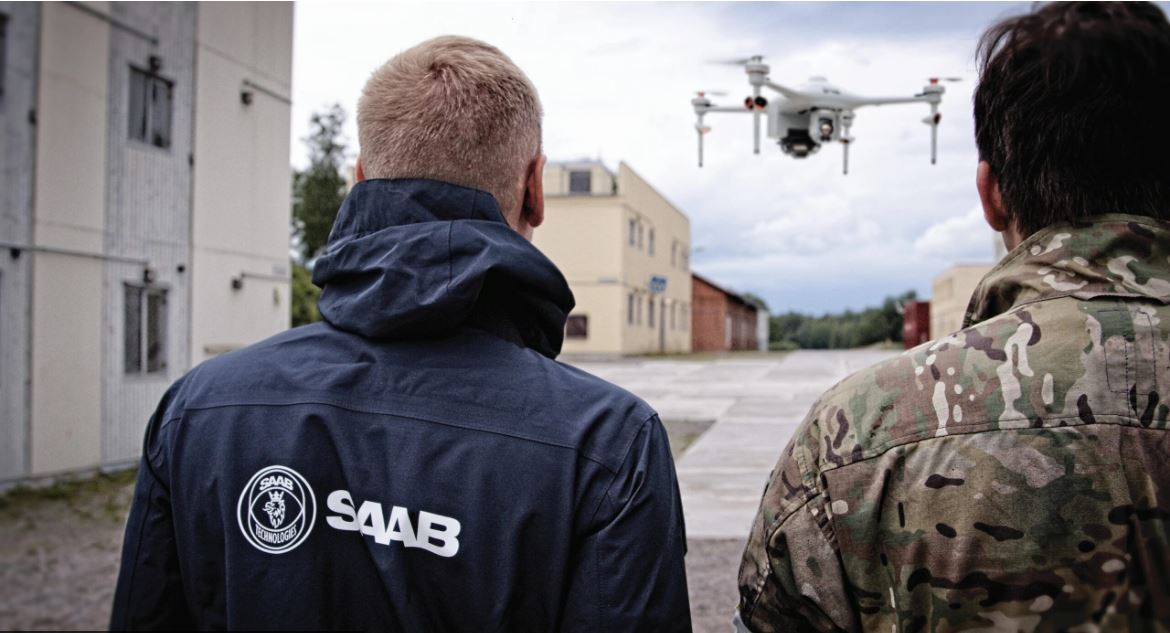
The Industrial Architecture: A Nordic Supply Chain in Action
The SEK 8.7 billion package is deliberately structured to leverage regional expertise:
| Partner | Core Contribution | Commercial Implications |
| Saab (SEK ~2.6 bn) | Giraffe 1X radar, Trackfire 30mm weapon station, electronic warfare, C-UAS detection | Strengthens Saab’s sensor/EW portfolio; creates downstream opportunities for software integration and AI-enabled threat classification |
| BAE Systems Bofors | Tridon MK2 40mm anti-aircraft gun on mobile truck platform | Reinforces Sweden’s artillery manufacturing base; potential for export adaptation to similar NATO short-range air defence needs |
| Nammo (Norway) | Ammunition supply contracts | Expands Nordic munitions production capacity; aligns with broader European efforts to reduce dependency on non-European suppliers |
| Sisu (Finland) | ~70 tactical trucks and 24 off-road vehicles | Validates Finnish heavy-vehicle engineering for defence applications; opens pathways for dual-use technology development |
This cross-border collaboration exemplifies the “Nordic defence cluster” model: specialised suppliers integrating under prime contractors to deliver sovereign capability while maintaining export competitiveness. For investors and suppliers, the signal is clear: defence is no longer a niche sector but a growth vertical with multi-year visibility.
Business Analysis: What Nordic Executives Should Watch
1. Procurement Velocity Is Accelerating
Traditional defence procurement cycles measured in decades are compressing. The GUTE II contracts were finalised within months of the January 2026 announcement of SEK 15 billion for territorial air defence. For businesses in aerospace, electronics, logistics, or cybersecurity, this creates opportunities—but demands agile partnership models and pre-certified compliance frameworks.
2. Dual-Use Technology Is the New Frontier
The systems procured under GUTE II—radar, electronic warfare, autonomous weapon stations—have clear civilian applications: border security, critical infrastructure protection, disaster response. Companies developing AI-driven sensor fusion, secure communications, or resilient power systems may find defence procurement a viable commercialisation pathway.
3. Regional Integration Creates Scale
Sweden’s investment complements parallel initiatives in Norway (Kongsberg’s NASAMS expansions), Finland (Patria’s air defence modernisation), and Denmark (new ammunition production). Together, these create a Nordic defence market with sufficient scale to attract R&D investment while maintaining strategic autonomy. For mid-sized suppliers, this regional approach lowers entry barriers to high-value contracts.
4. Workforce and Skills Implications
The Swedish Armed Forces plan to stand up to 50 territorial air defence companies in coming years. This will drive demand for specialised technicians, systems integrators, and cyber-defence professionals. Educational institutions and training providers across the Nordics should anticipate increased collaboration with defence primes on curriculum development and apprenticeship pathways.
Forward Outlook: Beyond 2028
Deliveries under GUTE II are scheduled for 2027–2028, but the strategic trajectory extends further. Sweden’s total defence budget rose by 18% for 2026, with continued emphasis on air defence, long-range precision fires, and unmanned systems. The government has also tasked the Civil Defence and Resilience Agency with delivering recommendations on protecting civilian infrastructure from aerial threats by February 2026—a report likely to spur additional public-private partnerships.
For business leaders, three questions merit strategic reflection:
– How can our organisation contribute to resilient, modular defence architectures?
– What dual-use innovations could address both security and commercial market needs?
– Are we positioned to engage with the accelerating Nordic defence procurement cycle?
Editor’s Note: This investment underscores a broader re-rating of defence as a long-term growth sector across the Nordics. Private capital, industrial policy, and security strategy are increasingly aligned—a convergence that demands informed, forward-looking business analysis.
What’s Next?
In our upcoming issue, we will examine the emerging Nordic “defence-tech” startup ecosystem: which innovations are attracting venture capital, how export controls shape commercialisation, and what opportunities exist for non-traditional suppliers. We invite readers to share insights on regional security-industrial trends via editor@nordicbusinessjournal.com or connect with our defence industry desk on LinkedIn.
Nordic Business Journal delivers executive-level analysis on the forces shaping business in Sweden, Norway, Denmark, and Finland. Subscribe for weekly insights on strategy, policy, and market intelligence.