
As of April 20, 2026, the link between crude and equities has snapped. Brent crude has been whipsawing between \$86 and \$106 a barrel in the past three weeks, driven by U.S.–Israel–Iran hostilities and a fragile ceasefire around the Strait of Hormuz, yet the S&P 500 just closed above 7,126 and the Nasdaq posted its 13th straight session of gains.
For Nordic investors and business leaders, the decoupling matters because it changes how you hedge, where you allocate, and how you read risk premiums. Here’s the updated breakdown and what it means for the region.
1. The market isn’t ignoring oil — it’s repricing it
– Supply shock, not demand collapse: The Iran war removed an estimated 9–11 million bpd of supply in March–April via Hormuz disruptions and shut-ins. But Goldman Sachs still holds its 2026 Brent average at \$83/bbl, assuming flows normalize by mid-May. SocGen is more hawkish, lifting its year-end Brent forecast to \$85/bbl and warning normalization could take eight months based on 70 years of Middle East shocks.
– Volatility, not level, drives fear: Brent settled -9% to \$90.38 Friday on ceasefire headlines, then jumped +7% to \$101.87 Monday on failed talks. Equity markets are trading the headline risk, not the absolute price.
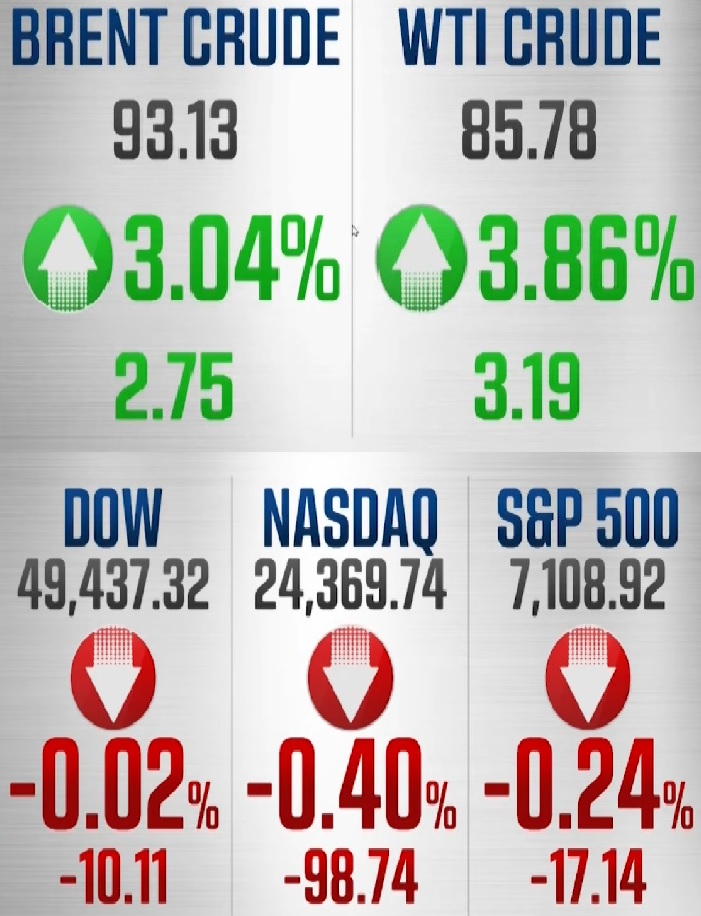
2. Five reasons equities are resilient in 2026
| Driver | Nordic Business Impact | Current Data Point |
| Earnings buffer | Tech/exporters with U.S. exposure benefit from strong S&P 500 earnings momentum | S&P 500 firms on track for ~19% 2026 EPS growth vs pre-war estimates |
| Energy sector hedge | Oslo Børs Energy Index and Danish shipping firms gain from tanker rates and LNG flows | Valero +44% YTD; European refiners paying near \$150/bbl for some grades |
| Lower oil intensity | Nordic economies already spend <4% of GDP on energy; EVs and district heating mute shock | Energy now ~4% of U.S. consumer spend vs 6% in 1990; Nordic ratio even lower |
| AI productivity offset | Swedish/Finnish industrials using AI for energy efficiency; margins less fuel-exposed | Nasdaq +6.8% last week on AI earnings |
| Temporary disruption thesis | Planning horizons can assume H2 normalization if Hormuz reopens | SocGen: “slow normalization” expected by year-end |
3. Where the risk still bites for Nordic companies
– Jet fuel and logistics: Airlines from Air New Zealand to Finnair are cutting routes as jet fuel doubles. Nordic air cargo and seafood exporters face margin squeeze.
– Refining margins: Physical crude premiums hit records as pre-war cargoes ran out. European refiners saw windfall profits in March, now compressing fast.
– Inflation pass-through: IMF raised its 2026 oil base case by 30% to \$82/bbl and cut global growth by 0.2pp. For Norway and Denmark, that means Norges Bank/ECB may delay cuts.
– Demand destruction risk: Goldman notes demand losses in early 2026 exceeded 2011 and 2022 spikes, especially in EM Asia/Africa. Nordic exporters to EM may see slower orders by Q3.
4. Social sentiment: what markets and Main Street are saying
Public discourse shows a split between macro calm and consumer frustration. Energy specialists flagged a 7% oil surge tied to U.S. strikes on Iranian tankers. Financial influencers warn the conflict is now the 1 macro risk for investors, linking it directly to food and transport inflation. Meanwhile, U.S. gas crossed \$4.018/gal, up 30% since Feb 28, and retail posts complain about lagging pump prices despite futures drops.
Takeaway for Nordic boards: Your customers read these posts. Even if your P&L is hedged, brand risk rises when consumers feel “footing the bill for the war”.
5. Actionable analysis for Nordic Business Journal readers
1. Re-hedge duration, not just price: With eight-month average normalization, 3-month hedges are under-protecting. Look at 2027 strips if Hormuz stays constrained.
2. Stress-test EM demand: If Brent holds >\$100 into Q2, model 750k bpd global deficit. That hits container rates and Nordic shipping utilization.
3. Watch the Strait, not just the war: Flows through Hormuz are still at a fraction of 130+ daily crossings. Marine insurers and port repair timelines matter more than ceasefire headlines.
4. Rotate into Nordic winners: Power-to-X, offshore wind, and grid infrastructure gain as EU accelerates away from LNG. AI-driven logistics software benefits from route volatility.
5. Communicate pricing early: Gas at \$4+ is now a political narrative. B2C firms should pre-announce fuel surcharges with clear time limits tied to Brent benchmarks.
Bottom line for the Nordics: High oil is no longer an automatic equity sell signal. The 2026 playbook is about supply duration, sector rotation, and inflation second-round effects. The firms that treat this as a logistics and communication shock—not just a cost shock—will outperform.
What’s next & how to connect
Follow-up direction: Our May issue will dive into “Hormuz Aftermath: How Nordic Shipping and Energy Security Are Being Redrawn”. We’ll map new LNG routes, insurance pricing, and Baltic port investments.
Connect with us: Have data on how the oil shock is hitting your sector? Email the editors at insight@nordicbusinessjournal.com or tag @NordicBizJournal on LinkedIn. We’re sourcing CEO perspectives and CFO hedging case studies for the next feature.
For readers attending Nordic Energy Week in Gothenburg May 12–14, join our live editorial roundtable: “\$100 Oil Playbook”. Register via our site to submit questions.