A vast, ice-bound island of 56,000 people now sits at the centre of the most complex strategic calculus in the Western alliance. What happens next will reshape Arctic security, critical supply chains, and the meaning of sovereignty itself.
For most of the post-war era, Greenland occupied a comfortable position on the periphery of global consciousness: a remote Danish territory, a cartographic curiosity, a place whose name evoked ice sheets and polar bears rather than power politics. That era ended abruptly.
Today, Greenland is not merely “strategic” in the abstract sense that all Arctic territory commands attention. It has become a decision point—a territory where climate change, security architecture, industrial supply chains, and Indigenous self-determination converge with unusual intensity. The forces reshaping the Arctic are not theoretical. They are operational, budgetary, and electoral. And increasingly, they are playing out in Nuuk, Copenhagen, Washington, and the corridors of NATO headquarters in Brussels.
What makes Greenland distinctive is not simply its geography, though that is formidable. It is that Greenland concentrates multiple systemic pressures—geopolitical, environmental, economic, and political—into a single, sparsely populated territory where every choice carries disproportionate consequence. For senior executives, investors, and policymakers, understanding Greenland is no longer a niche Arctic interest. It is a prerequisite for grasping how the Western alliance is restructuring itself for a contested century.
From Periphery to Fulcrum: The Security Architecture Takes Shape
The shift in how Western governments treat Greenland has been neither sudden nor theatrical. It has been architectural—built through successive layers of policy, procurement, and diplomatic coordination that, taken together, signal a fundamental reorientation.
In March 2026, the prime ministers of the Nordic countries and Canada met in Oslo and issued a joint statement that would have been unthinkable a decade earlier. The document committed the signatories to deepening defence industrial cooperation, ramping up production capacity, responding to hybrid threats, and developing interoperable dual-use technologies—all with explicit reference to Arctic security and the “safety, security and sovereignty” of northern populations. Crucially, the statement welcomed NATO’s enhanced Vigilance Activity, Arctic Sentry, launched in February 2026 under the command of Joint Force Command Norfolk, and acknowledged the need for “enhanced access to critical minerals and reliable global supply chains.”
This was not symbolism. It was structural.
NATO’s Arctic Sentry represents a significant operational evolution. By consolidating visibility of allied national activities across the Arctic and High North into a single coherent operational approach, the Alliance is treating the region as an integrated security domain rather than a collection of national postures. The December 2025 realignment that added Denmark, Finland, and Sweden to JFC Norfolk’s area of responsibility reflected a recognition that the geopolitical significance of the North Atlantic-Greenland-Iceland gap has returned to centre stage.
The Nordic-Canadian coordination is equally telling. Canada is not merely another Arctic state; it is a continental bridge between European and North American strategic thinking. When Ottawa aligns procurement, industrial readiness, and threat assessment with Nordic partners, the effect is multiplicative. It creates the scaffolding for a Western Arctic security system that transcends bilateral arrangements and moves toward genuine collective capability.
Yet this architecture raises a question that the joint statements address only obliquely: who, ultimately, decides what happens in Greenland?
The Sovereignty Question: Greenland’s Agency in an Age of External Pressure
Greenland is not a blank space on a geopolitical chessboard. It is a self-governing territory within the Kingdom of Denmark, with an elected parliament (the Inatsisartut), a devolved government (the Naalakkersuisut), and a legal pathway to independence established under the 2009 Self-Government Act. Denmark retains authority over foreign affairs, defence, and monetary policy. Greenland controls domestic policy, natural resources, and—critically—its own constitutional future.
This arrangement, born of decades of political evolution, creates a tension that no amount of diplomatic finesse can resolve. When Nordic governments and NATO allies emphasise Arctic security while simultaneously acknowledging that “Greenland belongs to its people” and that its future is for Greenlanders and Danes alone to determine, they are navigating a sovereignty paradox.
The paradox sharpened dramatically in late 2024 and early 2025, when the second Trump administration declared a renewed interest in acquiring Greenland—citing national security, critical minerals, and the need to counter Russian and Chinese Arctic presence. The rhetoric escalated quickly: threats of tariffs, refusal to rule out military force, and a State of the Union declaration that the United States would get Greenland “one way or the other.”
The response from Greenland and Denmark was unequivocal. Greenland’s then-Prime Minister Múte Egede stated plainly: “We are not for sale and we will not be for sale.” Danish Prime Minister Mette Frederiksen, while reaffirming the United States as Denmark’s closest ally, insisted that “Greenland belongs to the Greenlanders” and that any cooperation must be “respectful of the Greenlandic people.”
The March 2025 Greenlandic general election, held in the shadow of these threats, produced a significant result. The centre-right Democrats, led by Jens-Frederik Nielsen, emerged as the largest party with 29.9% of the vote—a surprise outcome that was interpreted, in part, as a rejection of Trump’s rhetoric. Nielsen, who described Trump’s position as “a threat to our political independence,” formed a broad coalition government that explicitly stated: “Greenland belongs to us. We decide our own future. We must choose our partners ourselves.”
A Verian Group poll conducted in January 2025 found that 85% of Greenlanders opposed becoming part of the United States, while 56% supported independence in principle—though 45% would reject it if it meant a deterioration in living standards. The Danish block grant, which covers roughly half of Greenland’s government revenue, remains the economic reality that independence advocates must confront.
This is the core tension: Greenland’s political class is broadly united on the goal of independence but divided on the timeline and the conditions. The Self-Government Act’s Section 21 provides a legal mechanism for independence through referendum and negotiation with Denmark. A constitutional commission presented a draft constitution in April 2023, and a commission reviewing the independence process is expected to report by late 2026. But the economic arithmetic is unforgiving. Without the Danish block grant, Greenland would face a fiscal chasm that mineral revenues—however promising—cannot presently fill.
For external powers, this creates a delicate operational environment. Security cooperation, investment overtures, and diplomatic engagement must all navigate a political landscape where Greenlandic agency is not merely a talking point but a legal and electoral reality. Any actor that appears to disregard this—whether through overt pressure or perceived paternalism—risks galvanising precisely the nationalist sentiment it seeks to manage.
Ice, Access, and Operating Advantage: The Climate-Security Nexus
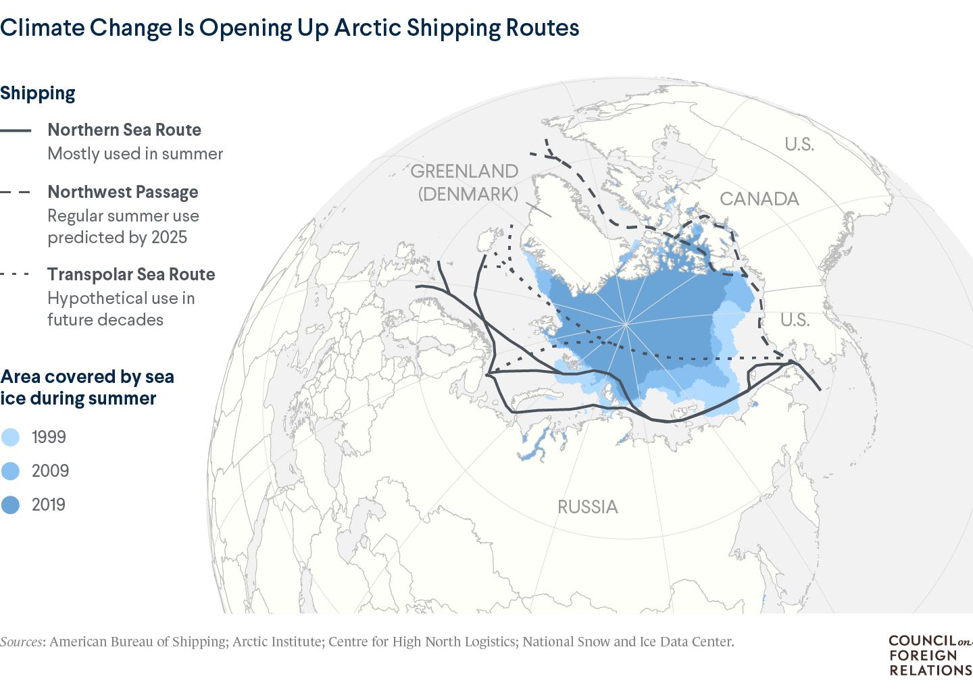
The transformation of Greenland’s strategic significance is inseparable from the physical transformation of the Arctic itself. Arctic ice loss is not a future scenario; it is a present operational reality that is altering the timing, routing, and feasibility of both civilian shipping and military operations across the region.
When sea routes become seasonally longer and more navigable, strategic planning shifts from contingency to routine. The question is no longer whether the Northwest Passage or trans-polar routes will open, but when they will become commercially and militarily predictable. For NATO planners, this means the Greenland-Iceland-UK (GIUK) gap—the Cold War-era chokepoint for monitoring Soviet submarine movements—has acquired renewed relevance not as a historical reference but as a contemporary operational requirement.
The implications extend beyond naval mobility. Ice loss affects radar coverage, air defence geometry, and the logistics of sustaining any military presence in the High North. It changes where infrastructure must be hardened, where surveillance assets must be positioned, and where allied forces must demonstrate persistent presence to deter adversary activity.
This is why Arctic security statements increasingly frame the region in terms of “deterrence, maritime awareness, and rapid coordination.” It is not alarmism. It is the recognition that a changing physical environment creates new vulnerabilities faster than static defence postures can adapt. Greenland, situated between North America and Europe, with the Pituffik Space Base providing missile warning and space surveillance, is the territorial anchor of this evolving architecture.
Critical Minerals: The Supply Chain Reality Behind the Headlines
The narrative of Greenland as a mineral El Dorado requires careful parsing. The territory is geologically endowed with deposits of rare earth elements, uranium, zinc, lead, gold, and gemstones. But geological endowment is not economic production. As of early 2025, Greenland had only two active mines, and Danish economics professor Torben M. Andersen assessed that mining would not play a significant economic role for at least another decade.
The challenges are structural. Greenland’s extreme weather, absence of infrastructure, lack of local refining capacity, and high extraction costs make it uncompetitive against established producers. Similar minerals are more abundant and accessible in the United States, Brazil, Vietnam, and elsewhere. The promise of a Greenlandic mineral bonanza has, in the assessment of some analysts, become a “geopolitical mirage”—attractive to strategic planners in capitals but disconnected from the realities of project finance, environmental permitting, and operational logistics.
Yet the strategic logic persists, even if the commercial timeline does not. The question for Western governments is not whether Greenland can replace Chinese rare earth dominance tomorrow—it cannot—but whether cultivating alternative supply chains, including Greenlandic sources, is a necessary hedge against concentration risk. China currently accounts for approximately 60% of global rare earth mining and nearly 90% of processing capacity. In a world where battery materials and permanent magnets are inputs to both clean energy transitions and defence-industrial production, that concentration is a vulnerability that policymakers are unwilling to accept.
Greenland’s role, then, is not as an immediate supplier but as a strategic option—a piece of a diversified supply chain architecture that may take decades to mature. The EU has sought to deepen its engagement with Greenland precisely on this basis, offering partnership frameworks that emphasise sustainable extraction, environmental standards, and local benefit-sharing. Whether these frameworks can overcome the fundamental economics of Arctic mining remains an open question.
For investors and corporate strategists, the lesson is clear: Greenland’s mineral potential is real but long-dated. The near-term opportunities lie not in extraction but in the enabling infrastructure, services, and technologies that would make extraction feasible—if and when the economics align. The risk is that geopolitical urgency drives capital allocation decisions that ignore the operational realities, producing stranded assets and damaged relationships with local communities whose consent is not merely desirable but legally and politically essential.
The Nordic Response: Cohesion Under Pressure
The Nordic countries have responded to the Greenland question with a degree of coordination that reflects both shared interests and shared vulnerabilities. The January 2026 joint statement by the foreign ministers of Denmark, Finland, Iceland, Norway, and Sweden was unusually direct: “As Nordic countries, Arctic States and NATO allies we are collectively committed to preserving security, stability and co-operation in the Arctic.” The statement reaffirmed that “matters concerning Denmark and Greenland are for Denmark and Greenland to decide alone” and referenced the 1951 US-Denmark Defence Agreement as the appropriate framework for security cooperation.
This was reinforced by a broader European statement in January 2026 from the leaders of France, Germany, Italy, Poland, Spain, the United Kingdom, and Denmark, which declared that “Greenland belongs to its people” and that “it is for Denmark and Greenland, and them only, to decide on matters concerning Denmark and Greenland.”
The European response to Trump’s threats was not merely rhetorical. France floated the possibility of troop deployments to Greenland (quickly clarified as not being Denmark’s preferred course). The European Commissioner for Defence stated that the EU was “ready to defend our member state, Denmark.” German Chancellor Olaf Scholz invoked the “inviolability of borders” as a fundamental principle of international law.
For Nordic policymakers, this episode has underscored a uncomfortable reality: even within the alliance, territorial integrity cannot be taken for granted. The Nordic-Baltic security continuum, already reshaped by Finland’s and Sweden’s NATO accession, must now incorporate a North Atlantic dimension that includes the defence of sovereign territory against pressure from within the alliance itself. This is not a scenario that Cold War-era planning anticipated.
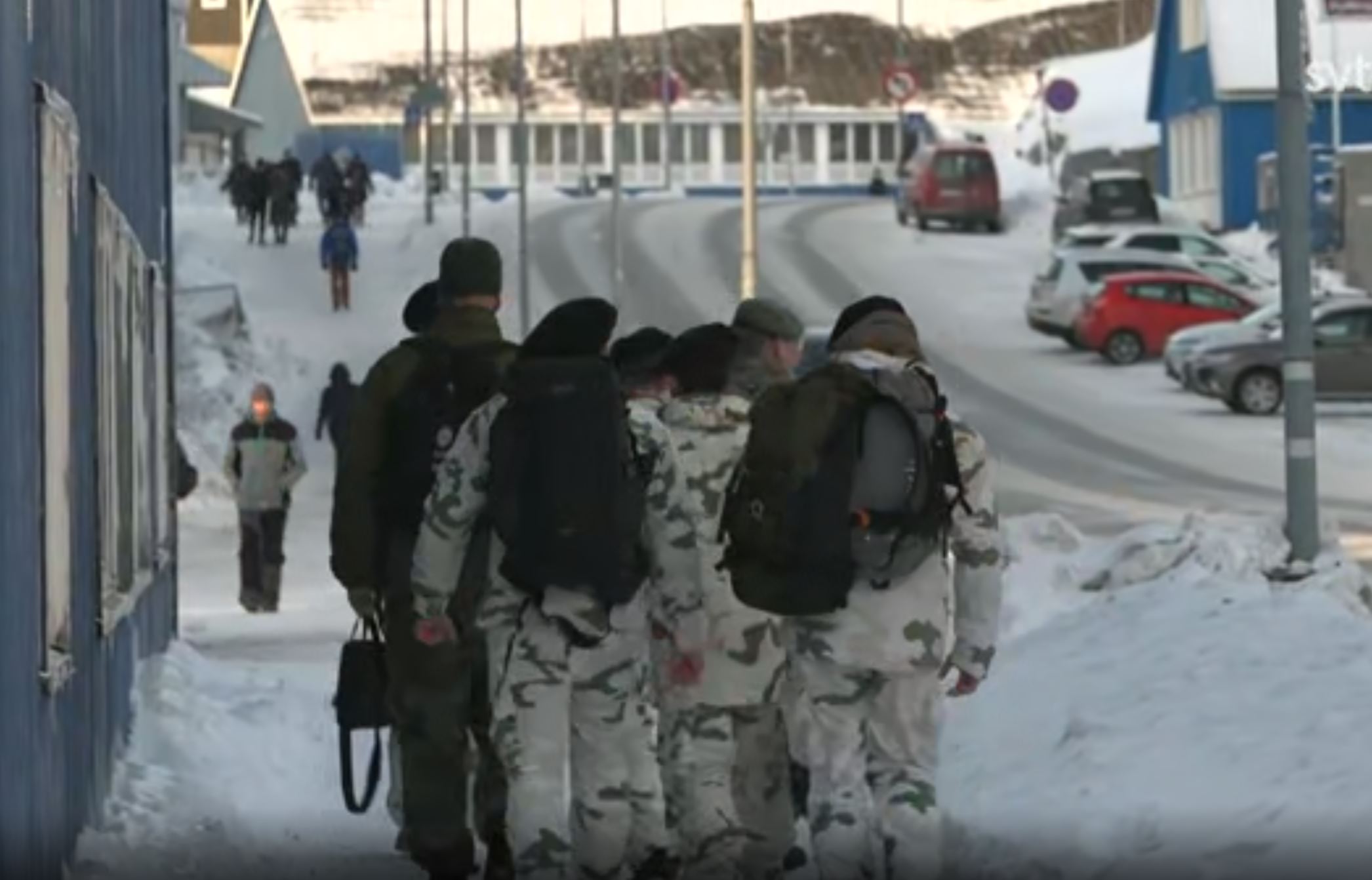
The practical response has been to accelerate the very integration that Trump’s rhetoric was ostensibly intended to catalyse. Nordic defence procurement alignment, shared situational awareness, and joint exercises (including Cold Response, Operation NANOOK, and Arctic Endurance) are being deepened not as gestures but as operational necessities. The Nordic countries and Canada have committed to “enhance defence industrial capacity to ramp up defence production, strengthen capabilities, respond to hybrid threats, build resilient infrastructure, and develop interoperable, innovative and dual-use technologies.”
The Long Game: Why This Matters Now
Arctic geopolitics moves at the pace of parliamentary approvals, procurement cycles, and infrastructure planning. It does not lend itself to dramatic reversals or sudden invasions. Yet the cumulative effect of these slow-moving processes is genuinely transformative. The security architecture being built today will shape energy flows, trade routes, technological competition, and Indigenous futures for decades.
For decision-makers in several domains, the implications are concrete:
For defence and security strategists, Greenland is no longer a distant concern. It is a front-line variable in Arctic deterrence, requiring sustained investment in situational awareness, infrastructure resilience, and allied interoperability. The GIUK gap has returned as an operational priority.
For investors and corporate leaders, Greenland presents a bifurcated risk profile. Near-term opportunities are limited by infrastructure deficits, regulatory complexity, and local political dynamics. Long-term positioning in critical minerals, Arctic logistics, and enabling technologies may yield significant returns—but only for patient capital that respects local governance and environmental constraints.
For policymakers and diplomats, the Greenland case illustrates a broader challenge: how to reconcile alliance cohesion with respect for self-determination in an era of great-power competition. The Western alliance’s credibility depends not only on its capacity to deter external adversaries but on its ability to manage internal pressures without fracturing the very solidarity it seeks to project.
For sustainability and ESG-focused stakeholders, Greenland embodies the tension between climate imperatives and security imperatives. The ice that makes the territory strategically significant is the same ice whose loss threatens the ecosystems and livelihoods of the Inuit communities who have governed these lands for millennia. Any development trajectory that ignores this duality will face legitimacy deficits that no amount of investment can overcome.
Conclusion: The Arctic’s Decision Point
Greenland is not merely located at the intersection of climate change, security strategy, industrial supply chains, and Indigenous sovereignty. It is where these forces are being negotiated in real time, with consequences that extend far beyond the Arctic Circle.
The power struggle forming around Greenland is not a thriller. It is an accumulating structure of policy choices, investment decisions, diplomatic alignments, and electoral outcomes that will determine whether the Arctic becomes a zone of managed competition or a source of systemic instability. The outcome hinges on whether the Western alliance can integrate Greenland’s agency into its strategic planning—treating the territory not as a prize to be won but as a partner whose consent, interests, and self-determination are foundational to any sustainable order.
The architecture being built now will outlast the political cycles that produced it. That is why Greenland deserves sustained, sophisticated attention: not because conflict is inevitable, but because the choices made in the next decade will constrain the choices available for the century that follows.
Editorial Outlook
Follow-up Angle: “The Independence Dividend: Can Greenland Finance Its Own Future?”
As Greenland’s constitutional commission prepares its report on the independence pathway (expected late 2026), a critical question remains unexamined: what would an economically viable independent Greenland actually look like? The current debate is dominated by political symbolism and external pressure, but the fiscal arithmetic is unforgiving. A deep-dive follow-up should examine the specific economic models under consideration—how Greenland might replace the Danish block grant, what mineral revenue timelines are realistic, whether sovereign wealth fund structures could bridge the transition, and how Copenhagen and Nuuk might negotiate a post-independence association agreement that preserves security cooperation while respecting full sovereignty. The article should also explore what lessons Greenland might draw from Iceland’s 1918 path to independence and the Faroe Islands’ ongoing autonomy negotiations. For investors, this is the question that will determine whether Greenland is a long-term opportunity or a strategic illusion.
The Nordic Business Journal welcomes engagement from senior executives, institutional investors, policymakers, and researchers working at the intersection of Arctic strategy, sustainable development, and Nordic economic policy. For editorial inquiries, partnership discussions, and contributed analysis, please contact our editorial team.
Nordic Business Journal is published for an international readership of decision-makers who require analytical depth, contextual rigour, and forward-looking perspective on the forces shaping the Nordic and North Atlantic economies. All views expressed are those of the author.
Primary official sources
1. Nordic Joint Statement on Greenland (January 2026)
Government of Sweden — Joint Statement by the Nordic Foreign Ministers on Greenland (6 January 2026) https://www.government.se/statements/2026/01/joint-statement-by-the-nordic-foreign-ministers-on-greenland/ `
Source: Authority: Official government publication (S-level)
Key content: “As Nordic countries, Arctic States and NATO allies we are collectively committed to preserving security, stability and co-operation in the Arctic… We collectively reiterate that matters concerning Denmark and Greenland are for Denmark and Greenland to decide alone.”
Why it matters: This is the definitive Nordic response to external pressure on Greenland, issued by all five Nordic foreign ministers. It supersedes earlier references and provides the most current official Nordic position.
2. Canada-Denmark-Greenland Defence Cooperation (February 2026)
Government of Canada — Minister McGuinty advances Canada’s defence priorities with Allies and partners in Europe (15 February 2026)
Authority: Official government publication (S-level)
Source: Signed a Defence Cooperation Memorandum of Understanding with Denmark and Greenland enabling “enhanced cooperation in defence and security activities, particularly in the Arctic and the North Atlantic, as well as defence innovation, defence materiel and industrial cooperation, mutual logistics support, and training.”
Why it matters: This is the most recent bilateral defence agreement specifically involving Greenland representation, operationalising the broader Nordic-Canadian coordination.
3. Canada-Nordic Prime Ministers’ Joint Statement (March 2026)
Source: Government of Canada — Prime Minister Carney deepens cooperation with Nordic countries in defence, Arctic security, and critical minerals (May 2026)
https://international.canada.ca/en/global-affairs/campaigns/canada-arctic/latest-news
Source: Authority: Official government publication (S-level)
Key content: Joint statement from Oslo meeting committing to “enhance defence industrial capacity to ramp up defence production, strengthen capabilities, respond to hybrid threats, build resilient infrastructure, and develop interoperable, innovative and dual-use technologies.”
Why it matters: This is the most recent high-level Canada-Nordic commitment, explicitly linking Arctic security with critical minerals and industrial cooperation.
4. Canada-Greenland Critical Minerals Declaration (March 2026)
Source: Government of Canada / Natural Resources Canada — Joint Declaration of Intent Between Canada and Greenland on Critical Minerals and Energy Cooperation (2 March 2026)
Authority: Official government publication (S-level)
Key content: Formal cooperation framework on critical minerals and energy, signed in Toronto.
Why it matters: Direct bilateral instrument between Canada and Greenland on the specific minerals issue, demonstrating Nuuk’s agency in international partnerships.
5. Canada-Nordic Strategic Dialogue (September 2024)
Source: Government of Canada — Joint statement following the Strategic Dialogue between Canada, Kingdom of Denmark, Finland, Iceland, Norway and Sweden (29 September 2024)
Authority: Official government publication (S-level)
Key content: Foreign ministers met in Iqaluit, Nunavut, with Greenland representation. Committed to “explore means through which to deepen security dialogue amongst all like-minded states in the Arctic” and confirmed commitment to “promote the responsible development of sustainable and resilient critical mineral value chains.”
Why it matters: Establishes the diplomatic precedent for the 2026 security architecture and includes Greenland’s direct participation.
6. Canada’s Arctic Foreign Policy (2024)
– Source: Government of Canada — Canada’s Arctic Foreign Policy (February 2026 update) https://international.canada.ca/en/global-affairs/corporate/reports/arctic-policy-2024
Authority: Official government publication (S-level)
Key content: Comprehensive policy framework including commitment to open new consulates in Nuuk, Greenland and Anchorage, Alaska; recognition of Greenland as part of the North American Arctic security continuum; commitment to “initiate an Arctic security dialogue with the ministers of foreign affairs of like-minded states in the Arctic.”
Why it matters: The definitive Canadian policy document on Arctic engagement, explicitly naming Greenland as a priority partner.
7. Northern Defence Dialogue / Arctic Allies Joint Statement (October 2024)
Source: Government of Canada — Joint Statement on Arctic Security and Defence (17 October 2024)
Authority: Official government publication (S-level)
Key content: Defence ministers of Canada, Denmark (with Greenland and Faroe Islands representatives), Finland, Norway, Sweden, Iceland, and the US reaffirmed “shared commitment to enhanced collaboration on security and defence in the Arctic” under the Northern Defence Dialogue.
Why it matters: The foundational defence ministerial statement that established the current Arctic security coordination format.
8. Sweden’s Arctic Allies Joint Statement (May 2026)
Source: Government of Sweden — Joint Statement on Arctic Security from the Arctic Allies (22 May 2026)
Authority: Official government publication (S-level)
Key content: Joint statement by Canada, Kingdom of Denmark including Greenland and the Faroe Islands, Finland, Iceland, Norway, Sweden, and the United States.
Why it matters: Most recent iteration of the “Arctic Allies” format, explicitly including Greenland in the joint statement.
Critical Minerals and Rare Earths Sources
9. Critical Metals Corp — REalloys Offtake Agreement (October 2025)
Source: Reuters via TradingView — Critical Metals surges on offtake agreement with REalloys
Authority: Reuters syndicated content (A-level)
Key content: “U.S.-based Critical Metals CRML has signed a letter of intent to supply magnet company REalloys with rare earths from its Tanbreez project in Greenland… CRML expects to supply up to 15% of Phase 1 production.”
Why it matters: Primary source for the specific rare earths project referenced in the article. Confirms the Tanbreez project as a real, active development with Western defence supply chain implications.
10. US Export-Import Bank Loan Consideration for REalloys (October 2025)
Source: Reuters via TradingView — US Export-Import Bank considers $200 million loan for rare earths firm REalloys
https://www.tradingview.com/news/reuters.com,2025:newsml_L1N3W90RZ:0-us-export-import-bank-considers-200-million-loan-for-rare-earths-firm-realloys/ Authority: Reuters syndicated content (A-level)
Key content: “It signed an agreement earlier this month to source ore from a Greenland mine that Critical Metals Corp CRML aims to develop.”
Why it matters: Demonstrates US government financial backing for the Greenland rare earth supply chain, elevating it from commercial venture to strategic priority.
11. REalloys 15-Year Definitive Offtake Agreement (June 2026)
Source: PR Newswire via TradingView — Western Rare Earth Supply Chains Are Finally Taking Shape
Authority: Industry news (A-level)
Key content: “REalloys signed a definitive 15-year offtake agreement with Critical Metals Corp. covering 15% of Phase 1 production from the Tanbreez project.”
Why it matters: Shows evolution from letter of intent to definitive long-term contract, confirming project viability.
12. Critical Metals Heavy Rare Earth Profile (May 2026)
Source: PR Newswire via TradingView — The Rare Earth Race Has a New Front-Runner https://www.tradingview.com/news/prnewswire:bcec12d9b653f:0-the-rare-earth-race-has-a-new-front-runner/
Authority: Industry news (A-level)
Key content: “Critical Metals estimates heavy rare earths account for roughly 27% of the project’s total profile.”
Why it matters: Technical detail on the Tanbreez deposit’s composition, distinguishing it from light rare earth projects.
13. Critical Metals Arctic Facility in Qaqortoq (May 2026)
Source: PR Newswire via TradingView — Inside The North Atlantic Critical Minerals Push: A $68 Billion Greenland Deposit Lands at the EU Raw Materials Summit
Authority: Industry news (A-level)
Key content: “Critical Metals is also advancing construction of an Arctic-grade, multi-use storage and pilot-plant facility in Qaqortoq, Greenland, scheduled…”
Why it matters: Shows on-the-ground infrastructure development in Greenland, not just exploration.
EU-Greenland Strategic Partnership Sources
14. EU-Greenland Strategic Partnership on Raw Materials (November 2023)
Source: European Commission — EU and Greenland sign strategic partnership (29 November 2023) https://ec.europa.eu/commission/presscorner/detail/en/ip_23_6166
Authority: Official EU publication (S-level)
Key content: “The EU signed a Memorandum of Understanding (MoU) with the Government of Greenland for a strategic partnership to develop sustainable raw materials value chains.” 25 of 34 EU critical raw materials found in Greenland.
Why it matters: Foundational document for EU-Greenland minerals cooperation, establishing the strategic framework.
15. EU RESourceEU Action Plan (December 2025)
Source: European Commission — RESourceEU Action Plan (3 December 2025)
– URL: https://single-market-economy.ec.europa.eu/document/download/01c448d6-dc93-40d7-9afe-4c2af448d00c_en
Authority: Official EU publication (S-level)
Key content: “CRMs imports from Canada, Kazakhstan, Greenland, Chile and Namibia have increased both in volume and value in the past years.” Greenland Resources’ Malmbjerg molybdenum project identified as priority for defence sector supply security.
Why it matters: The EU’s most recent comprehensive critical minerals strategy, explicitly naming Greenland as a priority partner.
16. EU-Greenland Partnership Implementation (September 2025)
Source: EIT RawMaterials — Greenland is ready to power Europe’s raw materials future
https://eitrawmaterials.eu/opinions/greenland-ready-power-europes-raw-materials-future
Authority: EU-affiliated institution (A-level)
Key content: Greenland’s perspective on the EU partnership, including the 10-year offtake agreement between Greenland Resources and Outokumpu for Malmbjerg molybdenum.
Why it matters: Greenland’s own voice on the partnership, adding Indigenous and local government perspective.
NATO and Security Architecture Sources
17. NATO Arctic Sentry / Vigilance Activity (February 2026)
Source: NATO — Allied Command Operations (February 2026) https://aco.nato.int/
Authority: Official NATO publication (S-level)
Key content: NATO’s enhanced Vigilance Activity, Arctic Sentry, launched in February 2026 under Joint Force Command Norfolk.
Why it matters: Confirms the operationalisation of NATO’s Arctic posture referenced in the article.
18. JFC Norfolk Area of Responsibility Expansion (December 2025)
Source: NATO — Joint Force Command Norfolk https://jfcnorfolk.nato.int/
Authority: Official NATO publication (S-level)
Key content: Denmark, Finland, and Sweden added to JFC Norfolk’s area of responsibility in December 2025.
Why it matters: Structural change in NATO’s Arctic command architecture, directly relevant to Greenland’s security context.
Greenland Political and Sovereignty Sources
19. Greenland Self-Government Act (2009)
Source: Government of Greenland / Kingdom of Denmark https://naalakkersuisut.gl/
Authority: Official government publication (S-level)
Key content: Establishes Greenland’s self-rule, including Section 21 provisions for independence through referendum.
Why it matters: Legal foundation for all discussions of Greenlandic sovereignty and agency.
20. Greenland Constitutional Commission Draft (2023)
Source: Government of Greenland https://naalakkersuisut.gl/
Authority: Official government publication (S-level)
Key content: Draft constitution presented in April 2023; commission reviewing independence process expected to report late 2026.
Why it matters: Demonstrates the active, ongoing nature of Greenland’s constitutional evolution.
21. Greenland General Election Results (March 2025)
Source: Various verified international media (Reuters, BBC, etc.)
Key content: Democrats led by Jens-Frederik Nielsen emerged as largest party with 29.9% of vote.
Why it matters: Electoral validation of Greenland’s resistance to external pressure and assertion of self-determination.
Additional Recommended Sources for Further Strengthening
22. Chatham House Analysis — UK-Greenland Trade Negotiations (October 2025)
Source: Chatham House — The race for Greenland’s rare earth minerals is heating up
Authority: Major international think tank (A-level)
Key content: Analysis of Tanbreez project sale to Critical Metals Corp after US-Denmark lobbying against Chinese acquisition; Greenland’s warming as “29th consecutive year” of ice loss; EU as Greenland’s “stable, reliable and important partner” per Prime Minister Nielsen.
Why it matters: Independent analytical perspective on the geopolitical competition for Greenland’s minerals, with climate-security nexus analysis.
23. Benchmark Mineral Intelligence — EU-Greenland Partnership Analysis (August 2024)
Source: Benchmark Mineral Intelligence — EU courts Greenland for critical raw materials amid Arctic geopolitical shifts
Authority: Industry intelligence specialist (A-level)
Key content: GEUS data on Greenland’s mineral endowment: 6 Mt graphite, 36.1 Mt REE, 235kt lithium, 106kt copper. EU Commission office opened in Nuuk March 2024; €22.5 million Green Growth program.
Why it matters: Quantified geological data and EU operational presence in Greenland.
24. HSF Kramer — US and EU Critical Minerals Approaches (February 2026)
Source: HSF Kramer — The US and EU Approaches to Critical Minerals Explained
Authority: Legal and policy analysis (A-level)
Key content: Detailed analysis of EU Critical Raw Materials Act, RESourceEU €3 billion investment drive, Greenland Resources’ Malmbjerg project as priority for EIB financing.
Why it matters: Comprehensive comparison of US and EU strategies with specific Greenland project financing details.
Additional Sources for Future Follow-up
For the “Independence Dividend” follow-up article proposed in the Editorial Outlook, I recommend tracking:
– Greenland Constitutional Commission final report (expected late 2026)
– Danish-Greenland block grant renegotiation (ongoing fiscal framework)
– EU-Greenland partnership roadmap implementation (specific project milestones)
– Critical Metals Corp Tanbreez project feasibility study (expected 2026-2027)
– NATO Arctic Sentry exercise outcomes (operational assessments)
– Pituffik Space Base (Thule) modernization (US-Denmark-Greenland trilateral dynamics)