Consequently, on Friday, June 12, 2026, SpaceX (NASDAQ: SPCX) executed a historic initial public offering. The company raised a record $75 billion, establishing a $2.1 trillion market valuation. This unprecedented capital event signals a major shift in global technology investment. Furthermore, it introduces complex dynamics for international institutional investors. Nordic pension funds now face immediate, structural exposure to this mega-cap asset. Understanding this market debut is critical for regional financial decision-makers. Therefore, we must analyze the underlying mechanics and long-term portfolio implications.
The Anatomy of a Historic Market Debut
The market debut established multiple all-time records across global exchanges. Shares priced at $135, immediately popping 11.1 percent to $150 at the open. Intraday trading briefly pushed the valuation near $2.3 trillion. Ultimately, the stock closed near $161, finishing roughly 19 percent above the initial price. Several aggressive financial mechanics sustained this momentum throughout the session. First, massive oversubscription created an artificial price floor. Institutional funds faced blocked allocations, forcing them to buy directly on the open market. Second, the company intentionally maintained a slim public float of merely five percent. High demand naturally inflated prices against this tightly bottlenecked supply. Third, an uncharacteristic 20 percent retail allocation satisfied massive individual investor appetite. Trading volume approached 500 million shares, echoing historic technology debuts. Finally, major index operators fast-tracked the stock for inclusion within 15 trading days. Consequently, large index-tracking exchange-traded funds were forced to purchase shares immediately. This historic event also minted the founder as the world’s first trillionaire.
The key supporting metrics from day one trading and an assessment of its long-term financial sustainability are detailed below.
Key Data Supporting the Trading Session
The market debut of SpaceX set multiple all-time records across Wall Street:
| Metric | Data Point | Market Impact / Context |
| IPO Set Price | $135 per share | Established an initial company valuation of $1.77 trillion. |
| Opening Price | $150 per share | Popped 11.1% immediately at the opening bell. |
| Intraday High | $176.52 per share | Pushed the valuation close to $2.3 trillion at peak midday trading. |
| Closing Price | $160.95 to $161.11 | Finished ~19.2% above the IPO price and ~7.3% above the open price. |
| Final Day-One Valuation | $2.1 trillion | Cemented SpaceX as the 6th largest publicly traded company in the U.S. |
| Total Capital Raised | $75 billion | Erased the previous global record held by Saudi Aramco ($25.6B in 2019). |
| Volume Traded | ~500 million shares | Approached Facebook’s historic 2012 launch volume (580M shares). |
| Elon Musk’s Net Worth | >$1.0 trillion | Minted SpaceX’s founder as the world’s first trillionaire. |
Valuation Realities: The Bull and Bear Dynamics
Despite the triumphant debut, analysts express steep skepticism regarding long-term sustainability. Morningstar equity research pegs the true fundamental value significantly lower. They estimate a fair value of $63 per share, highlighting a massive disconnect. Furthermore, the company currently trades at roughly 92 times its current earnings. This multiple is nearly ten times higher than established technology giants. Justifying this valuation requires aggressive growth projections over the next decade. Revenue must skyrocket from $3.2 billion today to $322 billion by 2030. Moreover, future success hinges entirely on the flawless scaling of the Starship architecture. Any launch failures will severely jeopardize critical satellite and deep-space infrastructure contracts. Conversely, the bull case emphasizes a true, massive capital infusion. Unlike historical listings, this offering featured zero percent offer for sale. All $75 billion raised goes directly onto the corporate balance sheet. This capital will fund immediate expenditures, including orbital communication networks. Additionally, the company holds an effective monopoly on commercial heavy-payload space transport. Therefore, it captures premium state-level defense and telecommunications spending globally.
The Nordic Pension Exposure Matrix
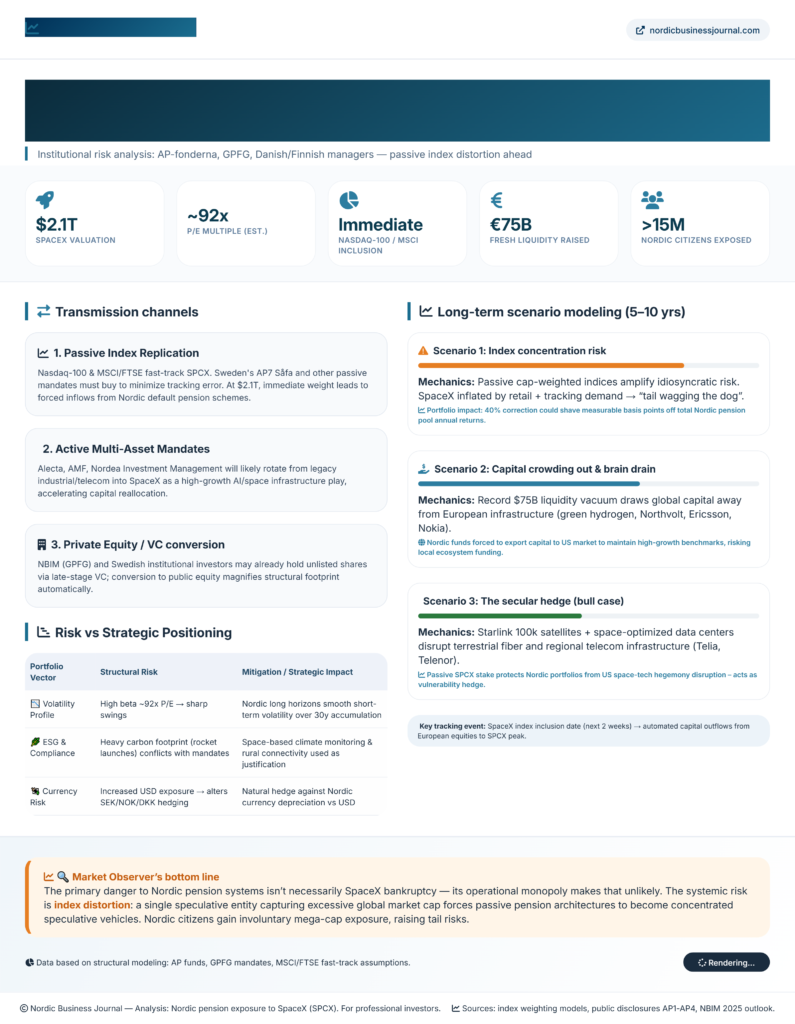
Institutional investors in the Nordic region are structurally exposed to global equity markets. Consequently, Swedish AP-fonderna, Norway’s Government Pension Fund Global, and Danish managers face immediate exposure. Because the company broke historical records, Nordic citizens are passively exposed. This occurs regardless of individual fund preferences or regional mandates. Nordic pension funds will absorb this exposure through three primary mechanisms. First, passive index replication will occur immediately. Global benchmarks are fast-tracking the stock, forcing passive funds to buy automatically. This minimizes tracking error but guarantees significant portfolio weighting. Second, active multi-asset managers will likely chase this high-growth secular trend. They may reallocate capital away from legacy European industrial sectors. This shift funds new positions in artificial intelligence and satellite logistics. Third, existing private equity pipelines may convert into public equity. Some larger institutional blocks already held unlisted shares via late-stage venture capital. Thus, private allocations are now seamlessly transitioning into public market holdings.
Long-Term Portfolio Scenarios and Strategic Risks
We can model three long-term macroeconomic scenarios over a ten-year horizon. Scenario one represents index concentration risk, a core structural vulnerability. Nordic funds are heavily concentrated in global capitalization-weighted indices. If the stock inflates purely based on retail momentum, it creates severe idiosyncratic risk. A sudden 40 percent correction could shave measurable basis points off annual returns. Scenario two involves capital crowding out and regional brain drain. The record capital raise effectively vacuums up global investment liquidity. Nordic funds have strict mandates to support sustainable, local European infrastructure. However, the gravity of this monopoly risks crowding out domestic technology ecosystems. Funds may be forced to export capital to the United States. Scenario three offers a secular hedge, representing the bull case for pensions. If the company successfully deploys its massive satellite network, traditional terrestrial infrastructure becomes partially obsolete. In this scenario, passive exposure acts as a vital vulnerability hedge. It protects the overall portfolio from being completely disrupted by foreign technological hegemony.
ESG, Currency, and Systemic Implications
From a strict risk-management perspective, the primary danger is systemic index distortion. When a single, highly speculative entity captures massive global market capitalization, it forces passive architectures to become concentrated. The volatility profile remains high due to an elevated price-to-earnings multiple. However, Nordic funds utilize long horizons, mathematically smoothing short-term swings. Environmental, social, and governance compliance presents a complex challenge. The heavy carbon footprint from frequent rocket launches conflicts with strict Nordic ESG mandates. Conversely, managers may utilize space-based climate monitoring to justify compliance. Furthermore, increased United States dollar exposure alters currency hedging ratios. This forces funds to buy more dollars against the Swedish krona or Norwegian krone. Yet, this provides a hedge for Nordic citizens against domestic currency depreciation. Ultimately, tracking the exact date of index inclusion provides a precise preview. It reveals when automated capital outflows from domestic European equities will peak.
Conclusion
The historic market debut represents a paradigm shift in global capital allocation. While operational execution remains robust, the valuation demands flawless future performance. For Nordic institutional investors, the challenge lies in managing involuntary concentration. Therefore, active risk mitigation and strategic hedging are now imperative. Decision-makers must balance the allure of technological monopolies with fiduciary responsibility.
Editorial Outlook
A compelling follow-up article should investigate the regulatory response within the European Union. Specifically, how will the European Securities and Markets Authority address passive fund concentration risks? Furthermore, analyzing potential capital controls or ESG exemptions for Nordic pension funds would provide critical strategic foresight.
Connect with Nordic Business Journal
We invite readers to connect with Nordic Business Journal for further insights. Please reach out to our editorial team for partnerships, subscriptions, and strategic discussions. Together, we can navigate the complexities of the modern global investment landscape.