Denmark’s demographic outlook is increasingly being discussed as a welfare-state risk—yet it should also be treated as an economic and competitiveness question. The core issue is simple: the country is approaching a period in which fewer young people will enter education-to-work pipelines at precisely the time when public services and labour demand are set to intensify. That combination is not only politically combustible; it is strategically determinative for employers, municipal finance, and the investment climate.
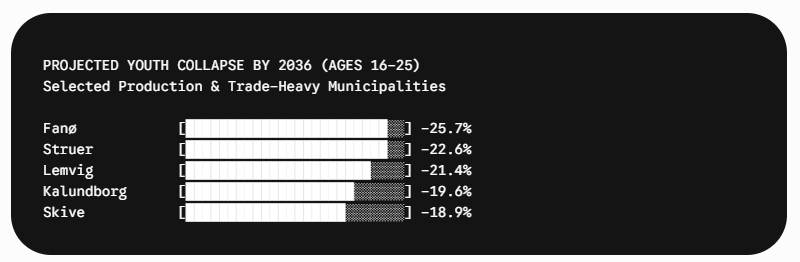
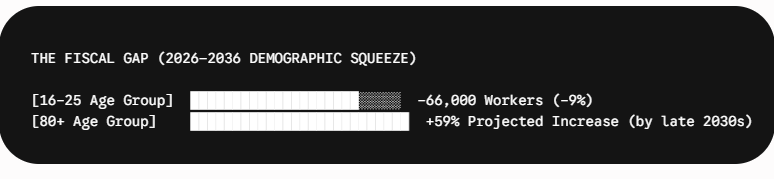
A new forecast from SMVdanmark points to a sharp contraction in Denmark’s youth cohort aged 16–25. The analysis suggests a decline of roughly 66,000 young people by 2036—about 9%—with the change concentrated across nearly the entire country: 96 of 98 municipalities are projected to experience falling youth numbers. For a small open economy with a universal welfare model and a deeply embedded tradition of apprenticeship-based workforce formation, this is not a slow-moving background trend. It is a structural shock to the labour supply chain.
The question for decision-makers now is not whether Denmark can adjust—but how, and at what cost.
An Apprenticeship Gap That Threatens the Fabric of Local Industry
Denmark’s apprenticeship system is frequently described as a social achievement. Economically, it is also an industrial strategy—especially for small and medium-sized enterprises (SMVs). When youth cohorts shrink, the impact is not evenly distributed. It concentrates where production and trade-heavy value chains depend on a steady inflow of entry-level talent.
SMVdanmark’s figures indicate that firms with fewer than 100 employees train roughly two-thirds of vocational apprentices. In micro-enterprises (five to nine employees), the training intensity is even higher—around 4.5 apprentices per 100 employees, more than double the rate seen in large corporations. This means the demographic shock is likely to be felt first in local workshops, family-owned service businesses, regional construction firms, and the broader ecosystem that turns training capacity into employability.
The geographic pattern matters. While Copenhagen and Aarhus are comparatively insulated—benefiting from ongoing education-related in-migration—the peripheral municipalities most closely tied to manufacturing, installation, and trade face sharper contractions. Even moderate national decline can become operationally decisive locally: a small plumbing firm or electrical contractor cannot compensate for a shrinking cohort in the same way a multinational can relocate recruitment pipelines or absorb administrative and regulatory complexity to import labour at scale.
“When youth cohorts shrink so dramatically, local vocational schools lose their viability, and businesses lose their lifeblood,” warns Kasper Munk Rasmussen, Chief of Education at SMVdanmark. “We are risking a severe bottleneck where the gap between urban centers and rural production zones widens into an unbridgeable chasm.”
SMV leaders also point to cash-flow and coordination frictions within the apprenticeship system. Businesses may carry monthly wage costs for apprentices while waiting for state reimbursements (AUB) later in the school cycle—an arrangement that becomes harder to sustain when recruitment demand is volatile. In a tight labour market, delays are usually manageable; in a demographic decline, they become structural.
Against that backdrop, the “Junior Master Apprenticeship” initiative (juniormesterlære)—which brings younger students closer to practical trades—looks less like a symbolic reform and more like a potential bridge. But the bridge only holds if the apprenticeship pipeline is de-risked financially and administratively for small shops, and if coordination between schools and employers is treated as a system-level capability rather than an ad hoc burden.
Strategic implication: Denmark does not primarily need “more apprentices.” It needs a resilient mechanism that keeps SMV training slots filled when demographic arithmetic goes against them.
The Welfare-State Pincer: Fewer Workers, Higher Care Demand
Demography becomes a fiscal problem when dependency ratios shift. If youth numbers fall while the oldest age groups expand rapidly, the country faces a “pincer movement”: fewer entrants to the tax base, paired with higher demand for municipal care, healthcare staffing, and pension obligations.
The forecast describes the labour shock over the same period that the 80+ age group is projected to grow substantially—driven by population aging and rising life expectancy. This is exactly where Denmark’s political economy is most vulnerable: Denmark’s universal model relies on stable labour supply not only for corporate tax revenues, but for the staffing capacity that enables public service delivery.
Labour shortages in care roles are already a live policy issue. The concern is not theoretical. When the labour pool for physically and emotionally demanding assistance roles shrinks, municipalities face two expensive options: increase wages and compete for scarce workers, or fund expanding costs with uncertain recruitment outcomes. Either way, it strains municipal budgets—at a time when the political demand for services tends to rise with public expectations.
Denmark’s recent policy emphasis on keeping older people in work longer has helped cushion some of the problem. But it functions as a temporary stabiliser, not a complete substitute for entry-level workforce formation. Retaining a 67-year-old longer may ease vacancies in some administrative and service roles, yet it does not automatically recreate the pipeline of 19-year-olds needed for the trades, installation, and hands-on public-sector functions that keep everyday infrastructure and services running.
Strategic implication: Denmark’s demographic challenge is best understood as a systems problem spanning education, workforce formation, municipal capacity, and fiscal planning—not as a single labour-market shortage.
The Senior Substitution—And Why Municipal Exceptions Matter
A demographic forecast can sound like inevitability. Yet Denmark’s labour-market response suggests that adaptation—through policy design and employer behaviour—can change outcomes.
Between 2015 and 2025, employment among citizens aged 60+ reportedly rose dramatically—up by nearly 170,000 workers (around +68%). Legislative changes, including the elimination of pension offsetting and subsequent expansions of tax-free senior incentives, have encouraged older labour participation. In effect, Denmark has created a counter-cyclical labour buffer: seniors are filling roles across industry, administration, and public services, softening the youth decline.

However, the more interesting signal for leaders lies in municipal variation. The SMVdanmark forecast indicates that only two municipalities are projected to see youth growth: Rødovre (+1.27%) and Skanderborg (+0.91%). Their divergence is not just demographic luck; it reflects policy and planning choices—particularly around education pathways, labour-market anchoring, and how municipalities position themselves to attract families and retain young people.
- Rødovre leverages its proximity to Copenhagen, using affordable housing and transport connectivity to attract families who want access to metropolitan jobs without Copenhagen’s full cost burden.
- Skanderborg demonstrates how vocational strategy can be embedded early. Local initiatives that connect students to practical trades and companies—starting in lower secondary years—help keep vocational routes viable and socially visible, creating a demand-driven feedback loop between businesses and education.
Strategic implication: Denmark’s youth deficit does not require a single national coping strategy. It requires a portfolio of municipal capabilities—especially in education coordination and local economic anchoring.
Policy Priorities for 2026–2036: Education Scale, Financial De-Risking, and International Talent
If Denmark treats the youth decline as a long-term statistical trend, it will be forced into short-term firefighting. The alternative is to act like investors: manage risk early, redesign processes, and build optionality.
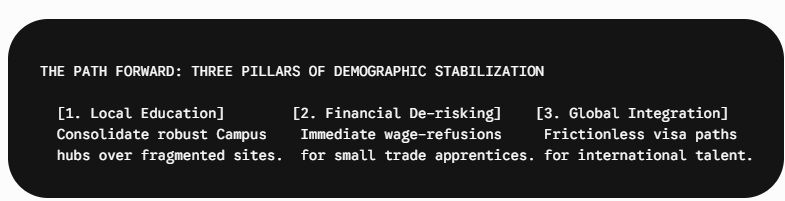
A coherent approach should be built around three pillars:
1) Consolidate Education into High-Quality “Campus” Models
Denmark should avoid spreading scarce educational capacity across too many low-enrolment tracks. Where youth declines are severe, the objective must be sustainability and quality—not proximity alone. Regional campus models can bundle vocational and academic pathways into hubs that remain attractive to students and capable of supporting richer training environments.
This is also an economic governance issue: quality education hubs reduce the “gravity” of youth outflow toward Copenhagen and Aarhus by ensuring regional destinations remain credible and connected to local employers.
2) De-Risk Apprenticeships for SMVs
“More programmes” is not the same as “better outcomes” when firms face cash-flow strain and coordination delays. Denmark’s policy agenda should focus on operational bottlenecks:
- streamline apprenticeship reimbursements (AUB) so wage-refusions reduce monthly liquidity pressure for small employers;
- assign dedicated vocational coordinators who actively bridge schools and local businesses; and
- treat junior trade pipelines as system infrastructure rather than isolated initiatives.
This is where Denmark’s political realism matters: if the smallest firms drop out of training because it becomes administratively or financially unworkable, the demographic deficit will translate into reduced trade capacity—region by region.
3) Build a Purpose-Built International Recruitment Pipeline
Even with optimal domestic adjustment, a birth deficit cannot be fully offset by labour-market participation alone. International recruitment—especially EU tradespeople and skilled vocational talent—should be handled as an economic capability requiring speed and predictability.
That means lowering administrative friction for recruiting and hiring small and medium-sized enterprises, accelerating visa processing where appropriate, and strengthening pathways for international students to remain and contribute after graduation. The aim is not “substitution” for domestic training; it is risk management for a labour system under demographic stress.
Strategic implication: Denmark’s choices will shape whether the next decade is characterised by resilient regional economies—or a widening divide where peripheral municipalities hollow out.
Conclusion: Demographics Are Not Destiny—But They Are Timing
Denmark’s projected decline of roughly 66,000 youth aged 16–25 by 2036, affecting 96 out of 98 municipalities, places the country at a critical juncture. The risk is not simply fewer workers; it is a breakdown in the education-to-employment machinery that sustains local industry and municipal care capacity.
Denmark has shown it can adapt—through higher senior employment and policy reform. Yet adaptation must be more structural than reactive. The coming decade demands a combined agenda: scalable education infrastructure, de-risked apprenticeships for SMVs, and an internationally competitive talent pathway designed for real-world hiring constraints.
Those who treat the youth deficit as a budgeting item may still survive the headline numbers. Those who treat it as a systems transformation will be better positioned to protect living standards, regional economic vitality, and Denmark’s long-standing model of trust between society, business, and the state.
1. Consolidate Education via Regional “Campus” Models
Rather than spreading resources thinly across underpopulated areas—such as the government’s proposed plan to build new, miniature educational tracks in every town with over 10,000 residents—policymakers must focus on quality over sheer proximity. SMVdanmark actively advocates for merging vulnerable regional programs into centralized, sustainable “Campus solutions.”
By bundling diverse vocational and academic paths into fewer, high-quality, and socially vibrant hubs, municipalities can create the attractive youth environments necessary to prevent students from fleeing to Aarhus or Copenhagen.
2. De-risk the Apprenticeship Pipeline for SMVs
The newly introduced “Junior Master Apprenticeship” (juniormesterlære) program—which allows 8th and 9th graders to spend up to two days a week training directly inside a local business—holds immense potential. However, a March 2026 member survey shows that small businesses feel structurally abandoned by local school boards regarding coordination and red tape.
To unlock this pipeline, municipalities must establish dedicated, proactive vocational coordinators to bridge the gap between public schools and local shops. Furthermore, the state must modernize the apprentice financial framework (AUB), introducing immediate monthly wage-refusions to alleviate cash-flow friction for businesses with fewer than ten employees.
3. Build a Dedicated Pipeline for Foreign and EU Labor
Even with optimal domestic optimization, the mathematical reality of Denmark’s birth deficit means international recruitment is no longer optional. The government must introduce frictionless, fast-track visa processing specifically tailored for small and medium-sized enterprises. This includes reducing administrative burdens for recruiting skilled EU tradespeople and actively incentivizing international students to remain in the Danish labor market post-graduation.
Ultimately, Denmark’s looming youth deficit is less an unmanageable crisis and more a challenge of resource allocation. By shifting from reactive stopgaps to structural upgrades in urban planning, vocational funding, and targeted migration, Denmark can transform its shrinking demographic realities into a lean, highly automated, and resilient modern economy.
Editorial Outlook: The Next Chapter for a Follow-Up Article
A strong follow-up topic would be: “From Apprenticeship to Resilience: How Denmark Can Build a Regional Talent System that Works Under Demographic Decline.” The follow-up should examine:
- which municipal governance models most effectively align schools, employers, and training capacity;
- how “campus” consolidation can be designed without undermining social cohesion and access;
- the measurable impact of AUB and other financial mechanisms on SMV willingness to train; and
- how international recruitment can be integrated in a way that preserves apprenticeship culture rather than replacing it.
This would turn demographic analysis into a practical investment-and-policy blueprint—ideal for executives deciding where to allocate resources and influence.
onnect With Nordic Business Journal
For further insights, policy dialogue, and partnerships, connect with Nordic Business Journal. Join discussions with executives, investors, entrepreneurs, and policymakers on how the Nordics can strengthen competitiveness, manage risk, and build durable growth in a rapidly changing global environment.
References
OECD (2026). OECD Economic Surveys: Denmark 2026. OECD Publishing. – https://www.oecd.org/content/dam/oecd/en/publications/reports/2026/01/oecd-economic-surveys-denmark-2026_985d3771/3d6cb4b8-en.pdf (accessed 9th June, 2026)
United Nations Economic Commission for Europe (2022). Denmark’s National Follow-up to MIPAA20.
Health Systems Facts (2025). Denmark: Aging.
Euro found (2004). The workplace of the future – managing the challenge of an ageing workforce. https://www.eurofound.europa.eu/en/publications/all/workplace-future-managing-challenge-ageing-workforce (Accessed 09th June 2026)
Northern Horizon Capital (2025). Securing the Future of Elderly Care in Denmark.