Global markets recently surged following unexpected U.S. diplomatic breakthroughs regarding Iran. However, European and Nordic leaders remain deeply skeptical. Consequently, the region is accelerating its strategic autonomy. This shift reflects a profound change in transatlantic relations. Europe now views the United States as an unpredictable partner. Therefore, long-term planning in Brussels and Copenhagen ignores Washington’s signals. Instead, the focus rests on structural insulation and regulatory sovereignty. This strategy fundamentally reshapes the global investment landscape.
Market Reactions to Geopolitical Shifts
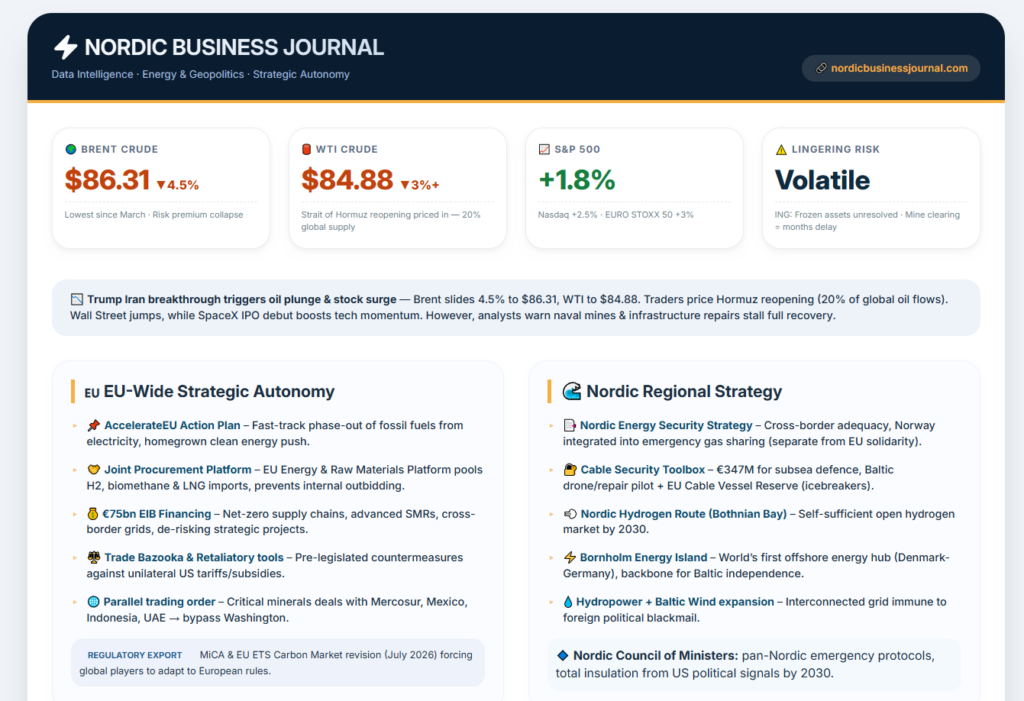
Global oil prices plunged sharply after the recent Iran peace announcement. Brent crude dropped roughly 4.5 percent to $86.31 per barrel. Similarly, U.S. West Texas Intermediate fell over 3 percent to $84.88. This correction erased a severe geopolitical risk premium. Traders aggressively priced in the reopening of the Strait of Hormuz. This vital chokepoint handles twenty percent of global oil supply. Meanwhile, equity markets responded with robust gains. Wall Street’s S&P 500 jumped 1.8 percent. Furthermore, the tech-heavy Nasdaq soared 2.5 percent. European indices like the EURO STOXX 50 also rallied 3 percent. Easing inflation fears and a highly anticipated SpaceX IPO sustained this momentum. Nevertheless, analysts from firms like ING urge caution. They note that market volatility remains high. Tehran has publicly emphasized that frozen asset terms remain unresolved. Moreover, experts warn that repairing damaged infrastructure will take months. Thus, Iranian oil flows will not recover immediately.
The EU-Wide Blueprint for Energy Security
The European Union has implemented concrete strategies to bolster energy security. This pivot reduces reliance on volatile transatlantic politics. The European Commission recently launched the AccelerateEU Action Plan. This initiative aggressively phases out fossil fuels from electricity production. It fast-tracks homegrown, clean energy alternatives. Additionally, the EU Energy and Raw Materials Platform pools European buying power. This mechanism allows member states to import hydrogen, biomethane, and liquefied natural gas collectively. Consequently, it prevents internal outbidding and reduces dependence on single suppliers. Furthermore, the European Investment Bank Group has unlocked €75 billion in financing. This capital is earmarked exclusively for net-zero supply chains. It also de-risks advanced nuclear Small Modular Reactors and cross-border grids. Therefore, Europe is building a resilient, self-sufficient energy architecture.
Route to Autonomy – the Nordic appraoch
The Nordic region is pursuing a parallel path toward strategic autonomy. The Nordic Council of Ministers formalized cross-border adequacy protocols. This framework integrates Norway into a pan-Nordic emergency gas sharing network. Crucially, this operates separately from the EU standard solidarity mechanism. Moreover, the region launched the Cable Security Toolbox. Backed by a €347 million budget, it defends critical subsea infrastructure against sabotage. This includes a dedicated Baltic Sea drone repair pilot. It also features plans for an EU Cable Vessel Reserve Fleet. Meanwhile, construction began on the Nordic Hydrogen Route in the Bothnian Bay. This project builds a self-sufficient, open hydrogen market by 2030. Additionally, Denmark and Germany signed a historic funding agreement. They will build the Bornholm Energy Island. This will serve as a major backbone for Baltic electricity. Thus, the Nordics are securing independent energy flows.
The Architecture of Post-Trump Transatlantic Signaling
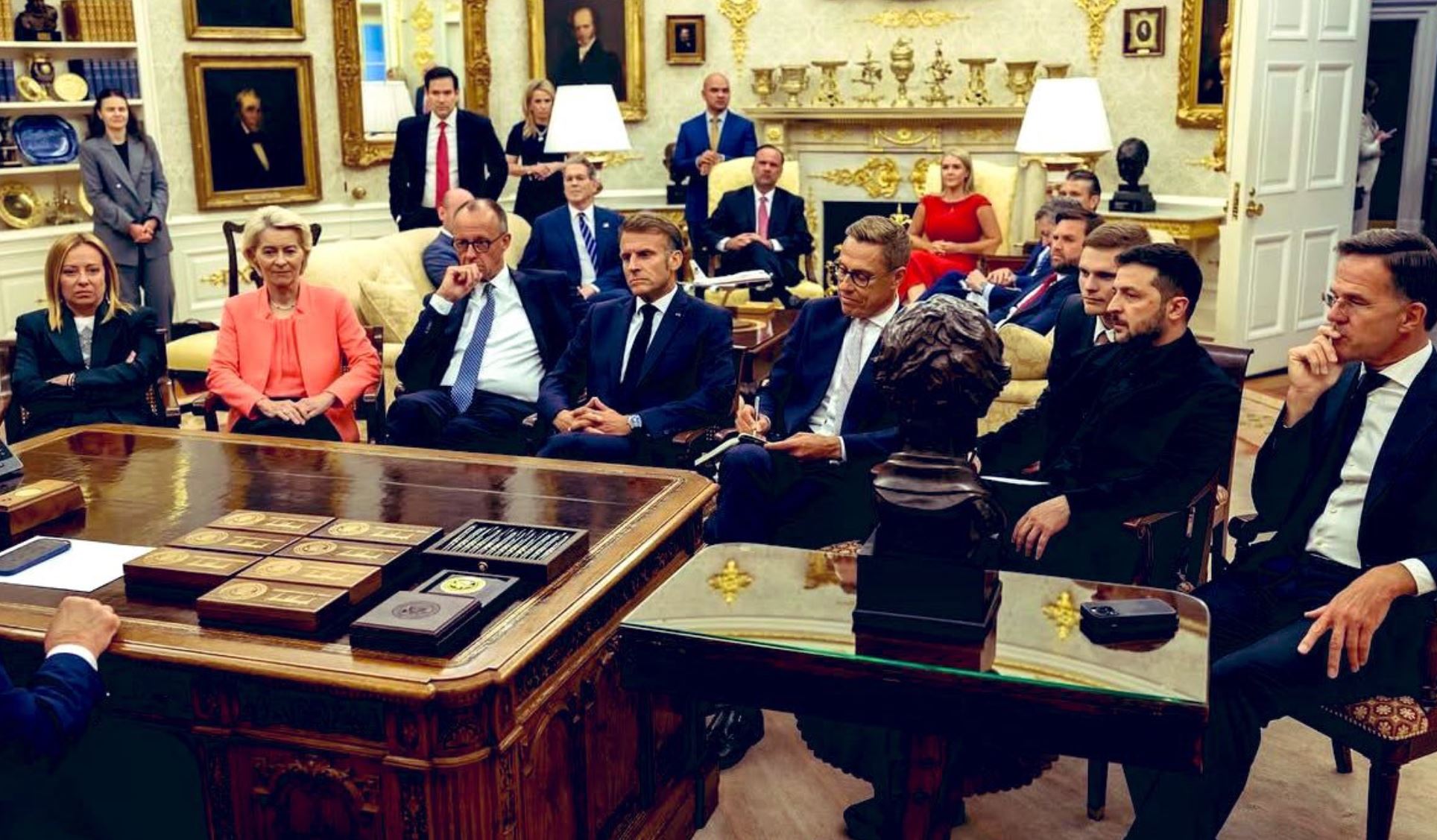
Future EU-U.S. relations will resemble a deeply transactional partnership. Structural hedging will replace unconditional trust. European nations will not rely on American political signals for long-term planning. Instead, the U.S. is now viewed as an unpredictable market participant. The diplomatic framework is shifting toward verification and isolation. Previously, Washington used defense guarantees to extract economic concessions. However, the EU has now fortified its own trade defenses. Future U.S. signals regarding tariffs will face immediate European retaliatory mechanisms. Furthermore, long-term planning on both sides is fundamentally diverging. The U.S. continues to expand fossil fuel exports. Conversely, Europe remains firmly committed to the European Green Deal. Consequently, corporate investments will signal entirely different strategic directions.
Short-Term Dependencies Versus Long-Term Insulation
European markets currently face forced entanglement due to recent treaties. Specifically, the Turnberry Trade Agreement binds the EU to U.S. energy supplies. This mandates purchasing $750 billion in liquefied natural gas and nuclear technology by 2028. Therefore, European think tanks warn of a new dependency swap. The continent has merely traded Russian risk for American volatility. Short-term gas pricing remains tightly bound to U.S. export terminals. However, long-term planning extends far beyond these temporary constraints. Nordic and EU policymakers are now focusing entirely on strategic insulation. The Nordics are leveraging domestic hydropower and Baltic wind expansions. They are building an interconnected grid immune to foreign political blackmail. Additionally, the EU is building a parallel multilateral trading order. It is finalizing trade agreements with Mercosur, Mexico, Indonesia, and the UAE. Thus, European supply chains will remain intact regardless of U.S. politics. Finally, Europe is exporting its own regulatory sovereignty. Frameworks like the Markets in Crypto-Assets regulation enforce European rules globally. Similarly, the upcoming July 2026 EU Emissions Trading System revisions will compel global adaptation. American companies must adapt to access the single market.
Strategic Perspective
The era of unconditional transatlantic trust has definitively ended. Europe and the Nordics are actively rewriting the rules of engagement. This strategic pivot prioritizes resilience over convenience. Investors must recognize this profound structural shift. Capital allocation will increasingly favor projects aligned with European regulatory sovereignty. Meanwhile, companies relying on U.S. political stability face elevated risks. The Nordic model of cross-border cooperation offers a compelling blueprint. It demonstrates how regional integration can neutralise external geopolitical shocks. Ultimately, strategic autonomy is no longer a theoretical concept. It is the foundational pillar of future European economic policy.
Editorial Outlook: The Next Frontier of Regulatory Arbitrage
Future coverage will examine how multinational corporations navigate this new regulatory divide. As the EU enforces stricter carbon and digital governance, companies face a critical choice. They must adapt global operations to European standards or risk market exclusion. We will analyze case studies of global tech firms. They are restructuring data architectures to comply with 2026 EU mandates. Furthermore, we will explore how Nordic fintech and cleantech sectors capitalize on this divergence. They are capturing global market share through early compliance. This analysis will provide actionable intelligence for executives managing cross-border strategic positioning.
Connect with Nordic Business Journal
Access premium insights directly from the Nordic Business Journal. We deliver rigorous analysis on geopolitics, sustainability, and investment trends. Join our network of senior executives, policymakers, and global investors. Subscribe to our weekly executive briefing for exclusive market intelligence. Alternatively, contact our partnerships team to explore bespoke sponsorship opportunities. Together, we can shape the future of Nordic and international business dialogue.Reference List
Ainger, J. (2026) ‘EU Grows Wary of a Growing Reliance on US Energy’, Bloomberg, 28 January. Available at: Bloomberg (Accessed: 13 June 2026).
Capital Economics (2026) ‘Crazy Irish GDP numbers; “ethical” US tariffs?’, Europe Economics Weekly, 5 June. Available at: Capital Economics (Accessed: 13 June 2026).
European Commission (2025) Accelerating our critical raw materials strategy to adapt to a new reality, COM(2025) 945 final. Brussels: European Commission. Available at: EUR-Lex (Accessed: 13 June 2026).
European Commission (2026a) EU Energy and Raw Materials Platform. Directorate-General for Energy. Available at: European Commission DG Energy (Accessed: 13 June 2026).
European Commission (2026b) EU Emissions Trading System (EU ETS). Climate Action. Available at: European Commission Climate Action (Accessed: 13 June 2026).
Foreign Affairs (2026) ‘Europe Is Stuck With America’, Foreign Affairs, 6 April. Available at: Foreign Affairs (Accessed: 13 June 2026).
ING (2026) ‘The Commodities Feed: Oil falls as Trump signals deal with Iran is close’, ING Think, 23 February. Available at: ING Think (Accessed: 13 June 2026).
Nordic Council of Ministers (2026) Nordic Energy Research 2026: Cross-border adequacy and grid protocols. Copenhagen: Nordic Council of Ministers Secretariat. Available at: Nordic Cooperation (Accessed: 13 June 2026).
Puzder, A. (2026) ‘”A deal is a deal,” Trump’s ambassador tells EU’, POLITICO Europe, Interviewed by Politico Staff, 23 April. Available at: POLITICO (Accessed: 13 June 2026).
Corresponding In-Text Citations (Examples)
Relating to oil market movements: …crude benchmarks collapsed by over 4% directly following the white house signals (ING, 2026).
As for transatlantic energy dependency: …the structural reliance locked in by the Turnberry golf course negotiations has forced a $750 billion dependency pivot toward US suppliers (Ainger, 2026; Foreign Affairs, 2026).
In relations to the European autonomous mechanisms: …the newly launched collective matchmaking framework helps insulate smaller regional buyers from single-source vulnerabilities (European Commission, 2026a).