
Stockholm—Sweden’s migration authority, Migrationsverket, has confirmed what government officials have been predicting for months: the country’s once-powerful pull for asylum seekers has cooled dramatically. In the first six months of 2025, 7 934 people lodged asylum claims, a 30 % drop compared with the 11 330 who applied during the same period in 2024. The decline is the steepest six-month fall on record outside of the pandemic years, and officials are in no doubt about the driver.
“Sweden’s attractiveness as a recipient country continues to decrease in line with the political reforms implemented in the migration area,” Director-General Maria Mindhammar said in a press release issued Thursday. The statement marks the first time the agency has explicitly linked falling numbers to the centre-right government’s tightening of asylum rules since taking power in late 2022.
What changed?
The headline reforms include:
- Temporary Protection Directive scaled back. Sweden decided last autumn not to extend blanket protection for Ukrainians beyond the EU minimum, meaning new arrivals must apply for regular asylum or move to other EU states.
- Lower welfare benefits. As of January, asylum seekers receive sharply reduced daily allowances and housing subsidies, while work-permit waiting times have been shortened to encourage faster labour-market entry.
- Stricter family-reunification rules. Income requirements were raised to the level applied to labour migrants, blocking many recent refugees from bringing relatives.
- Border controls extended. Spot checks on the Öresund rail link and ferry terminals have become routine, making secondary movements from Denmark and Germany less attractive.
- “Return-first” policy. Police and migration officers now prioritise deportation cases, and voluntary-return grants have been doubled to speed departures.
Mindhammar notes that Sweden is not alone; Denmark and Norway have reported similar, if smaller, dips in 2025 applications. “But Sweden’s policy package is the most comprehensive, so the drop here is proportionally larger,” she told reporters.
Who is no longer coming?
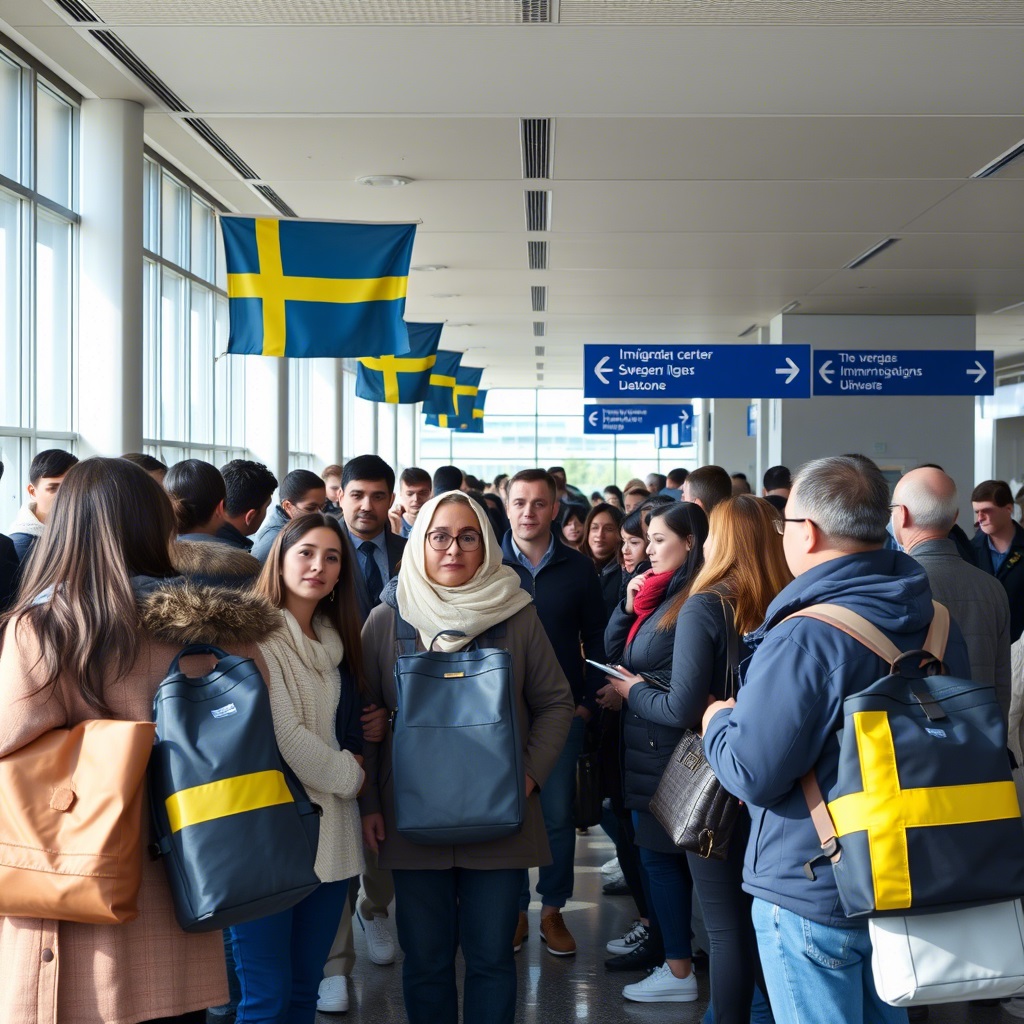
Syrians still top the list—1 540 lodged claims in January–June—but that is down 45 % on 2024. Afghans (-38 %) and Somalis (-27 %) have also fallen sharply. Ukrainian applications collapsed from 2 100 to barely 200 after the government ended automatic residence permits on 1 March. The most telling shift is in unaccompanied minors: only 330 arrived, compared with 900 last year.
Reception centres feel the difference
In Boden, above the Arctic Circle, the large arrival camp that housed 1 800 people last winter now holds 450. “We are mothballing wings and redeploying staff to handle returns,” said camp manager Erik Lindqvist. The agency has closed 11 centres nationwide since March and forecasts a SEK 1.4 billion underspend on migration this year.
Political reactions
Migration Minister Johan Forssell hailed the figures as proof that “Sweden is regaining control of its borders.” The populist Sweden Democrats, whose support underpins the minority government, demanded further cuts, tweeting: “30 % is a good start—let’s make it 50 %.” Opposition Social Democrats warned of “humanitarian blind spots” and called for a parliamentary review of family-reunification restrictions.
Civil-society push-back
The Swedish Refugee Council called the drop “deeply concerning” and warned that many claimants are now taking riskier routes to Germany and the Netherlands. “When legal paths narrow, smugglers fill the gap,” said Secretary-General Sanna Vestin. The Red Cross has documented 40 cases of asylum seekers sleeping rough in Malmö after being denied emergency housing.
Looking ahead
Migrationsverket’s forecast for the full year has been revised downward from 18 000 to 13 000 applications, a level unseen since 2012. Mindhammar cautions that global events could quickly reverse the trend. “A new conflict or intensified fighting in Syria could change everything overnight,” she said. For now, the agency is reallocating resources: two-thirds of asylum case officers will be retrained to handle labour-migration permits, reflecting a deliberate pivot from humanitarian protection to skills-based recruitment.
In the words of one migration analyst, “Sweden has swapped the welcome sign for a skills CV.” Whether the country’s labour market—and its humanitarian reputation—can handle the trade-off is the next question policymakers will have to answer.