
Sweden, long known for its neutrality, is undergoing a remarkable transformation as its defence industry powers forward at an unprecedented pace. Nowhere is this acceleration more palpable than in the small, pine-wrapped city of Karlskoga, where factories like Nammo are in the midst of a production frenzy—part of a wider surge fuelled by geopolitical instability and unprecedented government investment.
A Surge Rooted in Uncertainty
The tremors from the war in Ukraine and mounting international tensions have shaken Europe’s sense of security. For Sweden, these shocks have translated into action: defence spending is now rising faster than at any point since the Cold War. In 2024, Sweden allocated roughly 2.2% of its GDP to defence—up from 1.5% just a year prior. With an injection of SEK 25 billion ($2.2 billion) per year under the latest national framework and legislative pledges of SEK 300 billion more over the next decade, Sweden plans to push spending up to 3.5% of GDP by 2030.
The result? Defense industrial parks like Karlskoga’s Björkborn are humming around the clock. “Pretty much all businesses operating here are building as much as they can,” confirms Björn Andersson, head of business development at Nammo, Sweden’s leading ammunition producer.
Karlskoga at the Heart of the Ammo Race
Karlskoga has long been the beating heart of Swedish armaments, with roots tracing back to legendary munitions maker Bofors. Today, Nammo’s state-of-the-art plant is a centrepiece of Europe’s shell renaissance, specializing in the 155mm howitzer shell—the calibre most coveted on Ukraine’s front lines.
Not long ago, Nammo’s production lines ran mostly during daytime hours. In 2024, faced with an insatiable demand for artillery shells, the factory now operates 24/7. Workers pour explosives into steel casings in an almost ceaseless ballet—while robot arms stand ready to accelerate the pace further. “We are in the middle of a transition, focusing on scaling up production of 155mm shells,” explains Martin Stang, vice president for Nammo’s Swedish operations.
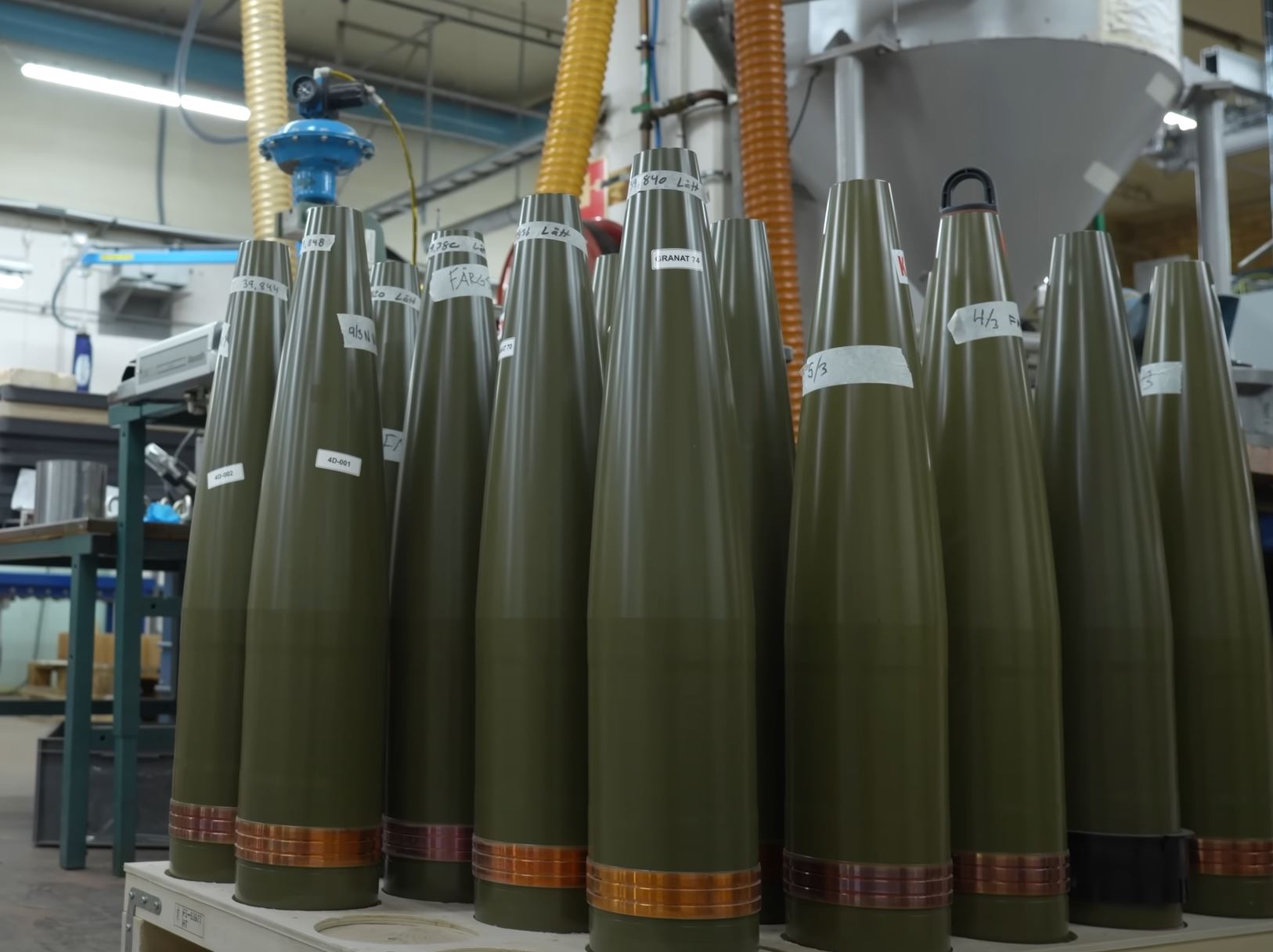
The production goal is nothing short of astounding: Nammo plans to triple its output within two years, backed by sweeping government and EU investment. The European Commission has funnelled €12.2 million into expanding filling capacity, with the Swedish state co-financing to bring total support to around €27 million. At full tilt, this should enable Karlskoga to triple its artillery shell production—an urgent priority both for Sweden’s own defence and continued support for Ukraine.
New Money, Old Legacies
This manufacturing rush isn’t just about modern robotics or government funding. Karlskoga remains a city whose very identity is intertwined with arms production—since the days when Alfred Nobel owned Bofors, up through the Cold War era, and now into the age of hybrid threats and NATO membership. While Saab and BAE Systems Bofors now dominate in other areas (Saab alone saw a 24% surge in order intake in 2024), it is Nammo’s relentless focus on artillery that has drawn global attention.
Challenging the Production Limits
Europe’s decentralized, privately owned defence sector brings unique challenges. Unlike in the U.S., swift ramp-ups require a delicate balance of public investment and private innovation. While other countries may build new production lines from scratch, Karlskoga’s answer has been to modernize and work longer hours with the facilities already in place. “We’re exchanging equipment and tripling capacity,” says Nammo’s Stang, “but for now, no new lines—we do what we can with what we have.”
The Road Ahead
Sweden’s historic defence build-up is not solely a matter of national security; it’s a calculated move to align with NATO standards and supply its European allies. As government, EU, and industry ambitions converge on places like Karlskoga, the city exemplifies how history, innovation, and international priorities are forging a new era in European defence readiness.
With factories working through the night and investment continuing to climb, the workstation lights in Karlskoga may be the brightest in Europe—illuminating not only the future of Swedish defence, but the continent’s capacity to meet the unpredictable demands of a changing world.