
By Our Tech Correspondent
Stockholm, Thursday 7 August 2025
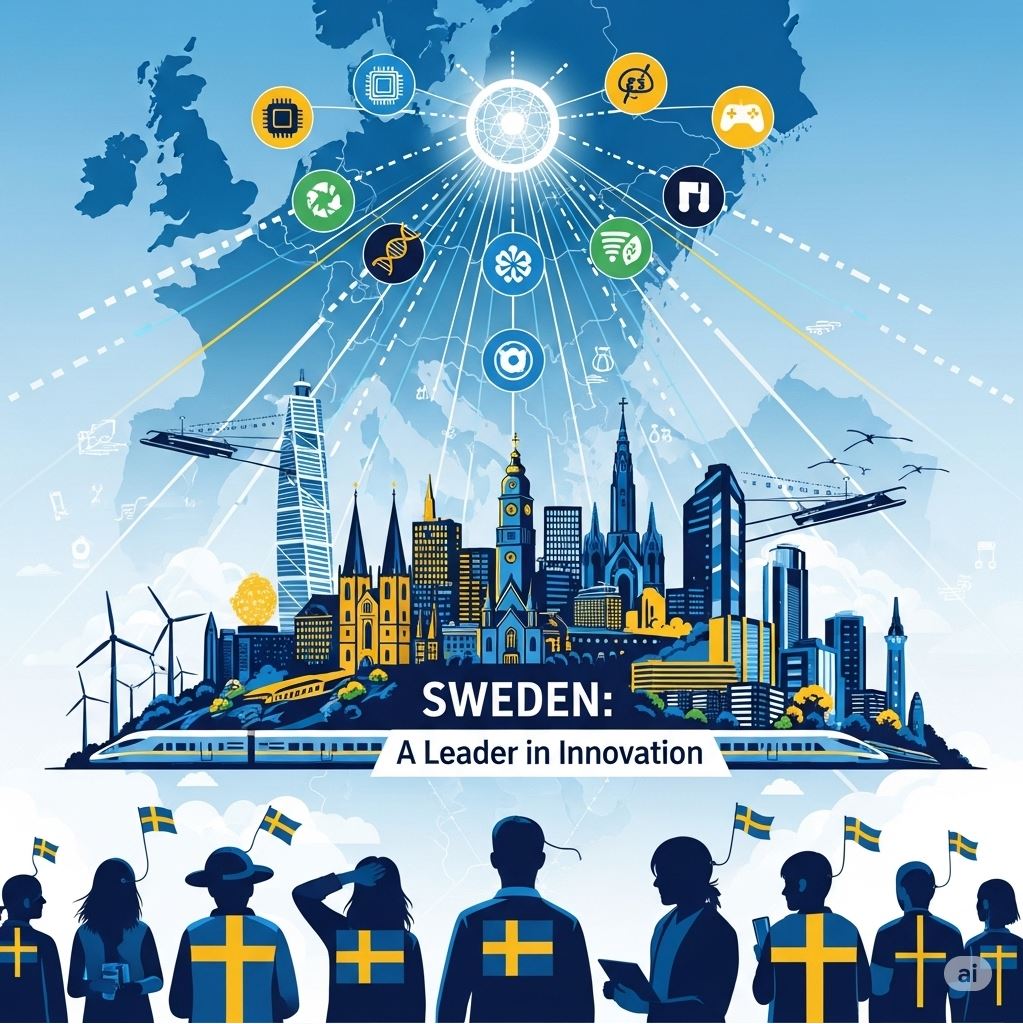
When the American cloud giant Amazon Web Services (AWS) published its annual “AI Maturity Index” this week, one line leapt off the page: Sweden has the highest concentration of artificial-intelligence-native start-ups per capita in the European Union. The finding crowns a decade-long push that began with Spotify’s music-recommendation algorithms and has now spread to everything from fika-serving robots in Lund to generative-AI design tools in Gothenburg.
Yet the same week brought a sobering counterpoint. Google Sweden released a 42-page white paper estimating that outdated digital infrastructure and red tape inside Swedish public administration are costing taxpayers up to 25 billion kronor (≈ €2.3 billion) in unrealised efficiency gains every year. The twin headlines sketch a paradox that is becoming familiar across Europe: while Nordic entrepreneurs sprint ahead in AI, the machinery of the Nordic welfare state lumbers behind.
The AWS report in detail
- Sweden scores 84/100 on AWS’s composite index, six points clear of runner-up Finland and ten points above the EU average.
- 38 % of Swedish start-ups surveyed describe AI as “core” to their value proposition, compared with 24 % in Germany and 19 % in France.
- Investment flow: Swedish AI start-ups attracted €1.4 billion in venture funding in the first half of 2025—already matching the full-year record set in 2023.
- Sector spread: life-science AI (e.g., CellCarta’s pathology models), green-industry optimisation (Northvolt’s battery-factory simulations) and creative AI (KLarna’s shopping assistant, now handling two-thirds of customer queries).
“Stockholm has quietly built the deepest AI talent pool outside London,” says Julien Simon, AWS’s Paris-based VP of AI & Machine Learning. “The difference is that almost every Swedish founder we meet talks first about sustainability and trust, not just growth.”
Three start-ups to watch
- Sana Labs (Stockholm) – corporate learning AI used by H&M and Spotify; valued at $1 billion after a May Series C led by NEA.
- Heart Aerospace (Gothenburg) – hybrid-electric aircraft whose flight-optimisation engine cuts fuel use by 25 %; AI-designed airframe secured 200-plane preorder from United Airlines.
- Imagimob (Kista) – edge-AI platform that shrinks ML models to run on sub-dollar microcontrollers; fresh €20 million round from Molten Ventures.
Google’s wake-up call
Google’s paper, timed to influence the government’s forthcoming National AI Strategy update, argues that Sweden’s public sector could automate 30 % of routine administrative tasks within five years—freeing the equivalent of 75,000 full-time employees—if only legacy IT systems were modernised and data silos opened. The 25-billion-kronor figure combines lower personnel costs, faster benefit processing and reduced fraud in tax, social security and healthcare.
“Swedish agencies collect world-class data, but it is locked in 1970s databases,” says Karin Tammemägi, head of Google Sweden’s public-policy division. “Meanwhile, we have start-ups exporting AI governance tools that our own municipalities can’t legally deploy on their own citizens.”
Political cross-currents
Finance Minister Elisabeth Svantesson welcomed the AWS findings but acknowledged the Google critique. “We will accelerate the Trafikverket model,” she told reporters, referring to the transport agency’s open-data portal that already feeds AI traffic-optimisation start-ups such as Klimato. A bipartisan motion to create a €500 million “AI Modernisation Fund” for local government is expected to reach the Riksdag after the summer recess.
Yet privacy watchdog IMY has warned that any wholesale move to cloud-based AI must first resolve conflicts between GDPR, the upcoming EU AI Act and Sweden’s own Public Access to Information laws. “Innovation and integrity can coexist, but the legislative calendar is tight,” says IMY director-general Lina Nilsson.
Voices from the ecosystem
Daniela Maniaci, co-founder of Sana Labs: “We hire PhDs in machine learning, but our biggest bottleneck today is getting anonymised health data from the regions for medical-education AI. Denmark solved this with one national API—why can’t we?”
Leif Östling, former CEO of Scania and now chair of AI Sweden’s public-private board: “If we fix the data plumbing, Sweden can become the first country where AI actually delivers on the welfare promise instead of just threatening it.”
What happens next?
- 15 August: Government to publish draft AI Act implementation roadmap.
- 2–3 September: Stockholm hosts “Nordic AI Summit” with EU Commissioner Margrethe Vestager keynote.
- October: Pilot programme launching in Gothenburg to let start-ups test municipal-grade language models on anonymised city data.
For now, the world’s investors are voting with their wallets. According to PitchBook, Sweden now hosts five “unicorn” AI companies—more than any EU country except France. Whether those algorithms ever reach the waiting lists at Swedish hospitals and benefit offices is the next chapter in the Nordic AI saga.