
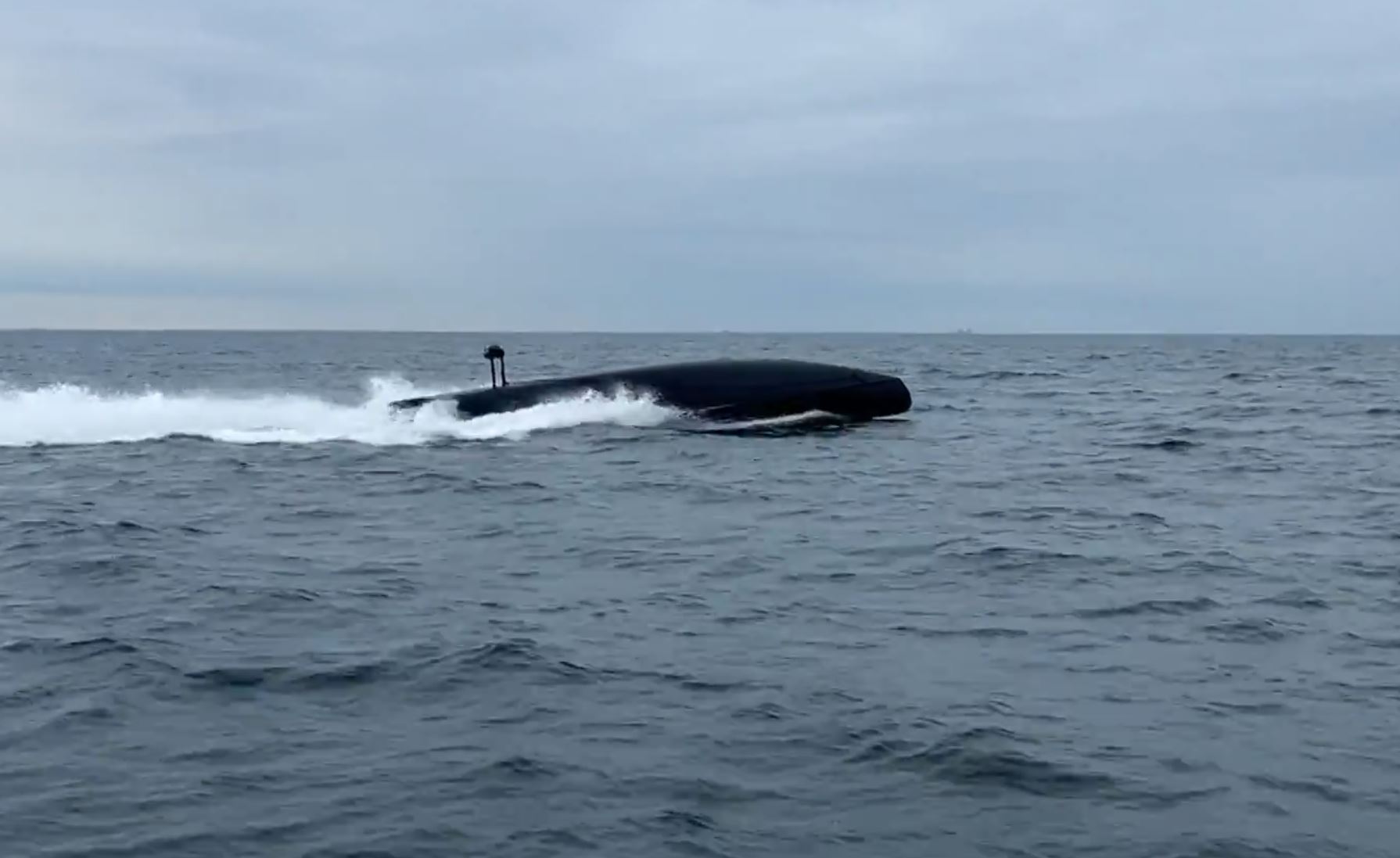
At the Nordic region’s largest arms fair in Ballerup, the Danish company Copenhagen Group pulled the cover off a secret project it has been working on for months: a 13-meter unmanned ocean drone named Orca.
Normally the arena hosts bike races. This week it’s filled with armoured vehicles, weapons displays, and more than 600 defence companies showing off their latest technology to 12,000 expected visitors. For Copenhagen Group, it was the perfect stage to reveal a vessel designed to be fast, heavily equipped, and almost invisible.
A Drone Built for the Shadows
Orca looks like a cross between a kayak and something out of a James Bond film. It can reach 80 kilometres per hour, carry over 800 kilograms of payload, and operate for weeks at sea. Missiles, mines, or surveillance drones can all be mounted depending on the mission.
What makes it stand out, according to CEO Jeppe Handwerk, is stealth.
“The most important thing is not to be detected,” he says. The vessel has been engineered to slip past both the naked eye and modern sensor systems.
Eyes on Denmark’s Waters
Handwerk describes Orca as Denmark’s first military drone of this scale, built specifically to guard national waters. Its role is less about direct attacks and more about deterrence and surveillance.
“It’s a bit like a police speed trap,” he explains. “If we’re out there, people behave differently.”
Equipped with sensors above and below the surface, Orca can loiter quietly for up to three weeks, watching over shipping routes, cables on the seabed, and critical infrastructure.
Lessons From Ukraine, But Different Goals
Sea drones have already proven their value in Ukraine, where they’ve been used to hit Russian helicopters, strike the Kerch Bridge, and ram ships in the Black Sea. Orca could theoretically be used in similar ways, but that isn’t Copenhagen Group’s aim.
“We think differently,” Handwerk says. “Ukraine uses drones for direct combat. In Denmark, we’re focused on monitoring, protecting, and controlling what happens in our waters.”
Built in a Windmill Factory
Although Orca is unmanned, it requires an operator who controls it remotely, navigating by camera as if on board. The technology behind it isn’t revolutionary, Handwerk admits, but rather a smart assembly of proven systems.
The prototype was developed in just nine months with help from the Danish Technological Institute, the University of Southern Denmark, and partners including Norway’s Radionor and Microsoft. Production took place in a Danish wind turbine factory—a deliberate choice so the process can be scaled and replicated abroad.
“If you can build wind turbine blades, you can build this,” Handwerk says.
More to Come
Copenhagen Group is already working on two larger versions of the Orca, the biggest capable of carrying up to 8,000 kilograms. Prices and development costs remain under wraps, but Handwerk is confident there will be buyers both in Denmark and overseas.
Bottom line: Denmark now has a new player in the fast-growing field of autonomous naval systems, and the Orca is just the beginning.