
Four new subsea links and a Sweden–Finland spur will lift capacity, cut latency, and harden the Nordics’ digital backbone.
Here’s what matters. GlobalConnect is building four new fibre cables across the Baltic Sea that, together with a separate Sweden–Finland project via Åland, will create a 1,250-kilometre ring tying Sweden, Finland and Estonia into one resilient loop. The company says the build targets a sharp rise in traffic from large data centres and AI hubs across the region.
What’s being built
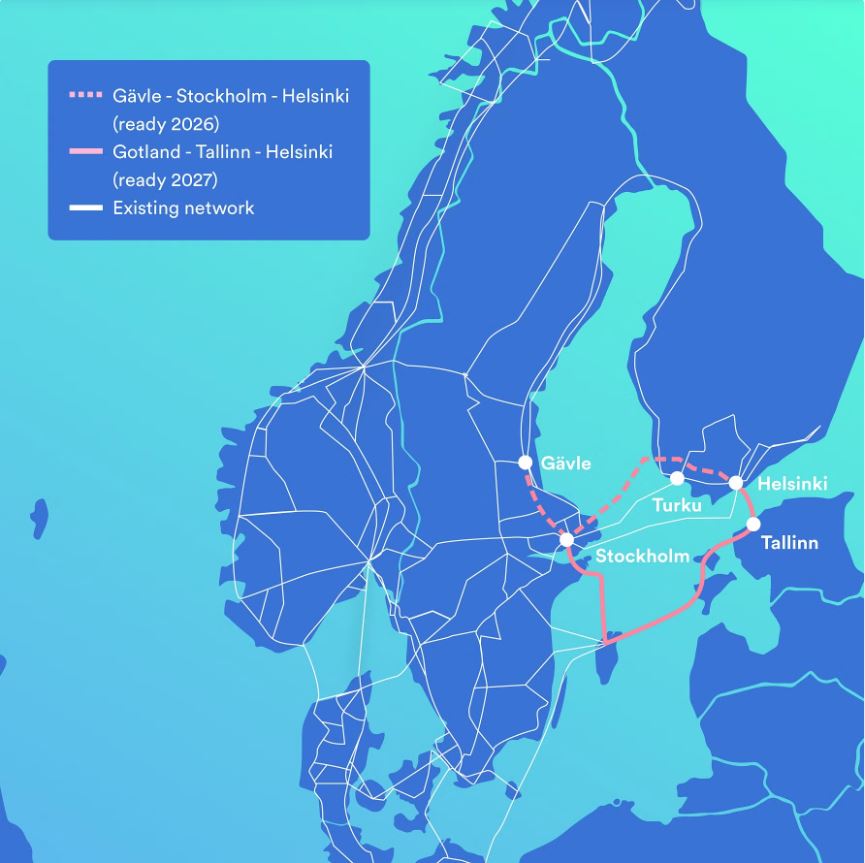
The Baltic project adds roughly 300 km of new subsea fibre and ~250 km of terrestrial routes in Estonia. The path runs Gotland → Saaremaa → Hiiumaa → Tallinn → Helsinki, opening fresh east–west capacity and route diversity where much of the infrastructure dates back three decades. GlobalConnect pegs the price at ~€40m, including €15m from the EU’s Connecting Europe Facility (CEF2); permitting and surveys are underway and go-live is slated for 2027.
To close the loop, GlobalConnect is also laying a new Sweden–Finland subsea link via Åland with upgraded land routes Helsinki–Turku–Stockholm–Gävle. That ~500 km project (including ~150 km subsea) is budgeted at ~€14m and targets end-2026 service. Together, the two builds form a 1,250 km ring around the northern Baltic.
Why now
In the company’s words: “We’re seeing a rapid increase in the need for secure, high-capacity fiber infrastructure—driven by the fast growth of major data centers and AI hotspots across the region.” That’s Pär Jansson, SVP at GlobalConnect Carrier. The firm also notes the Sweden–Estonia route has been underserved, with legacy infrastructure limiting options.
There’s a resilience angle too. The Baltic has suffered multiple cable and pipeline incidents since 2023, prompting Nordic governments and the EU to harden critical infrastructure and step up monitoring. Swedish authorities said damage to a Sweden–Estonia telecoms line was intentional, while the EU has floated stronger surveillance and a shared repair fleet in response to repeated outages. Redundant paths matter; this ring delivers them.
The business impact
Capacity and reach. GlobalConnect says the new route will boost its capacity on the corridor by about 4x, giving carriers, clouds and content networks more headroom for AI training bursts, inter-DC replication and edge growth. For enterprises, that translates into higher-throughput backhaul and sturdier SLAs.
Latency and diversity. The ring adds non-Copenhagen, non-Stockholm options into and out of the Nordics. Traffic can swing through Gotland and Estonia, or loop via Åland and Sweden, reducing single points of failure and shaving milliseconds on Sweden–Estonia–Finland paths—small numbers that matter for synchronous storage and HPC scheduling.
Public backing. Tallinn and Stockholm have both framed the project as a resilience upgrade with competitiveness upside. The EU co-funding signals alignment with Brussels’ digital-infrastructure priorities and helps de-risk timelines. Expect public-sector traffic (health, education, justice) to follow the new paths as they light up.
How it fits the bigger map
GlobalConnect has been stitching a north-south “Digital Highway” from Berlin to northern Sweden—a multi-year build with five Baltic subsea segments that the company touts as the largest Nordic digital-infrastructure project in a decade. The Baltic ring plugs into that spine, giving Finnish and Baltic capacity more direct on-ramps to Central Europe.
Timeline and key milestones
- 2025: Permitting, land and marine surveys; start of land works.
- 2026: Marine surveys, repeater (ILA) site builds, and sea-cable lay for the Estonia–Sweden–Finland segments; Åland spur targeted to go live by year-end.
- 2027: Final sea lay and Baltic ring go-live.
By the numbers (project scope)
- New build: ~300 km subsea + ~250 km terrestrial (Estonia)
- Route: Gotland → Saaremaa → Hiiumaa → Tallinn → Helsinki
- Total budget: ~€40m (EU CEF2 grant ~€15m)
- Capacity effect: ~4× on the corridor (GlobalConnect estimate)
- Ring length with Åland spur: ~1,250 km
What to watch
Procurement and protection. Final vendor choices, burial depths, and armouring specs will tell you how aggressively the system is engineered against anchors and trawls—non-trivial in the shallow, busy Baltic. Permits and seabed constraints will shape landing points and ILA placement, especially on the Estonian islands. And interconnect policy—how early and openly the operator offers spectrum, dark fibre pairs, or IRUs—will set the tone for carrier and hyperscaler uptake. (The broader policy push to monitor and quickly repair undersea assets should help once the system is live.)
Bottom line: the Nordics are building for the workloads they’re courting. A ringed Baltic with multiple fresh paths is exactly the kind of boring, essential plumbing that makes ambitious AI roadmaps and cross-border cloud growth feasible. If you run latency-sensitive or high-throughput infrastructure in Sweden, Finland, or Estonia, this is real capacity you can plan against.