
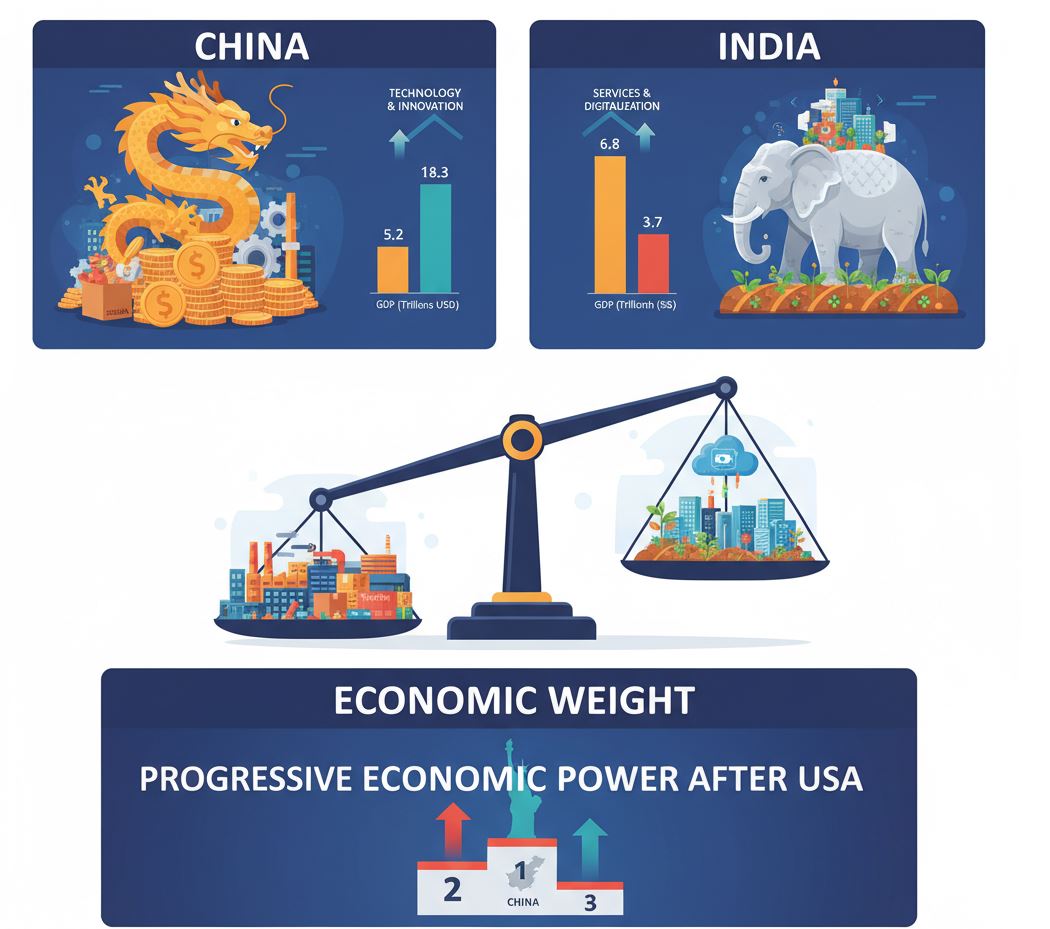
In recent decades, the global economic landscape has witnessed a dramatic shift, with China rapidly emerging as the second-largest economy in the world. This transformation has prompted significant debate about the effectiveness of “communism” versus “capitalism,” particularly in the context of China’s economic rise compared to India, a fellow populous nation that follows a capitalist model. While both countries share historical, demographic, and geographical similarities, their respective political and economic systems have led to divergent paths of development.
The Rise of China: A Case for Communist Success?
For many, China’s economic trajectory seems to defy traditional critiques of communism. Historically, communism has been associated with inefficiency, economic stagnation, and a lack of innovation. However, China’s exceptional growth over the past four decades—fuelled by rapid industrialization, massive state investment, and an export-driven model—has challenged this narrative. In fact, China’s economy has been growing at an average rate of 6-8% annually since the 1980s, and it is poised to surpass the U.S. as the world’s largest economy within the next decade.
China’s success lies, in part, in its unique form of socialism—often referred to as “socialism with Chinese characteristics.” Under the leadership of the Chinese Communist Party (CCP), China has embraced elements of capitalism, such as private enterprise, foreign investment, and market-driven reforms, while maintaining tight state control over key industries and strategic sectors. This hybrid model, sometimes termed “authoritarian capitalism,” allows the government to maintain a strong grip on the economy while fostering growth and innovation.
The state’s ability to direct and allocate resources efficiently has been pivotal. For example, China has invested heavily in infrastructure, technology, and manufacturing capacity, making it a global leader in industries like electronics, steel, and renewable energy. Furthermore, the Chinese government has managed to keep a firm hand on its banking system and key economic policies, enabling it to weather global financial crises more effectively than many Western economies.
India’s Capitalist Struggles: A Democratic Paradox
On the other side of the economic divide, India, the world’s largest democracy, follows a capitalist economic model. Despite its democratic framework and capitalist policies, India has lagged behind China in terms of economic growth. India’s economy, while large and diverse, has struggled with a number of challenges, including bureaucratic inefficiency, infrastructure deficits, political instability, and regulatory red tape. While India has made substantial strides in sectors like technology and services, its industrial base remains underdeveloped, and its poverty rates remain stubbornly high.
One of India’s primary challenges lies in its complex political system. While democracy is essential for political freedoms, India’s multi-party system and decentralized decision-making process can lead to slow policy implementation and inconsistent economic strategies. This is in stark contrast to China, where the CCP’s centralized authority allows for more decisive and long-term planning. Additionally, India’s political structure often results in policies that benefit specific regions or interest groups, impeding broader national progress.
Furthermore, India’s capitalist economy faces a number of obstacles, such as corruption, an underdeveloped banking system, and reliance on foreign capital. Unlike China, which has been able to generate enormous amounts of domestic capital through state-owned enterprises and state-backed companies, India struggles with insufficient investment in infrastructure and manufacturing.
The Role of Autocracy: Does It Matter?
A significant question in this debate is whether it is right to separate communism from autocracy and dictatorship. After all, while China is a communist state, it is also a one-party autocracy with little room for political opposition or civil liberties. In contrast, India, as a democracy, embraces individual freedoms, but its economic system is largely capitalist, with elements of protectionism and state intervention in certain sectors.
The notion that autocracy inherently leads to better economic outcomes has been debated for decades. Autocratic regimes, particularly those with centralized power like China, can often enact sweeping economic reforms without the delays or opposition that might come with a democratic system. China’s centralized decision-making allows for rapid policy changes, such as large-scale infrastructure projects or state-sponsored innovation in technology and manufacturing. In India, however, decision-making is often slower, as it must navigate political coalitions, bureaucratic hurdles, and regional disparities.
Yet, autocracy does not guarantee economic success. Many autocratic countries, such as Russia, Venezuela, and several nations in Africa, have failed to achieve the kind of growth seen in China. What sets China apart is not merely its autocratic political system, but its ability to combine central control with market reforms. By fostering a pragmatic approach to economics—one that includes foreign investment, open markets, and technological innovation—China has harnessed the strengths of both communism and capitalism.
Is Capitalism the Culprit in India’s Slower Growth?
India’s slower pace of economic growth compared to China raises questions about the merits of capitalism as an economic system. While capitalism has led to innovation, entrepreneurship, and wealth creation in some countries, it can also create inequality and social divisions, particularly in large, diverse societies like India. Capitalism, when not effectively managed, can lead to concentration of wealth in the hands of a few, leaving large segments of the population marginalized.
Moreover, India’s capitalist system has been hindered by inconsistent policies, regional disparities, and entrenched social hierarchies, such as caste-based inequality. These factors can make it difficult for India to achieve the scale and speed of growth seen in China. In contrast, China’s government, with its top-down approach, has been able to prioritize national unity and economic development, often overriding short-term individual interests for the sake of long-term prosperity.
How Americans Perceive Socialism and Communism: The Case of Zohran Mamdani and the Chinese Model
In the United States, the terms “socialism” and “communism” are often loaded with historical baggage, shaped by decades of the Cold War and an entrenched opposition to both ideologies. The way these terms are used in political discourse—especially when applied to political candidates like the New York mayoral candidate Zohran Mamdani, who is being called a communist—raises important questions about how Americans view these ideologies and whether the label “communist” always carries the same meaning.
Conclusion: Who’s Winning the Economic Race?
The debate between socialism and capitalism, or in this case, communism versus capitalism, is not a clear-cut dichotomy. China’s model of state-controlled capitalism has proven highly effective in fostering rapid growth, while India’s capitalist system has faced numerous challenges. While China’s authoritarian structure has been pivotal in maintaining economic stability and directing resources, India’s democratic system offers freedoms and checks that many argue are essential for long-term sustainability.
In the end, the question of who is “winning” in this economic race is complex. China’s rapid growth and technological advancements have positioned it as a global economic powerhouse, yet its model may not be easily replicable elsewhere. India, with its democratic system, faces unique challenges, but its capitalist model could potentially lead to greater innovation and equity if it can overcome its structural issues.
Ultimately, this debate underscores the importance of pragmatic, context-specific solutions. There is no one-size-fits-all answer to whether communism or capitalism is the superior economic system. Instead, the focus should be on adapting policies that work for each nation’s unique circumstances—combining the best elements of both systems, as China has done, while ensuring sustainable and inclusive growth, as India strives to achieve.