
As drones increasingly pose a significant threat to military assets and critical infrastructure worldwide, Nordic Air Defence (NAD), a recently founded company, is stepping up to the challenge. The innovative company is developing a cutting-edge anti-drone system called Vipro. Unlike traditional air defence systems, Vipro uses small homing “interceptors” to neutralize drone threats, and the system has now evolved into a truck-mounted concept through collaboration with Volvo Defence. This joint venture is set to reshape how defence forces combat the growing menace of unmanned aerial vehicles (UAVs) across global conflict zones, including the ongoing conflict in Ukraine.
The Vipro Anti-Drone System: A Revolutionary Approach
The Vipro system is composed of four key components designed to detect, track, and neutralize drones with high precision and efficiency.
- Long-Range Radar Panels: The system’s radar panels provide early detection, enabling long-range identification of incoming threats.
- Targeting Camera: Once a potential target is detected, a camera system locks onto it. The camera is capable of distinguishing between drones, birds, and other aerial objects, ensuring that only relevant threats are targeted.
- Human Operator or Autonomous Decision-Making: After target identification, the system can either relay the information to a human operator for intervention or autonomously make the decision to fire based on preset criteria.
- Interceptor Launch Mechanism: The final component of the system is the interceptor itself, which is a small, electric-powered, and propeller-driven vehicle that neutralizes the drone using kinetic force. The interceptor is housed in a compact, smaller firing system than traditional weapon stations.
An Innovative Interceptor with Precision and Autonomy
The Vipro interceptors are anything but ordinary. They do not feature rocket engines or explosive warheads like traditional missiles; instead, they rely on kinetic energy to take down their targets. The interceptor is powered by an electric motor and propeller, and its deployable wings allow it to maintain stability in flight. Upon launch, the interceptor uses the radar system’s target coordinates to plot its trajectory, and once it nears the target, its onboard homing system takes control. Powered by two batteries, the interceptor can chase its target for up to ten minutes, operating autonomously without reliance on GPS or radio signals, which could be jammed or disrupted in a conflict zone.
“We wanted to create a system that could work even in environments where communication networks are compromised,” says Nicholas Högasten, NAD’s product manager. “The Vipro system allows for autonomous operation, so the target is decided before launch, and the interceptor handles the rest.”
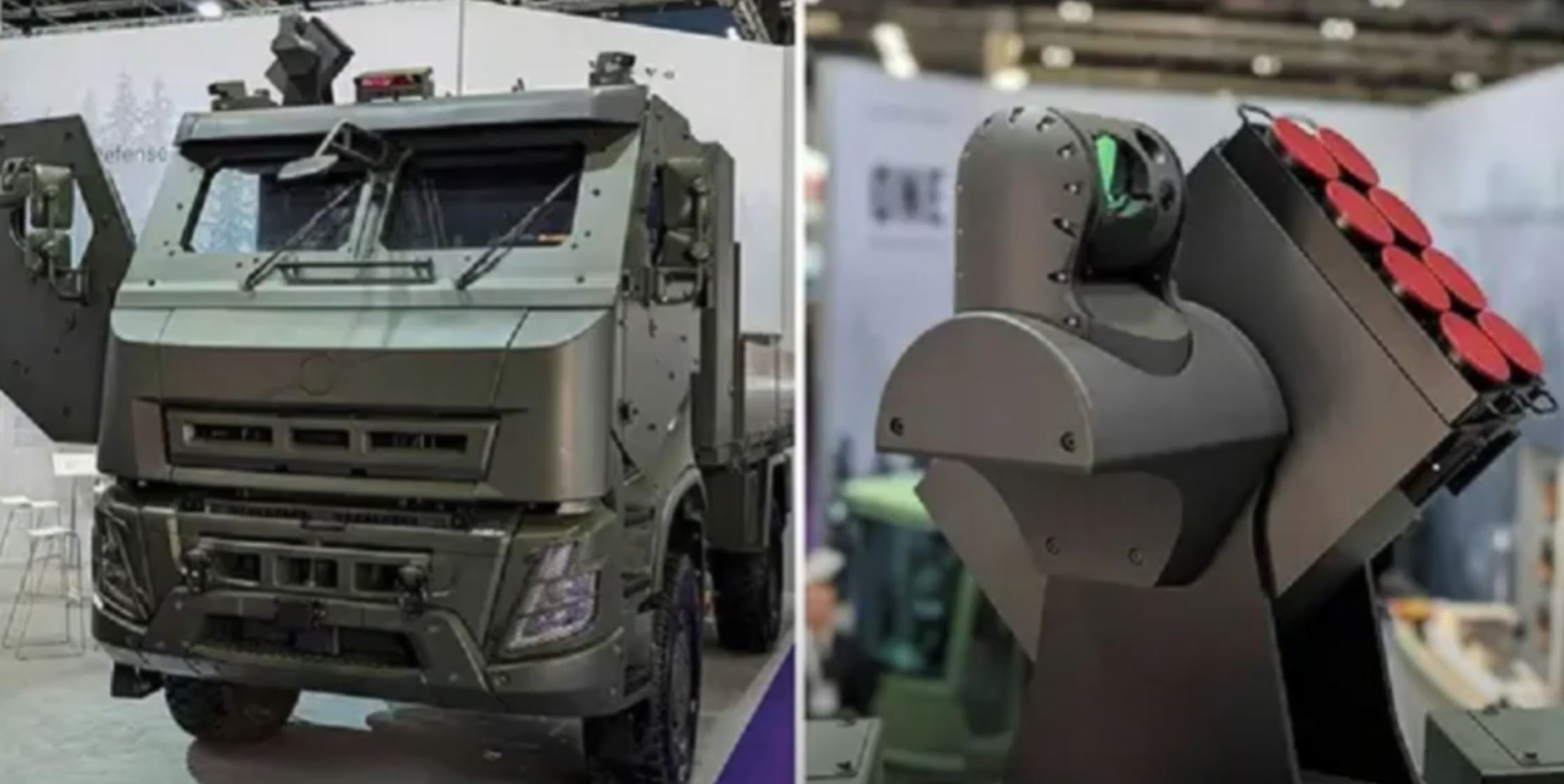
Collaboration with Volvo Defence: Bringing Vipro to the Battlefield
In response to the rising threat of drone attacks on military and civilian infrastructure, NAD is collaborating with Volvo Defence to create a truck-mounted version of the Vipro system. This integration is designed to offer flexibility and mobility, allowing military forces to deploy anti-drone capabilities in unprotected, mobile environments. By mounting the Vipro system on a robust, military-grade Volvo truck, the system can be easily transported and deployed in a variety of operational settings. This collaboration brings together NAD’s innovative technology with Volvo Defence’s expertise in rugged military vehicles.
A Growing Market and Global Demand
The demand for advanced anti-drone systems is rising, especially as small drone threats have become a significant concern for military and civilian security. In Ukraine, for example, drones have proven to be highly effective in targeting both military vehicles and civilian infrastructure. FPV (First Person View) drones, which are equipped with real-time cameras, can carry explosives and are increasingly used by both state and non-state actors. These developments have highlighted the need for effective countermeasures like the Vipro system.
NAD’s business director, Jens Holzapfel, emphasizes the broader applicability of the Vipro system: “We see applications for Vipro beyond military defence. Critical infrastructure, shipping lanes, and even armoured vehicles like tanks, which were once thought to be invulnerable, can benefit from protection against drone threats.”
Future Plans and Production Strategy
As the development of the Vipro system progresses, NAD is preparing for full-scale production. Prototypes are currently being manufactured for testing and demonstration purposes at NAD’s facilities in Solna, Sweden. The company is also gearing up for an investment round to fund the transition from prototype to mass production.
“We’re looking to produce the Vipro system in large volumes, at competitive costs, and with components sourced from suppliers across the Nordic region and Europe,” says Holzapfel. “Our goal is to keep the system efficient and cost-effective, with as many ‘off-the-shelf’ components as possible.”
To conclude, Nordic Air Defence’s Vipro anti-drone system represents a groundbreaking advancement in the defence industry. The collaboration with Volvo Defence to create a truck-mounted version of the system further expands its potential applications, making it more accessible for military forces to deploy in various operational scenarios. With growing concerns over drone threats and the proliferation of FPV drones in modern warfare, the Vipro system could play a key role in protecting critical assets on both the battlefield and at home.
As the company prepares for mass production, its innovative solution may soon become a standard feature in defence strategies worldwide, setting the stage for a new era of counter-drone technology.