
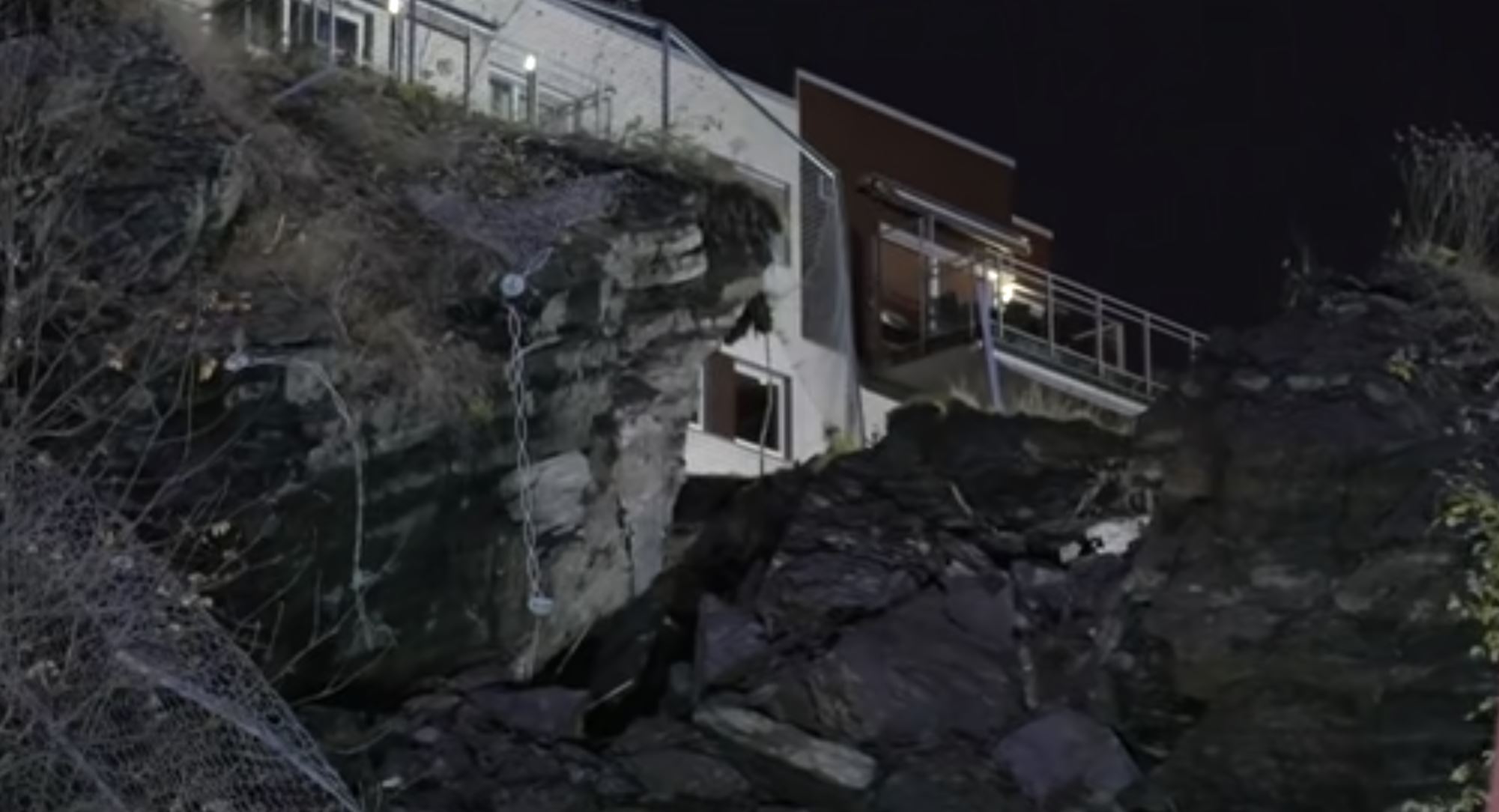
A significant rockfall struck a densely populated residential area near Carl Berners Plass in central Oslo on Sunday evening, prompting the immediate evacuation of approximately 300 to 400 residents—including students and families—as authorities warned of imminent further collapses.
According to emergency services, the incident occurred at approximately 5:10 p.m. local time when a large section of an unstable slope between two high-rise apartment buildings gave way. By 6:00 p.m., the situation remained critical, with emergency manager Thomas Broberg confirming to Aftenposten: “There is a danger that two massive rock blocks are still precariously positioned. The entire block is at risk, and we are evacuating everyone as a precaution.”
The Oslo Fire and Rescue Service, supported by police and municipal crisis teams, swiftly cordoned off the area. In addition to multiple apartment complexes, a nearby student residence was evacuated. While no injuries have been reported, a parked vehicle sustained minor damage from falling debris.
Eyewitnesses described scenes of panic and confusion. Erdem Kilci, a resident of the student housing complex, told NRK he was outside when the landslide struck. “I heard a tremendous noise—indescribable, really. It was terrifying. For a moment, I didn’t know what was happening,” he said.
Geological Concerns and Urban Risk
The incident has reignited concerns about Oslo’s underlying geology and the vulnerability of urban infrastructure built on or near steep, rocky slopes—a common feature in Norway’s capital due to its glacial topography. Preliminary assessments by the Norwegian Water Resources and Energy Directorate (NVE) suggest that recent heavy rainfall may have saturated the soil and weakened the bedrock, contributing to the instability.
“This is a textbook example of how climate-driven weather extremes can exacerbate geological hazards in urban settings,” said Dr. Ingrid Solheim, a senior geotechnical engineer at the Norwegian Geotechnical Institute (NGI), in a statement to the Nordic Business Journal. “Oslo has over 100 mapped rockfall-prone zones. Many are monitored, but not all are mitigated—especially in older neighbourhoods where development predates modern risk assessments.”
Response and Next Steps
Municipal authorities have established a temporary shelter at a nearby community centre and are coordinating with housing agencies to provide alternative accommodations. Engineers from NGI and the city’s public works department are conducting drone surveys and ground-penetrating radar assessments to evaluate the stability of the remaining slope.
The evacuation order remains in effect until further notice. Residents are advised not to return to their homes until structural and geological safety has been confirmed—a process that could take several days.
Broader Implications for Nordic Urban Planning
This event underscores a growing challenge across Nordic cities: balancing urban densification with natural hazard resilience. As climate models predict more frequent and intense precipitation events in Southern Norway, experts warn that similar incidents could become more common without proactive investment in slope stabilization, early-warning systems, and updated building codes.
“Cities like Oslo must integrate geological risk into their urban planning frameworks with the same rigor applied to flood or fire safety,” Dr. Solheim emphasized. “What happened Sunday wasn’t just an accident—it was a stress test for our preparedness.”
The Nordic Business Journal will continue to monitor developments and provide updates on recovery efforts, municipal response, and potential policy reforms in the wake of this incident.