
After decades of false starts, abandoned prototypes, and investor disillusionment, wave energy is emerging from the shadows of renewable energy failure—and it’s doing so with unprecedented engineering precision, smart materials, and a clear path to grid-scale competitiveness. At the forefront of this transformation stands CorPower Ocean, the Swedish clean-tech innovator whose breakthroughs suggest that wave energy may soon eclipse even solar and wind in reliability, seasonality, and system-level value.
A Sea of Broken Dreams—Finally Turning the Tide
The raw potential of ocean waves has long been undeniable. The world’s oceans carry more kinetic energy annually than the roughly 30,000 terawatt-hours (TWh) of electricity produced globally in 2023. Along the U.S. West Coast alone, wave energy converters (WECs) could generate an estimated 770 TWh per year—enough to meet 18% of national electricity demand, with even greater potential further offshore. Yet for over 40 years, wave power remained a cautionary tale of overpromising and underdelivering.
High-profile failures—from Oceanlinx’s collapsed oscillating water columns to Pelamis Wave Power’s bankruptcy during the 2008 financial crisis—left the sector stigmatized. The fundamental challenge was—and remains—the complex physics of ocean waves. Unlike wind or river currents, which flow linearly, waves move in a three-dimensional orbital pattern, rising and surging forward, then sinking and drifting back. Capturing this motion efficiently, reliably, and economically proved elusive—until now.
CorPower Ocean: Engineering the Impossible
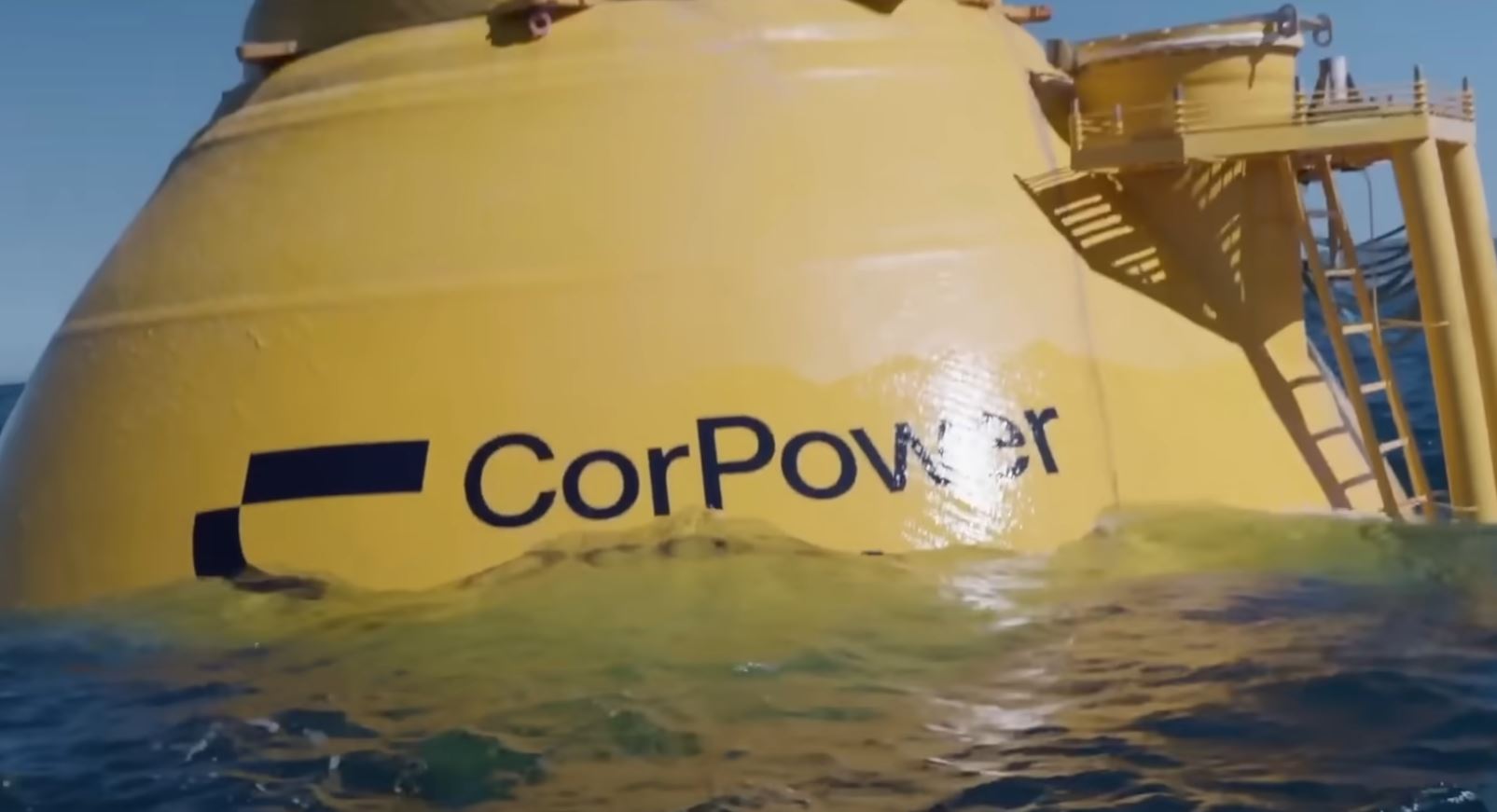
CorPower Ocean, founded in 2013 as a spin-off from the KTH Royal Institute of Technology in Stockholm, has redefined what’s possible in wave energy through a fusion of resonant dynamics, composite materials, and AI-driven control systems.
1. Surviving the Unsurvivable
In the winter of 2023, CorPower’s fourth-generation WECs endured record-breaking 18.5-meter (60-foot) waves off the coast of Portugal—conditions that would have destroyed earlier prototypes—while continuing to feed clean power into the grid. This feat was enabled by an AI-powered control system that “detunes” the buoy during extreme storms, rendering it nearly transparent to wave forces (akin to how wind turbines feather blades in high winds). Once the storm passes, the system autonomously retunes to optimal energy capture mode.
2. WaveSpring™: The Resonance Revolution
At the heart of CorPower’s design is its proprietary WaveSpring™ technology, co-developed with Norway’s NTNU. Inspired by the physics of a trampoline jumper timing each bounce to amplify height, WaveSpring synchronizes the buoy’s heave motion with incoming wave frequencies, even in low-energy seas. In real-world tests, a CorPower buoy achieved 3 meters of vertical motion in just 1-meter waves—a 300% amplification that dramatically boosts energy yield.
3. Dual-Direction Energy Harvesting
Unlike traditional WECs that only capture energy on the upward stroke, CorPower’s point absorber design integrates a tension-recoil system that pulls the buoy downward between wave crests. This allows energy harvesting on both the rise and fall of each wave cycle—effectively doubling the power extraction window.
From Prototype to Profitability: A Radical Cost Strategy
Historically, wave energy’s Achilles’ heel was cost. CorPower addressed this from day one by designing for manufacturability and scalability, not just performance.
– Material Innovation: Replacing heavy, corrosion-prone steel hulls with lightweight composite fiberglass and resin—the same materials used in wind turbine blades and racing yachts—reduced weight, maintenance, and material costs.
– Automated Production: CorPower’s manufacturing process is 70% automated, slashing the Levelized Cost of Energy (LCOE) by 70% in early deployments. The company now operates a high-efficiency production line in Västervik, Sweden, with plans for global replication.
– Mobile Factories: To bypass the logistical nightmare of transporting 9-meter-wide buoys across continents, CorPower is pioneering modular, mobile fabrication units that can be deployed near project sites—cutting transport emissions, costs, and lead times.
The result? A clear LCOE trajectory:
– $76/MWh at 600 MW (2,000 buoys)—competitive with offshore wind.
– $32–$43/MWh at 20 GW scale—on par with onshore wind and utility-scale solar.
Wave Energy’s Grid Advantage: Consistency, Seasonality, and Synergy
What truly sets wave energy apart is not just its cost curve—but its system-level value in a decarbonized grid.
1. Unmatched Reliability
While offshore wind in California can stall for 1,000 hours per year, wave energy remains active 98% of the time—going still for only ~200 hours annually. When combined, wind and wave systems shrink total downtime to just 100 hours, drastically reducing the need for backup generation or expensive battery storage.
2. Winter Peak Generation
Wave energy peaks in winter, precisely when solar output plummets and electricity demand soars. Along the U.S. West Coast, winter wave energy is four times stronger than in summer—making it the ideal complement to solar-dominated grids.
3. Co-Location: The $40% Cost Breakthrough
Perhaps the most transformative economic insight is the synergy between offshore wind and wave farms. By co-locating WECs with wind turbines, projects can share permits, vessels, crews, and—most critically—the subsea export cable, which accounts for up to 30% of offshore project costs.
According to Wave Energy Scotland, pairing a 100 MW wave farm with a 500 MW wind farm:
– Cuts wave project CAPEX by 40%.
– Reduces wind project CAPEX by 7%.
– Lowers total bundled system costs by 12%.
This isn’t just efficiency—it’s systemic grid optimization.
From Vision to Reality: The Road to 2030
CorPower is no longer confined to test tanks or pilot buoys. The company is advancing toward commercial deployment with:
– A 30 MW wave energy array in Ireland by 2028, backed by €39.5 million in EU Innovation Fund support.
– Partnerships with global energy majors and grid operators across Europe, the U.S., and Asia.
– Plans to reach 1 GW of installed capacity by 2032.
With 20 GW of global wave potential identified in technically viable zones (from Chile to Japan to Norway), the sector is poised for exponential growth—if policy and investment keep pace.
Conclusion: The Missing Piece of the Clean Energy Puzzle
Wave energy is not merely another renewable—it is the missing stabilizer in a grid increasingly strained by the intermittency of wind and solar. CorPower Ocean has proven that the engineering, economic, and operational barriers can be overcome. With superior consistency, winter peaking, and infrastructure-sharing economics, wave power may soon become not just competitive—but indispensable.
As the world races toward net-zero by 2050, the ocean’s rhythm may well become the heartbeat of the clean energy transition. The dream isn’t broken anymore—it’s bobbing steadily on the horizon, riding every swell toward a scalable, stable, and sovereign energy future.
For the Nordic Business Journal, this marks a pivotal moment: the rise of a homegrown Nordic champion with the potential to power continents—not with hype, but with heave, resonance, and relentless innovation.