
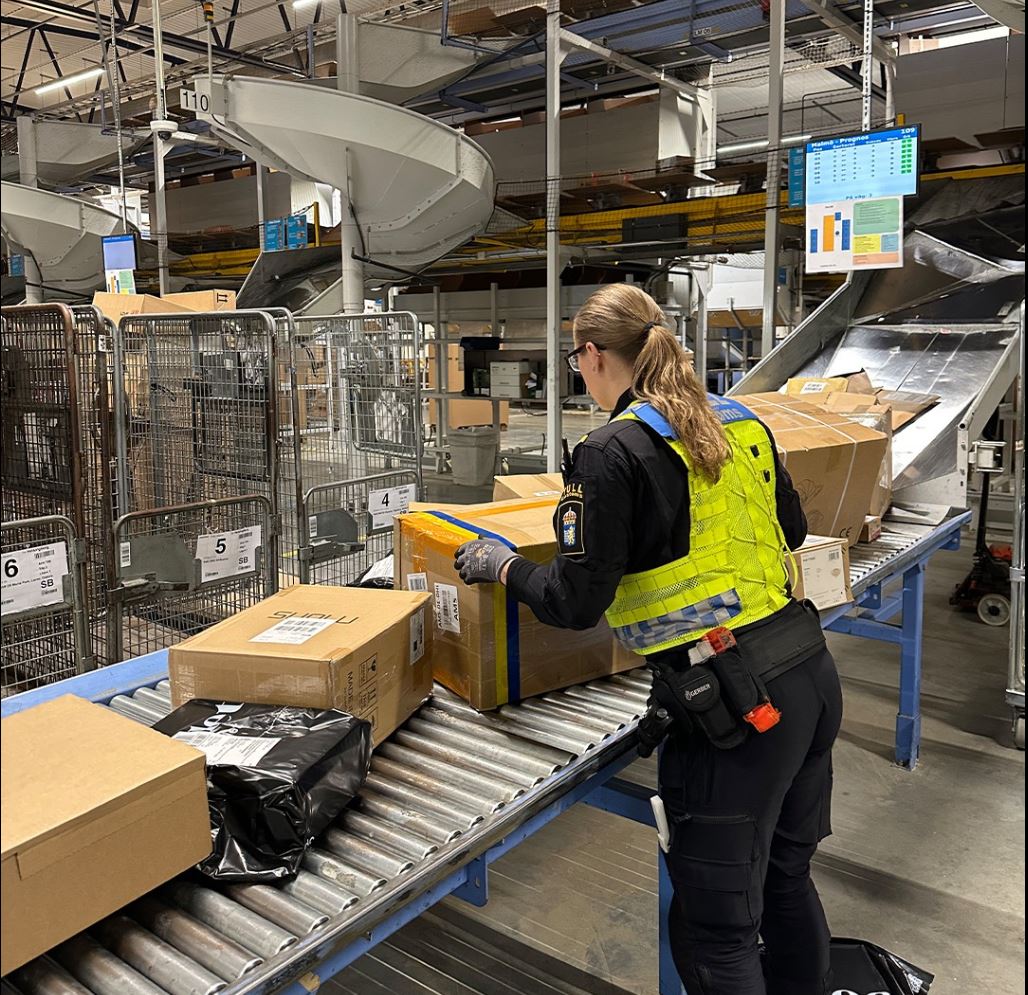
Swedish Customs (Tullverket) has uncovered a highly coordinated and increasingly professional form of narcotics smuggling—where criminal networks are hijacking the import permits of legitimate Swedish businesses to funnel large quantities of illicit drugs, primarily cannabis, from the United States into Sweden. First brought to public attention in a December 1, 2025 press release and subsequently reported by SVT Nyheter, Dagens Nyheter, and Göteborgs-Posten, the operation reveals a troubling confluence of digital fraud, regulatory loopholes, and transnational organized crime.
A New Frontier in Trade-Based Money Laundering and Smuggling
At the core of this scheme is a disturbingly simple yet effective tactic: criminals identify small- and medium-sized Swedish importers that hold valid permits—often for regulated goods such as chemicals, pharmaceuticals, or dietary supplements—and then impersonate them. Using email addresses nearly identical to the real company’s (e.g., swapping a “.se” for “.com” or altering a single character), the perpetrators place orders with U.S. suppliers, attaching stolen or forged copies of legitimate import licenses. The result? Shipments containing 2 to 250 kilograms of cannabis per consignment enter Swedish ports under the guise of legal commerce.
According to Tullverket, approximately 20 Swedish companies have been exploited in this way to date. Critically, none appear to have knowingly participated—the real businesses remain unaware their identities were weaponized for illicit gain.
Scale, Substance, and Strategic Shifts
While initial reports highlighted synthetic drugs like fentanyl analogues and amphetamines, Tullverket’s latest communications clarify that all confirmed seizures tied to this specific license-hijacking method involved cannabis—a substance that, while illegal in Sweden, is legal or decriminalized in many U.S. states. This legal asymmetry may be facilitating sourcing and logistics on the American side.
The total volume intercepted now stands at hundreds of kilograms, with individual shipments ranging dramatically in size. Authorities stress that this is not opportunistic crime but part of a broader trend: organized groups are increasingly embedding narcotics within legitimate trade flows, exploiting Sweden’s open economy and digital infrastructure.
This modus operandi marks a significant evolution from older smuggling tactics. Where once drugs were hidden in shipping containers or carried by couriers, today’s criminals are leveraging bureaucratic trust—using real permits, real company names, and falsified digital correspondence to bypass scrutiny. Tullverket describes this as a form of “professionalized” smuggling that mirrors tactics seen in trade-based money laundering.
Cross-Border Collaboration and Regulatory Gaps
In response, Swedish Customs has intensified cooperation with U.S. law enforcement agencies, including the Drug Enforcement Administration (DEA) and Homeland Security Investigations (HSI), as well as international freight and logistics partners. The aim is to flag discrepancies earlier—such as mismatched sender details or unusual order volumes—before shipments leave U.S. soil.
Domestically, Tullverket and the Swedish Chemicals Agency (Kemikalieinspektionen) are reviewing the import permit system to introduce stronger verification protocols. Businesses holding permits are being urged to:
– Implement multi-factor authentication for email and procurement systems
– Monitor for unexpected purchase orders or supplier communications
– Report any suspected impersonation immediately
Still, significant vulnerabilities remain. The current system relies heavily on document authenticity rather than real-time identity verification during customs clearance. Experts warn that without digital modernization—such as blockchain-based permit ledgers or direct API integration between business systems and customs databases—similar schemes could proliferate across the Nordic region.
Broader Implications for Nordic Trade Security
This case underscores a critical vulnerability at the intersection of digital identity and international trade. As Sweden—and the Nordics more broadly—push for seamless cross-border commerce, criminals are exploiting the very systems designed to facilitate legal trade.
Moreover, the involvement of U.S.-sourced cannabis highlights the unintended consequences of divergent drug policies. While U.S. state-level legalization has created legitimate markets, it has also generated new supply channels for transnational criminal enterprises targeting countries with stricter regimes.
Tullverket has not yet disclosed the names of affected companies, specific ports of entry, or links to named criminal networks, citing ongoing investigations. However, analysts note that several recent large-scale seizures in Gothenburg and Malmö—Sweden’s busiest commercial hubs—may be connected.
Looking Ahead
The hijacking of import permits represents a strategic shift in organized crime: less about brute-force concealment, more about systemic mimicry. For Nordic businesses, especially SMEs engaged in regulated imports, the message is clear—digital hygiene is now a matter of national security.
As 2026 approaches, expect tighter scrutiny of import documentation, potential reforms to permit issuance processes, and possibly new EU-wide guidelines on verifying commercial identities in cross-border trade. For now, Sweden’s experience serves as a cautionary tale: in the global economy, trust must be verified—not assumed.
Additional Context (December 2025 Update):
In late November 2025, Europol flagged a related trend across the Baltic and Nordic regions, noting a 37% year-on-year increase in “trade-facade” drug smuggling. Meanwhile, the U.S. Customs and Border Protection (CBP) has begun piloting an outbound screening initiative for commercial parcels destined for the EU, focusing on anomalies in business-to-business transactions. These developments suggest the Swedish case may be just the tip of a larger transatlantic challenge.
— Reporting contributed by Nordic Business Journal’s security and trade desk.