
Copenhagen – For the first time since the Second World War, Denmark’s Defence Intelligence Service (FE) has explicitly named the United States as a security concern. The agency’s 2025 threat assessment, Udsyn, released yesterday, warns that Washington is now “using its economic and technological strength as a means of power, including toward allies and partners.”
The language is diplomatic; the implications are not.
“This is the party we have called our biggest and most important ally since 1945, and suddenly it is also the party that threatens us,” says Jacob Kaarsbo, former chief analyst at FE. “For a Danish intelligence service to say this aloud is one of the most sensitive and startling admissions it can make.”
From Partner to Pressure Point
he shift did not happen overnight. Over the past decade, Washington has imposed technology export controls that have crippled European semiconductor firms, threatened tariffs on Danish pharma giants over drug-pricing rules, and pressed Copenhagen to ban Huawei—costs that FE now counts as “coercive statecraft.”
Rasmus Sinding Søndergaard, senior researcher at the Danish Institute for International Studies (DIIS), calls the wording “a marked, but not surprising, course-correction.”
“The White House’s own 2024 National Security Strategy labels the EU an ‘economic competitor’ and singles out European regulation as a threat to U.S. tech supremacy,” Søndergaard notes. “Once both sides see each other as strategic rivals, the alliance becomes transactional.”
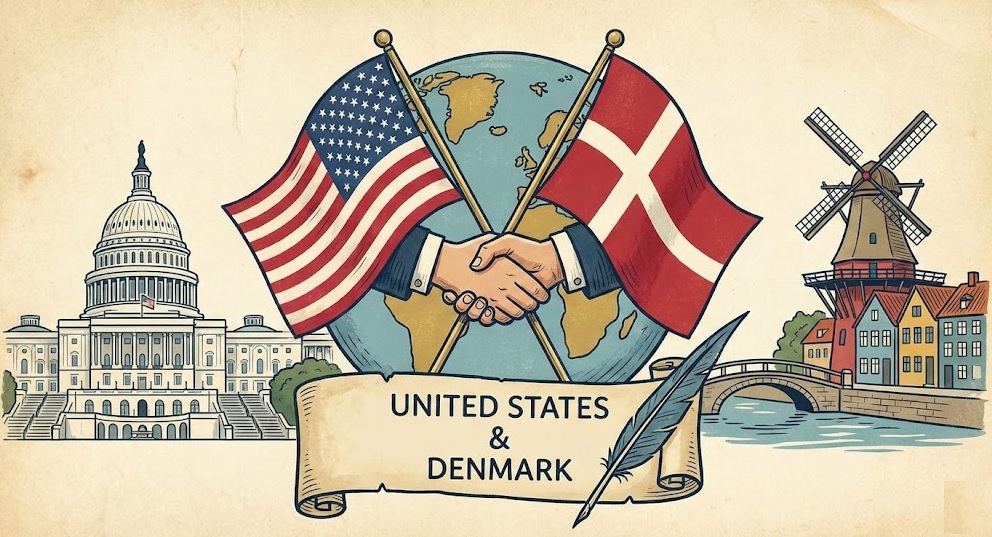
Business Impact: What Nordic Boards Should Watch
1. Dual-Use Tech Controls
Washington’s expanding “Foreign Direct Product Rule” already restricts Danish subsidiaries (Novo Nordisk’s U.S. cloud data, Vestas’ American-made turbines) if they contain >10 % U.S. origin content. FE warns the threshold could drop to zero for quantum or AI components, forcing firms to re-engineer supply chains at short notice.
2. Arctic Supply Chains
Greenland’s rare-earth deposits—critical for wind magnets—sit at the intersection of U.S., Russian and Chinese interest. FE assesses that the U.S. is likely to condition defence guarantees on exclusive mining rights, raising the political-risk premium for Nordic miners and their institutional investors.
3. Defence Spending Arbitrage
The report projects that Russia will out-produce the EU in artillery shells at least through 2027. If Washington pivots fully to the Indo-Pacific, Denmark faces a €2–3 billion budget gap to keep the Baltic gap closed. Expect accelerated joint Nordic procurement (FCAS fighter, Baltic Shield satellite constellation) and new domestic tax incentives for cyber and drone start-ups.
The Balancing Act
FE director Thomas Ahrenkiel stressed that the U.S. “remains Denmark’s closest ally.” Yet the agency’s scenario planning shows a 30 % probability that, by 2030, Washington will make security cooperation contingent on market access concessions—mirroring the CHIPS-for-base-deals swaps already offered to Japan and South Korea.
For corporate risk managers, the takeaway is clear: hedge the alliance.
“Build products that can be certified under both EU and U.S. export rules, diversify cloud providers across jurisdictions, and treat American venture capital the way you once treated Russian gas—valuable, but not to be relied on exclusively,” advises Mads Korsager, DR’s defence correspondent.
Bottom Line
Denmark’s intelligence service has done what Nordic business leaders have privately discussed for months: downgrade “the special relationship” from strategic assumption to calculable risk. Boards that embed this new uncertainty into scenario plans today will avoid the write-downs tomorrow.