
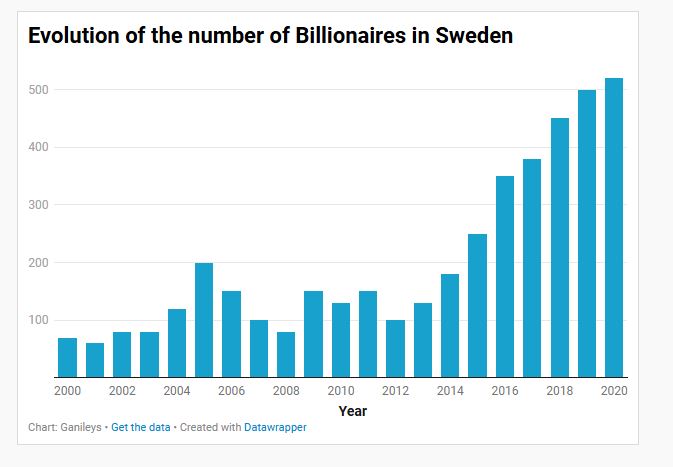
Over the past two decades, Sweden has witnessed a striking transformation in its wealth landscape: the average Swede is now three times wealthier than in 1999, and the number of billionaires has surged tenfold—from around 50 to more than 500 by 2020. Yet beneath these headline-grabbing figures lies a more complex—and troubling—reality: while wealth has grown across the board, it is the ultra-rich who are pulling dramatically ahead, reshaping Sweden’s long-held image as a bastion of economic equality.
Broad-Based Wealth Growth—But Mostly at the Top
According to a new comprehensive study by the Research Institute of Industrial Economics (IFN), funded in part by the Confederation of Swedish Enterprise, nearly all Swedes have benefited from rising asset values—primarily driven by soaring housing prices and robust returns on pension savings. “Almost everyone has become richer,” confirms Daniel Waldenström, professor of economics at IFN. “The broad middle has seen gains through home equity and fund-linked pensions.”
Indeed, average household net worth has climbed from roughly SEK 1 million in 1999 to SEK 3 million in 2020. But averages can be misleading. As former Social Democrat minister Anders Sundström—now active in the private sector—points out: “The average is quite uninteresting. The vast majority own very little.”
This insight cuts to the heart of Sweden’s evolving inequality. While median wealth has grown, the concentration of capital at the very top has accelerated far more rapidly. The primary engine? Business ownership. Sweden’s tech boom, successful IPOs, and cross-border entrepreneurship have minted a new generation of ultra-wealthy individuals whose fortunes dwarf those of ordinary citizens.
A Dual Picture of Inequality
The study presents a paradox: on one hand, ordinary households now hold a larger “share” of total national wealth compared to two decades ago—suggesting a narrowing of “relative” inequality. On the other, the “absolute” wealth gap has widened dramatically. The distance between the median Swede and the top 1%—measured in annual salaries—has ballooned from 89 to 137 times.
That places Sweden as the “sixth most unequal country globally” in terms of top-end wealth concentration—ranking just behind Brazil and Russia, and ahead of even the United States, according to journalist Andreas Cervenka’s analysis of the data.
This duality challenges conventional narratives about the Nordic model. Sweden remains a leader in income equality and social safety nets, but its wealth distribution is increasingly mirroring global trends seen in less egalitarian economies.
Policy Vacuum and Data Gaps
A key factor complicating the picture is the abolition of Sweden’s wealth tax in 2007. Since then, official statistics on household wealth have been sparse, creating a two-decade blind spot in public policy discussions. The IFN study—drawing on capital income records, business ownership data, and debt registers—helps fill that void, but also underscores the need for transparent, regular wealth monitoring.
As Riksbank Governor Erik Thedéen recently emphasized in a separate interview with Ekonomibyrån, macroeconomic stability must account not just for inflation or employment, but also for asset-driven disparities. “We can’t have mortgage rates so low they inflate housing bubbles that only benefit asset owners,” he cautioned—highlighting central banking’s growing role in addressing inequality.
Beyond the Billionaires: What Does This Mean for Business?
For Nordic Business Journal readers, the implications are multifaceted:
1. Consumer Markets: Rising middle-class wealth—especially in housing and pensions—creates resilient domestic demand. However, overreliance on asset inflation poses systemic risks if property markets correct.
2. Entrepreneurship & Investment: Sweden’s surge in billionaires reflects a thriving innovation ecosystem. Yet, excessive concentration at the top may stifle competition if startup capital remains locked within elite networks.
3. Policy Risk: Growing inequality could fuel political pressure for wealth redistribution, capital gains reform, or even a reintroduction of wealth taxation—issues that businesses must anticipate.
4. Social Cohesion: The Nordic model’s sustainability hinges on perceived fairness. If citizens feel the system increasingly rewards inherited or speculative wealth over labour and productivity, trust in institutions may erode.
The Human Dimension
To understand this shift, consider Johan Magnusson, a Swedish tech entrepreneur turned billionaire, who describes his lifestyle as “comfortable but not ostentatious.” Yet his net worth—built through scalable digital ventures—represents capital gains orders of magnitude beyond what even high-earning professionals can accumulate. Meanwhile, younger Swedes face soaring housing costs and precarious job markets, making wealth accumulation increasingly difficult without family support or equity stakes.
Even in gaming—a sector emblematic of Sweden’s digital prowess—concerns about inequality emerge. As Rasmus Siljavaara, a participant at DreamHack 2025, notes, microtransactions and “skin” economies can trap lower-income players in cycles of spending, prompting calls for stronger consumer protections as the industry faces structural challenges.
For the future, Sweden’s wealth story is not one of decline, but of divergence. The country has successfully generated prosperity—but its distribution is becoming less inclusive. As policymakers, businesses, and citizens grapple with this new reality, the central question is no longer whether Swedes have gotten richer, but who is benefiting—and at what cost to the social contract that has long defined the Nordic way.
For Sweden to retain its edge as a model of inclusive capitalism, it must address not just wealth creation, but wealth access. Otherwise, the gap between the median household and the billionaire elite may stretch beyond just kronor—it may begin to fracture trust, opportunity, and long-term economic resilience.