
In an era marked by geopolitical realignments and democratic stress tests, Europe is undergoing a profound — yet often muted — reassessment of its relationship with the United States. While historically the transatlantic alliance rested on shared democratic values, the post-2016 trajectory of American politics, culminating in a second Trump administration, has strained that consensus to its limits. European voices, from civil society to think tanks to parliamentary committees, are increasingly vocal in their concern about U.S. democratic backsliding and human rights regression. Yet, at the governmental level, Europe’s criticism remains measured, selective, and largely behind closed doors. This discrepancy is not a moral failure, but a strategic calculation shaped by four hard realities: power asymmetry, mutual vulnerability, internal democratic weaknesses, and acute geopolitical distractions.
The Unspoken Alarm: Europe’s Quiet Disquiet
Contrary to popular perception, European criticism of the United States is neither absent nor token. Across capitals from Stockholm to Lisbon, think tanks and human rights experts have grown increasingly candid. Descriptions of the U.S. as “sliding into semi-authoritarianism” are no longer fringe commentary but mainstream analysis. Under the Trump administration’s second term — set to begin in January 2025 — Washington has intensified its hostility toward multilateral institutions, democratic norms, and even European sovereignty itself. The December 2025 National Security Strategy explicitly frames the EU not as a values-based partner but as a civilisational threat — accusing it of “civilisational erasure” through green policies, migration norms, and speech regulations.
European civil society, drawing on painful lessons from Hungary and Poland, now regularly warns American counterparts to “safeguard your institutions.” This reversal — where Europe, once the pupil of American democracy, now offers cautionary advice — reflects a tectonic shift in transatlantic moral authority.
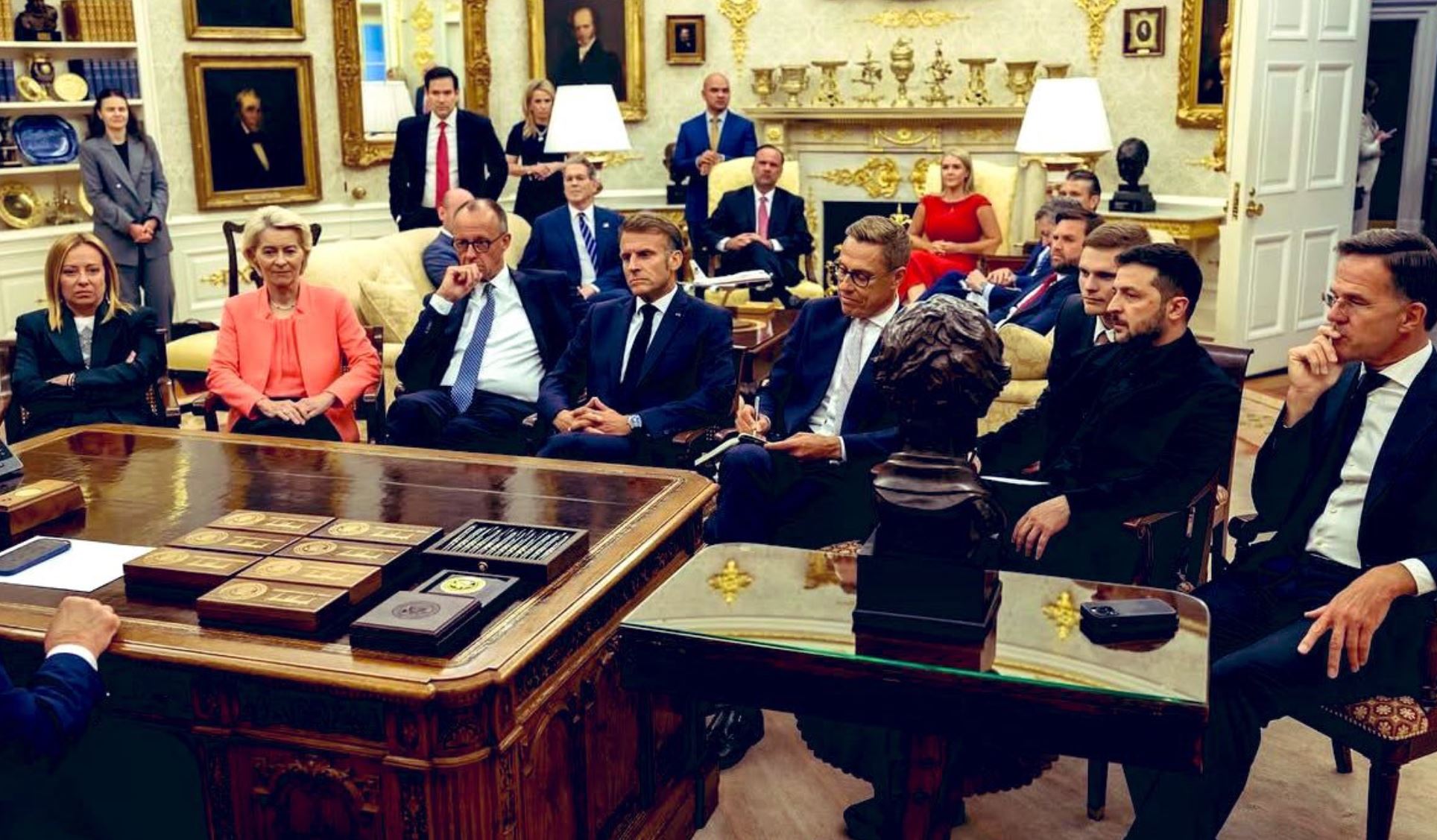
Why Governments Hold Their Tongue
Despite this undercurrent of concern, EU and national leaders remain remarkably restrained in their public diplomacy. This caution stems from structural dependencies that have only deepened since 2016:
1. Security Dependence: NATO’s backbone remains American — from nuclear deterrence to satellite surveillance and rapid-deployment forces. In the wake of Russia’s war in Ukraine, European defence ministries know that U.S. military commitments are non-negotiable, even as Washington flirts with isolationism and transactional alliances.
2. Economic and Digital Subordination: From SWIFT and the dollar to cloud infrastructure controlled by Google, Amazon, and Meta, Europe’s financial and digital ecosystems remain tethered to U.S. platforms. The 2014 BNP Paribas fine and the 2023 Siemens board overhaul — both driven by U.S. regulatory pressure — are stark reminders of Europe’s vulnerability. Public confrontation risks swift economic retaliation that EU institutions cannot yet buffer.
3. Capacity Limits: When the Trump administration froze external democracy funding in early 2025, global civil society turned to Brussels. Yet EU officials admitted they could not scale up democracy support by the required 70–80% to fill the gap. Europe lacks both the budgetary muscle and the operational reach to replace U.S. soft power.
4. Strategic Overload: From Russia’s war and China’s retaliatory EV tariffs to the collapse of the WTO appellate body, Brussels faces a “perfect storm” of external pressures. In this context, openly challenging Washington on values is seen as a luxury Europe cannot afford — especially when NATO cohesion is paramount.
The Credibility Deficit at Home
Europe’s ability to lecture the U.S. is further undercut by its own democratic fissures. The EU’s moral authority is weakened by ongoing rule-of-law crises in Hungary, Poland, and now Slovakia. Simultaneously, European border practices — pushbacks, detention camps, and cooperation with authoritarian regimes to stem migration — have drawn sharp rebukes from UN human rights bodies.
Moreover, domestic laws restricting online speech in the name of counter-terrorism or “digital safety” increasingly blur the line between legitimate security policy and illiberal overreach. As one Brussels-based analyst put it: “The more Europe frames the world as ‘democracies versus autocracies,’ the more its internal contradictions erode its credibility.”
This mutual vulnerability has fostered a tacit understanding: both sides avoid the kind of conditionality they routinely impose on African, Middle Eastern, or Southeast Asian partners. The double standard is real — and increasingly acknowledged within European policy circles.
A New Bargain for Democratic Solidarity?
Yet silence is not surrender. Experts argue that this moment demands a reimagining of the “international democracy agenda.” Rather than clinging to a U.S.-led model now visibly fraying, Europe must decide how far it is willing to step up — not as a replacement hegemon, but as a co-steward of democratic resilience.
Human rights practitioners emphasize that rights are “under pressure, but not in retreat.” The path forward lies in peer-based, multilateral scrutiny that applies the same benchmarks to Washington, Warsaw, and Windhoek. This is not idealism; it is necessity. As U.S. policy turns inward and illiberal, Europe’s strategic autonomy — in defence, tech, and finance — becomes not just an economic project, but a democratic imperative.
The race is now on: Can Europe build enough counter-power to withstand U.S. retaliation while defending shared norms? Or will the erosion of the rules-based order accelerate faster than Brussels can adapt?
For Nordic businesses and policymakers, the stakes are clear. The transatlantic alliance is no longer a values-based given — it is a contested, transactional space where economic interdependence and democratic solidarity are increasingly at odds. Navigating this new landscape will require realism, resilience, and a renewed commitment to holding all democracies — including one’s own — to the highest standards.
The era of assumed transatlantic unity is over. The era of conditional, values-aware partnership has just begun.