
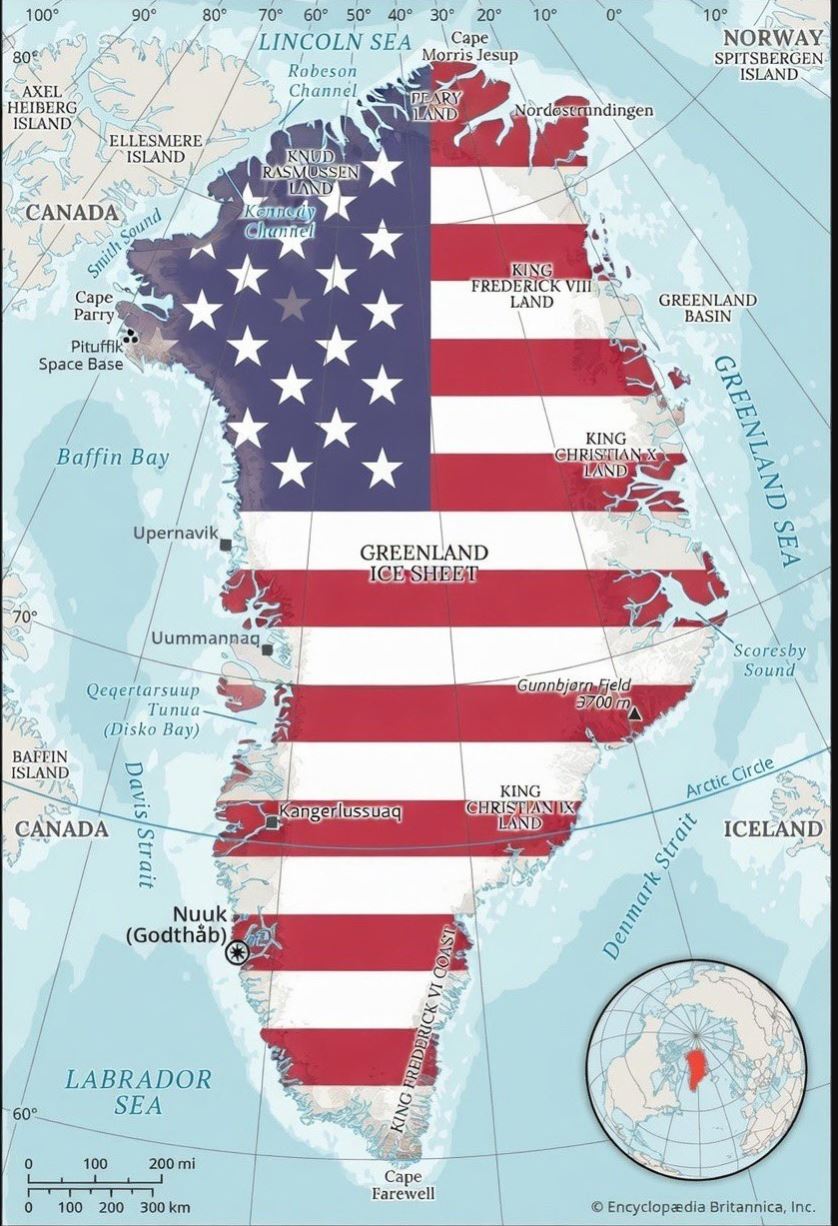
In a rare and high-stakes diplomatic manoeuvre, Denmark has convened an emergency session of its Foreign Affairs Committee following renewed—and unsettling—statements from former U.S. President Donald Trump about his ambitions to acquire Greenland. Though Trump is no longer in office, his comments, made during a televised interview on January 3, 2026, have reverberated through Nordic political and security circles, reigniting long-simmering concerns about Arctic sovereignty, strategic competition, and the fragility of transatlantic trust.
Trump, now a leading contender in the 2026 U.S. presidential primaries, declared he remains “very serious” about the idea of the United States taking control of Greenland—a semi-autonomous territory within the Kingdom of Denmark. While he offered no clear timeline or legal pathway, the mere repetition of such rhetoric has triggered alarm not only in Copenhagen but across the Nordic region and the broader European Union.
For Denmark, Greenland is far more than a distant territory; it represents a cornerstone of national identity, Arctic policy, and geopolitical influence. Since 1953, Greenland has been an integral part of the Danish Realm, though it gained self-rule in 2009, with control over most domestic affairs—except foreign policy and defence, which remain under Copenhagen’s purview. Critically, Greenlanders have consistently rejected full independence, but they equally reject external claims over their land.
A Controlled Environment, Heavily Guarded Secrets
On January 5, Denmark’s parliamentary Foreign Affairs Committee met behind closed doors in a high-security room at Christiansborg Palace. Mobile phones, smartwatches, and even coffee cups were barred—standard protocol for discussions involving classified security matters. Foreign Minister Lars Løkke Rasmussen and Defence Minister Troels Lund Poulsen led the session, which focused not only on U.S. intentions but also on contingency planning for Arctic deterrence, NATO cohesion, and diplomatic outreach to EU partners.
“While Trump is not currently in power, his influence within the Republican Party—and the possibility of a 2027 return to the White House—means this cannot be dismissed as political theatre,” said political analyst Inger Sørensen of the Copenhagen Institute for Strategic Studies. “The Nordic countries are watching closely. What begins as rhetoric can quickly become policy if unchecked.”
European Unity—and a Warning to Washington
In a swift and coordinated response, leaders from Denmark, France, Germany, Italy, Poland, Spain, and the United Kingdom issued a joint declaration affirming Greenland’s status as an inalienable part of the Danish Realm, governed by the will of its people. The statement, notable for its directness, emphasized that “sovereignty, territorial integrity, and the inviolability of borders are non-negotiable principles under the UN Charter.”
The declaration also called on NATO to adopt a unified Arctic security strategy—one that respects international law and counters growing militarisation by non-NATO powers. This is particularly relevant as Russia continues to expand its Northern Fleet capabilities, and China—though not an Arctic state—increases its scientific and economic presence under the guise of its “Polar Silk Road” initiative.
Greenland’s Premier, Jens-Frederik Nielsen, struck a measured tone in a subsequent press briefing: “This talk of annexation is fantasy—but it distracts from real cooperation. We value our partnership with the United States on climate science, search-and-rescue operations, and joint defence through Thule Air Base. But partnership is not ownership.”
Why This Matters to Nordic Business
Beyond the headlines, the Greenland controversy speaks to deeper strategic shifts with direct implications for Nordic businesses:
- Resource Security: Greenland holds vast reserves of rare earth elements, uranium, and critical minerals essential for green tech and defence industries. Any instability or contested sovereignty could disrupt supply chains or deter investment.
- Defence & Infrastructure Contracts: With NATO increasing its Arctic footprint, Nordic defence firms (e.g., Saab, Kongsberg, Terma) stand to benefit—but only if regional stability is assured.
- Investor Confidence: Ambiguity over territorial control risks chilling foreign direct investment in Arctic infrastructure, shipping lanes, and renewable energy projects.
Moreover, the episode underscores a broader trend: the Arctic is no longer a geopolitical backwater. It is a contested frontier where climate change, resource scarcity, and great-power rivalry converge.
The Road Ahead
As the U.S. election cycle heats up, Nordic governments are bracing for more inflammatory rhetoric. But Copenhagen is also quietly strengthening ties with fellow Arctic states—Norway, Sweden, Finland, and Iceland—while deepening EU coordination on Arctic policy. Denmark has also signalled it may propose a new “Nordic-EU Arctic Compact” at the upcoming March summit in Helsinki.
What’s Next?
In our next feature, we’ll examine how Nordic companies are positioning themselves amid rising Arctic competition—and whether public-private partnerships can help secure responsible development in Greenland without compromising sovereignty. We’ll also analyse the economic viability of Greenland’s mining sector and the role of ESG standards in attracting ethical investment.
We invite our readers to share their perspectives. Are Arctic sovereignty concerns shaping your business strategy? How should Nordic nations respond to great-power ambitions in the High North? Connect with us at insights@nordicbusinessjournal.com or join the conversation on LinkedIn using ArcticSovereignty.
© 2026 Nordic Business Journal. All rights reserved.
Follow us for in-depth analysis on Nordic geopolitics, defence economics, and sustainable development in the Arctic.