
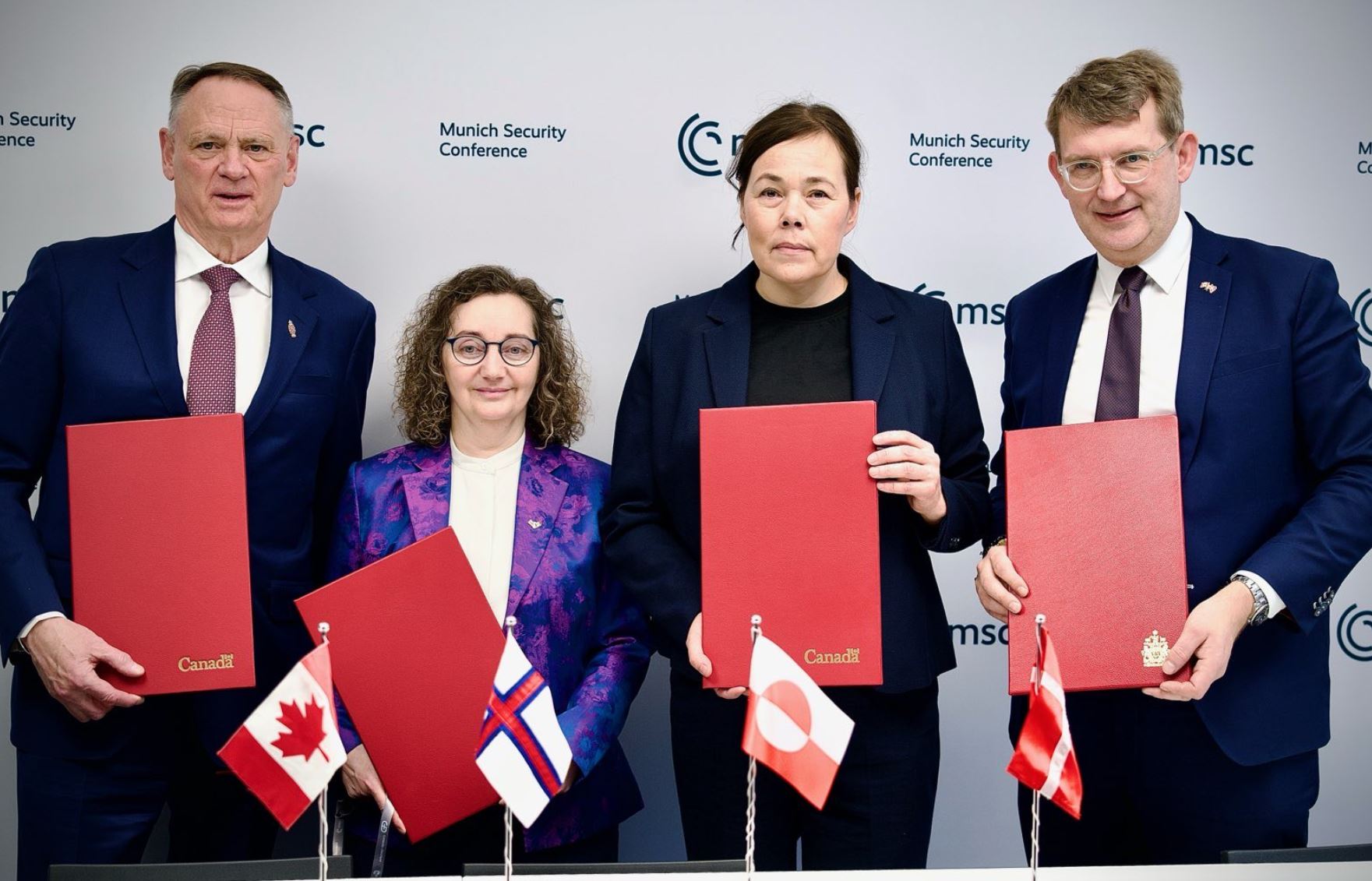
MUNICH — At February’s Munich Security Conference, Denmark’s Defence Minister Troels Lund Poulsen—joined by Greenlandic Minister Vivian Motzfeldt and Faroese counterpart Sirid Stenberg—signed a comprehensive defence cooperation agreement with Canadian Defence Minister David J. McGuinty. While framed as a bilateral accord, this pact represents a strategic recalibration with tangible implications for Nordic defence industry executives navigating an increasingly contested Arctic domain.
Beyond Symbolism: The Business Case
For Nordic business leaders, three dimensions merit attention:
1. The Kingdom Advantage as a Strategic Asset
Unlike conventional nation-state partnerships, this agreement uniquely leverages Denmark’s constitutional architecture—uniting Copenhagen, Nuuk, and Tórshavn under a single defence framework. Canada, facing a 3,000-kilometer maritime border with the Kingdom and shared Arctic sovereignty challenges, gains a partner with operational presence across the entire North Atlantic corridor. For Nordic defence firms, this creates a template: positioning as integrated Arctic solutions providers—not merely component suppliers—could unlock premium contracts in surveillance, maritime domain awareness, and cold-weather logistics where Canada seeks to reduce U.S. dependency.
2. Quantum and Dual-Use Technology Transfer Pathways
The defence pact builds upon a November 2025 quantum technology cooperation declaration between Copenhagen and Ottawa. With both nations investing heavily in quantum sensing for submarine detection and secure communications, Nordic firms specialising in quantum-resistant cryptography, satellite-ground integration, and AI-enabled pattern recognition should position themselves as interoperability enablers. Canada’s defence industrial strategy explicitly seeks Nordic partnerships to diversify supply chains beyond American primes—a $2.5 billion annual export opportunity currently underexploited by Danish industry.
3. Arctic Sentry as a Catalyst for Industrial Engagement
The agreement arrives as NATO launches Arctic Sentry—a permanent surveillance and rapid reaction framework formalized February 11, 2026. Denmark has already committed four F-35s to the mission, operating alongside Canadian CF-18s and American assets from Greenlandic and Icelandic bases. This sustained presence creates recurring demand for:
– Cold-weather maintenance and sustainment services
– Arctic-specific sensor calibration and data fusion
– Satellite bandwidth and secure communications infrastructure
– Indigenous community engagement protocols (a Canadian requirement increasingly adopted by allies)
Contextual Imperatives Driving the Pact
– Sovereignty Economics: Canada’s December 2024 Arctic Foreign Policy explicitly prioritises Nordic partnerships to secure northern sea lanes amid melting ice and increased great-power activity. Denmark, chairing the Arctic Council through 2027, offers diplomatic cover for joint infrastructure projects.
– Budget Momentum: Denmark’s 2026 defence allocation exceeds 3% of GDP—a sustained commitment enabling multi-year procurement cycles. Canada’s parallel push to source 15–20% of defence procurement from non-U.S. allies creates a window for Nordic exporters.
– Geographic Reality: With Russian naval activity intensifying east of Greenland—a recognised vulnerability for North American early-warning systems—the Kingdom’s surveillance capabilities in the GIUK Gap represent asymmetric value Canada cannot replicate domestically.
Strategic Implications for Nordic Executives
This agreement signals that Arctic security is transitioning from a geopolitical concern to an industrial opportunity. Forward-looking Nordic defence firms should:
1. Map interoperability gaps between Canadian and Nordic platforms (particularly F-35 sustainment ecosystems where Denmark, Norway, and Canada operate common fleets)
2. Develop Arctic-certified service packages—not just hardware—with emphasis on rapid deployment, extreme-environment reliability, and indigenous partnership frameworks
3. Engage Canadian provincial innovation agencies (particularly in Nunavut and Northwest Territories) where local content requirements increasingly shape federal procurement
The Denmark-Canada pact is less about new capabilities than about institutionalising cooperation channels that survived the 2025 Greenland sovereignty tensions. For Nordic industry, the lesson is clear: Arctic security contracts will increasingly reward firms that understand sovereignty as an economic proposition—not merely a military one.
Next Steps & Engagement
This analysis initiates our Arctic Industrial Corridor series. Next month: “Norwegian Subsea Surveillance Exports to Canada—Regulatory Pathways and Indigenous Partnership Models.” To discuss how your firm can position within emerging Arctic defence supply chains, connect with our defence industry desk at insights@nordicbusinessjournal.com. Nordic Business Journal hosts an exclusive Arctic Security Industry Roundtable in Copenhagen on April 15, 2026—limited executive seats available.