
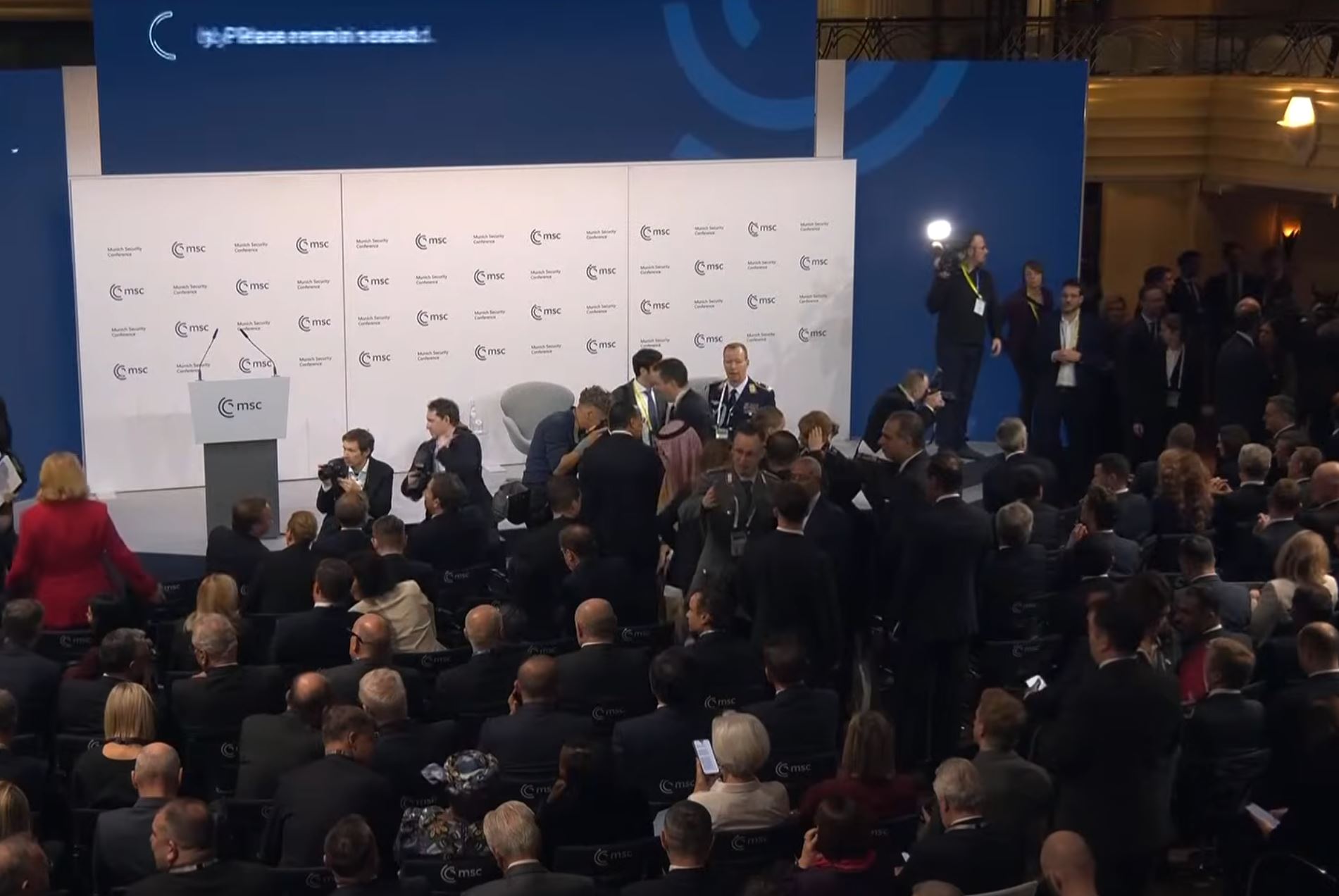
MUNICH — As world leaders converge at the 62nd Munich Security Conference (February 13–15, 2026), a once-taboo subject now dominates closed-door sessions: Europe’s capacity to project credible nuclear deterrence without guaranteed U.S. backing. For Nordic business leaders, this strategic pivot carries profound implications for defence industrial strategy, export opportunities, and capital allocation across the region’s €25 billion defence ecosystem.
The conversation has shifted dramatically since Vice President JD Vance’s blunt 2025 address, in which he declared Europe’s greatest threat “from within” rather than external actors. That intervention catalysed what security analysts now describe as Europe’s “strategic adolescence” — a painful but necessary recalibration toward autonomous defence capabilities. German officials, long constrained by post-war nuclear taboos, have quietly initiated structured dialogues with Paris on extended deterrence frameworks, while Chancellor Olaf Scholz (not Friedrich Merz, who leads the opposition CDU) has reaffirmed Germany’s commitment to NATO nuclear sharing arrangements at Büchel airbase.
The Nordic Angle: Sweden’s New Leverage
French President Emmanuel Macron’s confirmation that Sweden participates in “specific conversations” regarding France’s nuclear architecture marks a watershed moment. Since joining NATO in March 2024, Sweden has transformed from neutral outlier to alliance linchpin — bringing not just strategic geography but a world-class defence industrial base to European security planning. Saab’s Gripen E fighters, now integrated into NATO’s nuclear sharing certification pathways, position Swedish industry at the nexus of conventional and strategic deterrence modernisation.
This matters commercially: European allies seeking alternatives to sole reliance on U.S. extended deterrence will require dual-capable aircraft, secure command-and-control systems, and survivable basing infrastructure — all domains where Nordic firms hold competitive advantages. Saab’s share price has surged 118% year-on-year as markets price in structural demand shifts, while Kongsberg Defence & Aerospace reported near NOK 90 billion in orders for 2025 amid continental rearmament.
Business Implications: Three Strategic Shifts
1. Industrial Consolidation Accelerates
The €1.065 billion European Defence Fund (EDF) 2025 work programme prioritises collaborative projects in air combat, space, and ground systems — explicitly favouring transnational consortia over national champions. Nordic firms must decide whether to lead niche capabilities (e.g., Kongsberg’s precision strike systems) or embed within Franco-German industrial architectures. The Northwood Declaration (July 2025), which deepened UK-French nuclear cooperation, signals that strategic capabilities will increasingly flow through bilateral rather than EU-wide channels.
2. Nuclear-Adjacent Markets Expand
Even without weaponising, Europe’s deterrence gap creates demand for “nuclear-enabled” technologies: hardened communications, electronic warfare resilience, and survivable logistics. A February 2026 European Nuclear Strategy Group report warns of a “dangerous deterrence gap” unless Europe urgently rethinks its posture — language that translates directly into procurement pipelines for Nordic cybersecurity and C4ISR specialists.
3. Export Diversification Imperative
As European capitals redirect budgets toward strategic autonomy, traditional U.S. procurement channels may narrow. Nordic defence exporters must accelerate partnerships in Indo-Pacific markets (where Kongsberg is building U.S. and Australian missile factories) while leveraging NATO interoperability standards to access Southern European modernisation programmes.
Reality Check: Limits of European Nuclear Autonomy
Experts caution against overinterpretation. France’s arsenal — approximately 290 warheads — lacks the flexible theatre options and forward-deployed infrastructure that underpin U.S. extended deterrence. Germany remains legally bound by the Nuclear Non-Proliferation Treaty and shows no appetite for weapon acquisition; its engagement centres on political consultation within NATO’s nuclear planning framework. The credible near-term outcome is not a European nuclear force but enhanced Franco-British consultation mechanisms with political signalling value — sufficient to complicate adversary calculus without triggering proliferation cascades.
Next Steps For Nordic Leaders
This article launches our “Strategic Autonomy” series examining Europe’s defence industrial realignment. Next month: “The Nordic Missile Gap — How Kongsberg, Nammo and BAE Bofors Are Racing to Scale Production Amid Continental Shortfalls.” We invite defence executives, procurement directors and policy advisors to share insights on supply chain bottlenecks and export control challenges at insights@nordicbusinessjournal.com. Your perspective will shape our reporting agenda.