
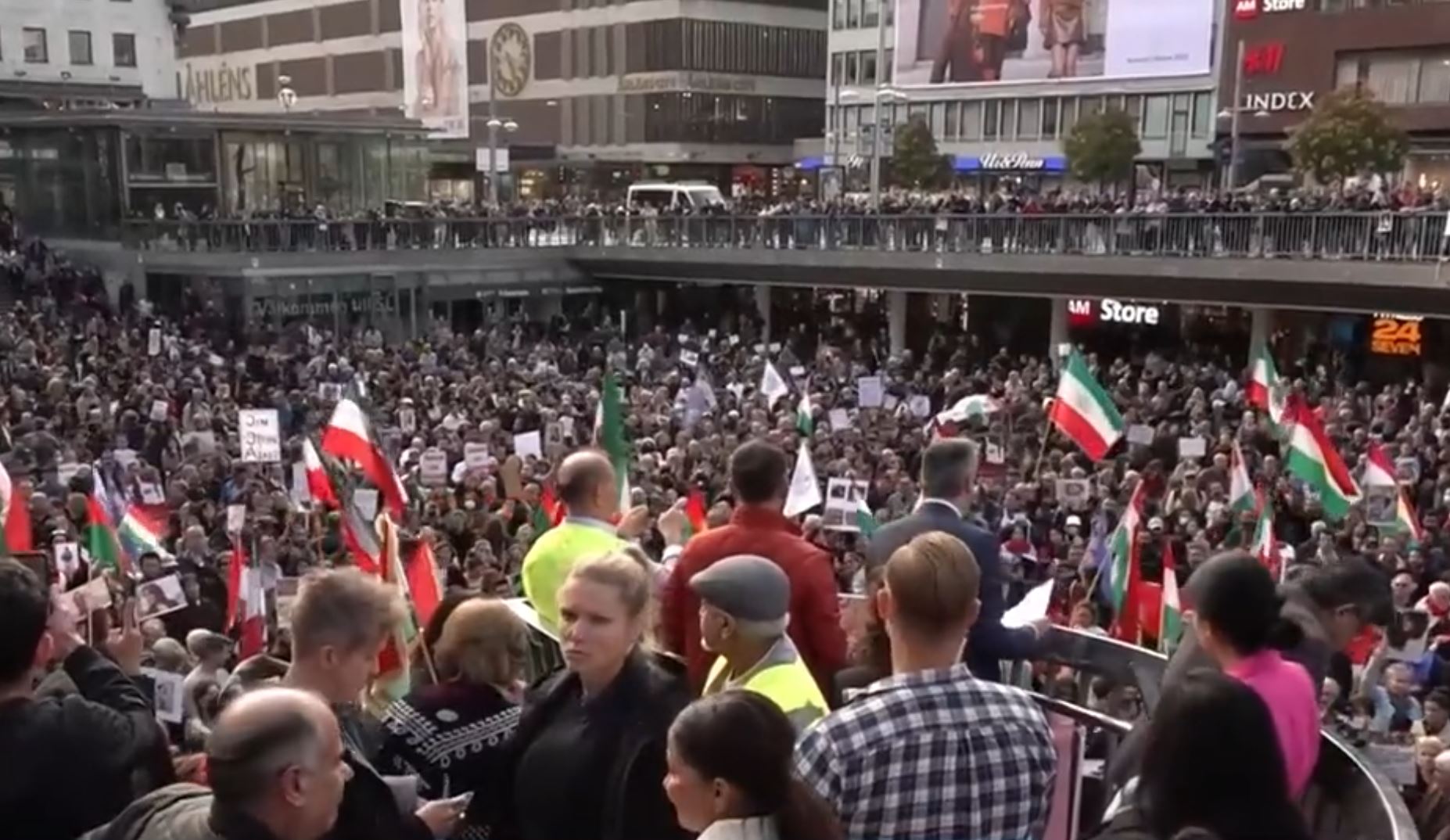
In a historic gathering on Sunday, hundreds of Swedish-Iranians gathered outside the Iranian embassy in Stockholm to mark a momentous occasion—the death of Iran’s supreme leader, Ayatollah Ali Khamenei. This significant event has stirred a mixture of emotions within the Iranian diaspora in Sweden, with some feeling a sense of closure and others acknowledging that the fight for change is far from over.
Anahita, a 33-year-old Swedish-Iranian woman, poignantly expressed the sentiment of many present at the rally. Having lost a relative during the recent protests in Iran, Anahita shared, “We can finally feel a little happiness after weeks of sorrow. The monster is gone. But we still have much work to do. We cannot truly celebrate until the regime is overthrown completely.”
This moment of catharsis represents both the culmination of years of oppressive rule under Khamenei’s leadership and a crucial turning point in the broader struggle for freedom and democracy in Iran. For many in the Swedish-Iranian community, this event marks a bittersweet victory—a step toward a freer Iran, but still, a distant dream.
Experts Warn of Wider Regional Impacts: Prolonged Conflict in Iran Could Shake the Global Stage
As military tensions continue to escalate in Iran, regional analysts are raising alarms about the broader implications for not only the Middle East but for countries like Sweden, far removed from the epicentre of the conflict.
Aron Lund, a Middle East expert at the Swedish Defence Research Agency (FOI), noted that while it is still early to make definitive predictions, the prolonged instability in Iran could have ripple effects that extend well beyond the region. “Any prolonged conflict in Iran could set off a chain reaction,” said Lund, emphasizing the growing complexity of geopolitics in the region. “Countries like Sweden are not immune to the political and economic fallout of this unrest.”
Lund further explained that the growing influence of neighbouring powers and the potential for economic disruptions could strain Sweden’s relations with both the Middle East and global powers.
Professor Hossein Sheiban, a historian at Stockholm University, shared his personal experience of trying to reach relatives in Tehran, highlighting the emotional toll the ongoing crisis has had on families spread across the globe. “We have witnessed this tragedy up close, not just as academics but as individuals with deep connections to the people of Iran,” Sheiban remarked.
His reflections echo a growing sentiment within Sweden’s Iranian diaspora, where anger and hope are simultaneously being channelled toward not just an end to the regime but a future of democratic reform in Iran. “There’s a lot of grief,” he said. “But also, a deep sense of anticipation. The death of Khamenei is just the beginning of a much bigger struggle.”
What’s Next for the Swedish-Iranian Community?
While many within the Swedish-Iranian community feel a sense of triumph, it is clear that this victory is only symbolic. As long as the political machinery of the Iranian regime remains intact, real change seems elusive. Yet the diaspora’s resilience has never been clearer.
For businesses, policymakers, and international observers, the ripple effects of these developments are not just a matter of regional interest but a global one. Sweden, which has long been a haven for Iranian refugees, may find itself increasingly involved in diplomatic, humanitarian, and economic responses to the evolving situation in Iran.
In addition, Sweden’s position as a leading player in human rights advocacy may see a shift in its foreign policy, as the nation assesses how best to balance support for the Iranian people with the reality of the country’s complex geopolitical status.
A Call to Action: The Global Business Community’s Role
As the international community watches the unfolding situation in Iran, businesses, think tanks, and foreign policy experts in Sweden and abroad will need to engage with the reality of a world more interconnected than ever. A prolonged conflict in Iran, combined with potential spillover effects across the Middle East, could have far-reaching consequences, including on trade, diplomacy, and investment.
The Swedish-Iranian community’s voices—fuelled by decades of struggle and hope—have never been more potent. Whether the death of Khamenei will serve as a catalyst for change within Iran remains to be seen. However, one thing is certain: for those who have lost family members, homes, and livelihoods in the pursuit of freedom, the fight is far from over.
In the words of Anahita, “This is not the end; it’s just the beginning.”
Additional Insights for the Global Audience
For international readers, particularly those in the business community, the events unfolding in Iran hold significant importance. The ramifications of this political shift extend beyond borders, and understanding the dynamics at play could offer valuable insight into regional markets, security risks, and the potential for future economic partnerships or conflicts.
As tensions mount, both diplomatic and economic relationships will need to be recalibrated. Global business leaders should consider how developments in Iran might affect not just the Middle East but markets and supply chains worldwide.
In Conclusion
The ongoing developments in Iran are more than just a political story—they are a human one. The Swedish-Iranian community’s collective response to Khamenei’s death signals a pivotal moment in the region’s history, and the broader international business community must stay vigilant to the shifting tides that could reverberate across the globe.