
The outbreak of major hostilities in the Middle East last quarter delivered a stark reminder that even the world’s largest sovereign wealth fund is not immune to short-term market shocks. Norway’s Government Pension Fund Global (GPFG) posted a negative return for the quarter — a reported loss of roughly NOK 636 billion — as global equities, which make up about 70 percent of the fund, slid. The equity sleeve alone is said to have produced a negative return of about 2.6 percent.
At the end of March, the fund’s market value stood just under the NOK 20 trillion mark. Since quarter-end, however, markets have shown resilience: major indices recovered, with the US stock market in particular reaching new highs during the subsequent rally. That rebound highlights a central truth for owners and observers of the fund — the GPFG operates with a long-term horizon, and quarterly swings, even large ones, must be read in context.
What drove the drop — and the recovery?
Geopolitical risk premium. The eruption of conflict in the Middle East injected a risk premium into global markets, pushing investors away from equities in favour of safe-haven assets. The initial market reaction was amplified by uncertainty over potential disruptions to energy flows and trade routes.
Commodity and currency moves. Oil prices reacted quickly to supply-risk fears, then normalised as markets assessed the actual disruption. For the fund, movements in oil and gas prices matter indirectly (through global growth and equity valuations) and directly (via currency swings that affect the NOK-value of foreign assets).
Concentration in equities. With roughly 70 percent of assets allocated to listed equities, GPFG’s quarterly result tracks global equity performance closely. When global risk-off events hit, the fund is naturally exposed.
Fast rebound driven by rotation and tech. The post-quarter bounce was supported by sector rotation — in particular renewed appetite for US large caps and tech names — and investor relief as immediate tail risks diminished.
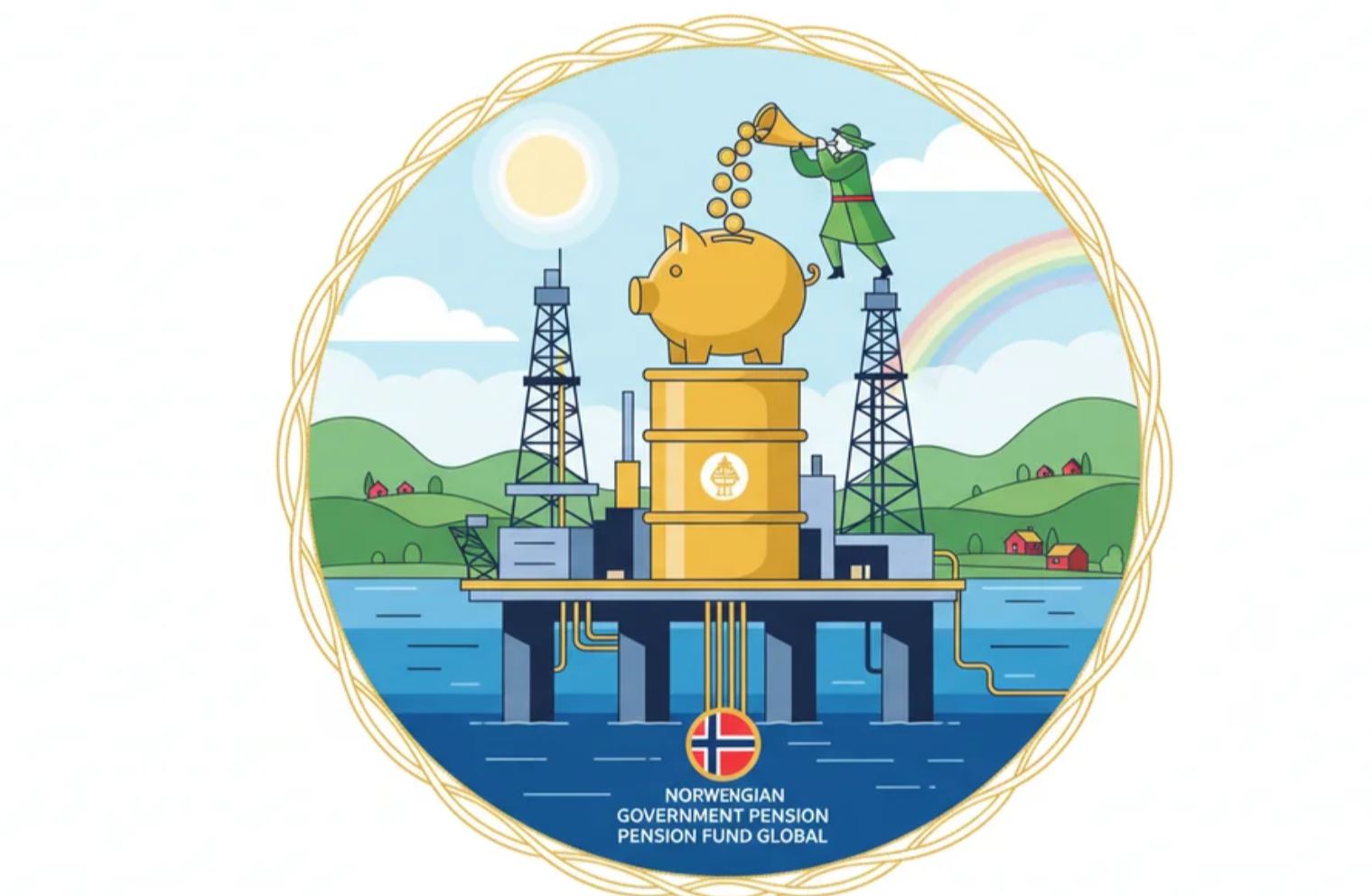
Analytical takeaways for Nordic institutional and private investors
1. Size insulates but does not immunise
The GPFG’s scale gives Norway policy flexibility that few countries have: strong fiscal buffers, the ability to smooth spending and a mandate to sustain intergenerational wealth. But size does not eliminate market exposure. A single quarter loss in the low single-digit percent range — while headline-grabbing — is not uncommon across large diversified funds in volatile times.
2. The fiscal rule still matters
Norway’s fiscal framework (the guideline to spend only the real return, commonly described as around 3 percent annually) means that quarterly market swings are typically absorbed without immediate changes to public spending. That continues to provide macroeconomic stability — but sustained multi-quarter losses would test political patience and fiscal arithmetic.
3. Diversification and liquidity are visible strengths
The fund’s broad geographic and asset-class diversification, and its substantial liquidity, mean it can withstand shocks while maintaining strategic positions. However, the weighting toward equities makes it sensitive to sudden market repricing, which argues for continued emphasis on risk management.
4. Geopolitics remains a structural risk
Investors — especially Nordic asset managers and corporate treasurers — should factor an elevated baseline of geopolitical risk into scenario planning. That affects supply chains, energy security, and sovereign credit dynamics. Hedging strategies and stress tests should explicitly include protracted regional conflicts.
5. Opportunities in volatility
Periods of market dislocation create pick-up opportunities in high-quality assets and in sectors that benefit from security spending and energy investment. For long-term investors, disciplined rebalancing and opportunistic buying into quality cyclical dips can enhance long-term returns.
Actionable guidance for Nordic investors and business leaders
Reassess stress testing assumptions. Model more protracted geopolitical scenarios for portfolios and corporate supply chains.
– Don’t abandon strategic allocation shifts based on quarter-to-quarter moves. The GPFG and most disciplined investors use rebalancing signals, not headlines, to change allocations.
– Use currency hedges selectively. Rising NOK volatility can materially alter the local-currency returns for Nordic investors with international exposure.
– Watch active opportunities in less-efficient corners. Volatility creates windows in credit, small-cap equities and ESG-transition plays where active managers can add value.
– Monitor policy responses. Government fiscal and central bank moves to stabilise markets can be rapid; corporate and investment strategies should be nimble.
What this means for Norway and the region
Norway remains exceptionally well-positioned compared with most commodity-exporting economies, thanks to the GPFG and conservative fiscal management. A single quarter of negative returns won’t alter Norway’s long-term trajectory, but it sharpens the political debate about spending levels, climate transition investments, and how best to balance domestic needs with preserving wealth for future generations.
Outlook
Markets have shown that rebounds can be swift once the near-term shock is absorbed. But the path forward will be marked by episodic volatility as geopolitical tensions, central bank policy expectations and the trajectory of global growth interact. For the GPFG, the immediate priority will be to stay the strategic course: maintain diversification, adhere to governance and sustainability mandates, and use its size to influence long-term corporate behaviour while protecting Norway’s fiscal foundation.
Next steps and how to connect
In our next piece we will take a deeper look at how the GPFG is positioning itself for the energy transition and rising geopolitical risk: portfolio tilts, engagement on climate risk, and the balance between returns and ethical constraints. We want your perspective — what questions should we put to the fund managers and policymakers?
Connect with the Nordic Business Journal:
– Visit our website to subscribe and submit questions for future coverage.
– Follow and message us on LinkedIn and X for real-time updates and discussion suggestions.
– Send story ideas or requests for expert interviews through our reader engagement page.
We’ll incorporate reader input into the next feature — tell us which angles matter most to you.