
Robust order books and easing supply chains signal continued industrial strength — but export risks loom for Nordic executives
Stockholm, May 2026 — Sweden’s manufacturing sector delivered its strongest performance in over four years this spring, with the Purchasing Managers’ Index (PMI) rising to 57.2 in April from 56.2 in March, according to data released by Swedbank and Silf. The figure marks the highest reading since April 2022 and extends a 10-month streak above the 50-point threshold that separates expansion from contraction.
The April uptick was driven by three key sub-indices: new orders at 58.9, production at 57.6, and employment at 54.1. “This is robust development by any measure,” said Jörgen Kennemar, senior economist at Swedbank. “Domestic demand remains solid, but the real driver is export orders, particularly from Germany, the US, and a rebounding Asian market.”
Analysis: What’s Driving the Surge — and What Could Stall It
For Nordic business leaders, the headline number only tells half the story. Three structural factors explain why Swedish industry is outperforming its European peers in 2026:
1. Green tech and defence tailwinds
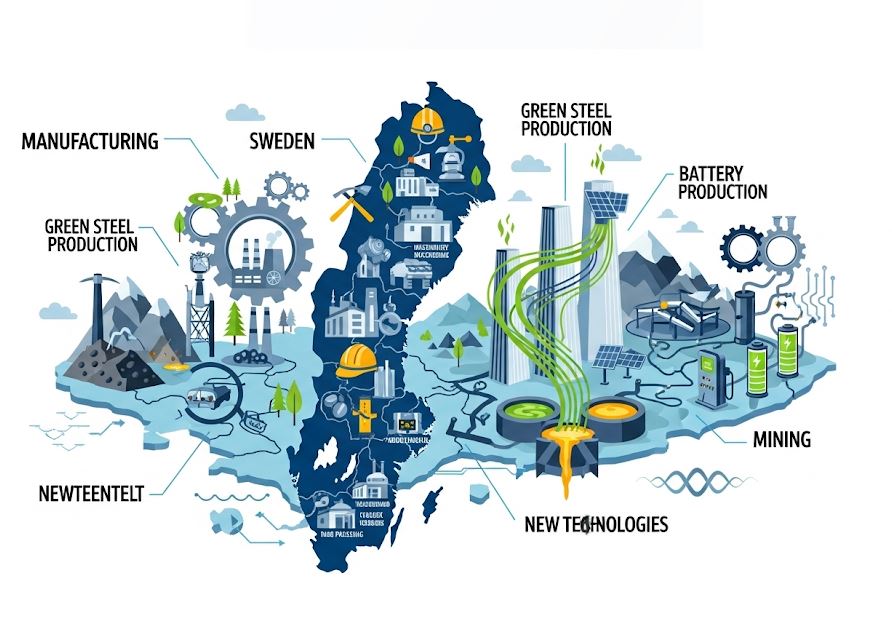
Sweden’s industrial base has tilted heavily toward sectors with structural demand. Electrification, battery production, and defence equipment now account for an estimated 23% of manufacturing output, up from 14% in 2021. Recent EU defence procurement packages and the US Inflation Reduction Act’s final implementation phase have funnelled orders to firms like Saab, Northvolt, and Volvo Group.
2. Inventory normalisation is over
The post-pandemic supply shock cycle appears complete. Supplier delivery times — a key PMI component — improved for the fifth consecutive month. That means Swedish firms can now fulfil backlogs faster, converting orders to revenue without the margin erosion seen in 2022–2023.
3. Weak krona still providing a buffer
Despite Riksbank rate cuts to 2.75% in March 2026, the krona remains 8% weaker against the euro than its 5-year average. For exporters, that’s been a de facto subsidy. CFOs should note: SEB’s FX desk now forecasts SEK/EUR to strengthen to 11.20 by Q4, which could trim competitiveness if productivity gains don’t keep pace.
Update: Where We Stand in May 2026
The April data predates two material developments readers should factor in:
| Development | Impact for Nordic Executives |
| Riksbank signals pause after March cut | Borrowing costs for CAPEX likely stable through summer. Investment committees can model 2.75% as the base case. |
| EU carbon border tax Phase 2 started May 1 | Steel, aluminium, and cement exporters face new reporting and costs. Margins in heavy industry could see 40–120 bps compression. |
| German industrial production +1.4% in April | Sweden’s largest export market is recovering. Expect spillover demand in Q3, especially for automation and trucks. |
Risks on the horizon: The PMI’s “price of input goods” sub-index rose to 61.3, the fastest increase since late 2022. Energy and rare earths are the culprits. If conflict in the Red Sea disrupts Asian shipping again, expect lead times to stretch by Q3.
Strategic Takeaways for Readers
1. Revisit hedging: With SEK strength likely in H2, exporters with >30% USD/EUR revenue should stress-test earnings at 10.80 SEK/EUR.
2. Capacity decisions: Order backlogs are now at 3.8 months vs. 2.1 months in early 2025. If you’ve delayed automation or hiring, the window for adding capacity without losing market share is narrowing.
3. Watch the service PMI: Swedish services PMI dipped to 49.8 in April. A manufacturing–services split often precedes consumer slowdown. B2B firms tied to domestic demand should monitor Q2 retail data closely.
Next in Nordic Business Journal
In our June issue, we’ll dive deeper into the supply chain: “From Just-in-Time to Just-in-Case: How Swedish Manufacturers Are Rewiring for Geopolitical Risk.” We’ll interview procurement heads at three listed industrials on dual-sourcing, nearshoring to the Baltics, and CBAM compliance costs.
Connect with us
Have data from your own operations that challenges or confirms this trend? Our editorial team wants to hear from you. Share your insights or pitch a case study at editor@nordicbusinessjournal.com or join the conversation with fellow executives on our LinkedIn page.
Data sources: Swedbank/Silf PMI, SEB Economic Research, SCB. Analysis current as of May 4, 2026.