Norwegian households and businesses are confronting a renewed acceleration in food prices that is diverging sharply from the country’s overall inflation trajectory. New data from Statistics Norway (SSB) show food and non-alcoholic beverage prices rose 2.8% month-on-month in April and 6.1% year-on-year — nearly double the 3.4% annual rise in the Consumer Price Index (CPI). The decoupling underscores a policy challenge now familiar across the Nordics: while targeted fiscal interventions can dampen headline inflation, structural pressures in food supply chains remain exposed to climate, geopolitical, and input-cost volatility. For executives, investors, and policymakers, the split between headline and food inflation carries direct implications for wage negotiations, margin management, and the investment case for agritech, retail, and logistics.
Food Prices Accelerate While Headline Inflation Moderates
SSB’s April CPI release confirms a two-speed inflation environment. Food prices advanced 2.8% in a single month, lifting the 12-month rate to 6.1%. By contrast, the all-items CPI increased 3.4% over the past year.
The divergence is explained, in part, by energy. “In March, electricity and fuel contributed to driving up price inflation, while this month the same goods contributed to dampening the rate of growth in the CPI. One of the reasons is cuts in fuel taxes,” says Espen Kristiansen, Head of Section at Statistics Norway.
The fiscal relief on fuel has provided near-term breathing room for households and transport-intensive sectors. Yet food, which accounts for roughly 12% of the Norwegian CPI basket, is now the dominant upward force.
Nordic context: Norway’s 6.1% food inflation sits above Sweden’s April print of 5.4% and Denmark’s 4.9%, but below Finland’s 6.4%, according to the respective national statistical agencies. The pattern is consistent across the region: energy-driven CPI relief is not fully passing through to grocery shelves.
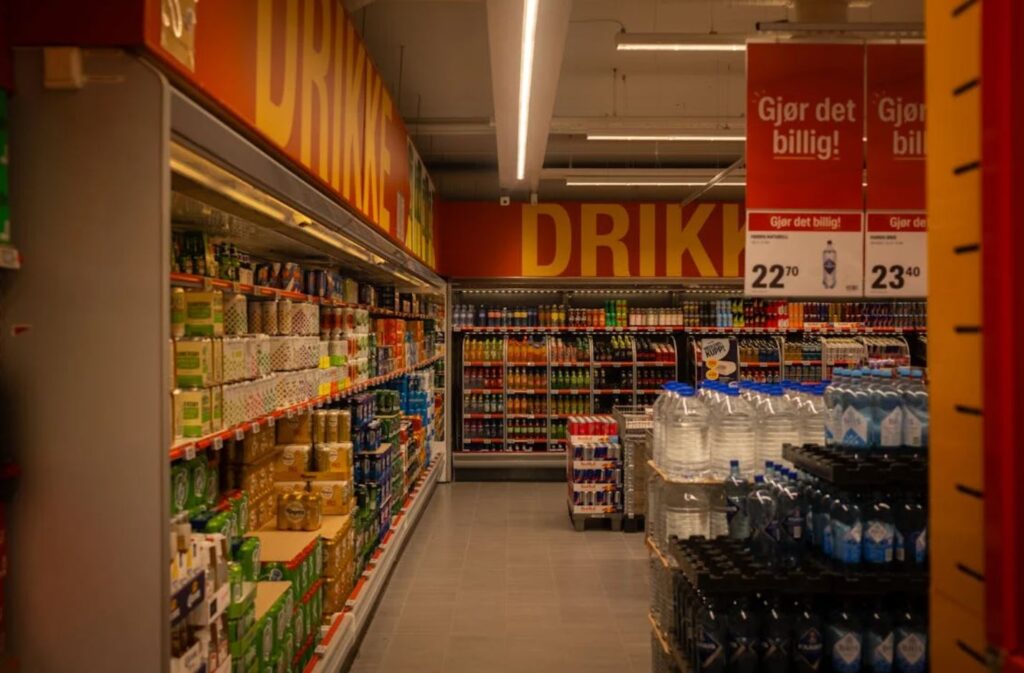
What’s Driving the Grocery Bill Higher
Four interlocking factors explain the persistence of food inflation in Norway and the broader Nordic market:
1. Input and import costs: A weaker krone through Q1 2026 raised the cost of imported agricultural commodities, feed, and fertilizer. With Norway importing ~50% of its food consumption, FX pass-through remains material.
2. Climate and supply shocks: Reduced yields in Southern Europe and elevated global cocoa, coffee, and olive oil prices continue to filter into processed goods. The EU’s new deforestation regulation, effective January 2026, is also adding compliance costs to key supply chains.
3. Retail concentration and pass-through lags: Norway’s grocery sector is among Europe’s most concentrated, with three groups controlling >95% of sales. Negotiated annual contracts between suppliers and retailers mean cost increases often appear in waves, contributing to the 2.8% monthly jump.
4. Labour and logistics: Collective wage agreements settled in April added 4.2% to labour costs in food manufacturing and retail, while revised road tolls and carbon-related transport surcharges persist despite fuel tax cuts.
Business Implications: Margins, Strategy, and Investment
For retailers and FMCGs: The spread between food inflation (6.1%) and headline CPI (3.4%) signals continued pressure on consumer purchasing power. Volume elasticity is re-emerging in discretionary categories, while private-label penetration reached 38% in Q1 — a record for Norway. Expect further SKU rationalisation, supplier renegotiation, and accelerated investment in automation to protect margins.
For investors: Food inflation volatility strengthens the case for Nordic agritech and supply-chain resilience plays. Precision farming, vertical greenhouse capacity, and alternative proteins are attracting capital as buyers seek to de-risk import exposure. Listed grocers with strong private-label and logistics assets are better positioned than pure-play brands.
For policymakers: Fuel tax cuts are effective at containing headline CPI but do little for food. With Norges Bank holding its policy rate at 4.25% to balance krone stability and inflation, fiscal tools targeting food system efficiency — VAT adjustments on fruit and vegetables, targeted support for greenhouse energy costs, or competition reviews — are likely to re-enter debate ahead of the 2026 budget.
Why This Matters Now
Three timing factors elevate the issue from cyclical to strategic:
1. Wage cycle: Norway’s main wage negotiations conclude in May. A 6.1% food inflation print becomes the reference point for unions, raising the risk of a wage-price feedback loop if headline CPI moderation is perceived as temporary.
2. Consumer sentiment: SSB’s consumer confidence index remains negative, with food prices cited as the top household concern. Discretionary spending in travel, durable goods, and housing will remain sensitive to grocery bills.
3. Geopolitical backdrop: Continued disruption in Red Sea shipping lanes and uncertainty around EU agricultural policy add upside risk to import costs through H2 2026.
Risks and Forward Outlook
Upside risks: A further weakening of the krone, adverse summer weather in Europe, or escalation of trade-related food export restrictions could push Norwegian food inflation toward 7–8% by Q3.
Downside risks: Easing global commodity prices, a recovery in hydropower reservoir levels reducing food processing energy costs, and stronger NOK on higher oil revenue could pull food inflation below 5% by year-end.
Long-term trend: The Nordics are moving toward a structurally higher food-cost regime driven by climate adaptation, sustainability compliance, and supply-chain regionalization. Companies that internalise this — through vertical integration, renewable-powered greenhouses, and digital traceability — will define competitive positioning for the next decade.
Strategic Perspective
Norway’s latest data illustrate a broader Nordic reality: energy can be managed with fiscal levers, but food security and affordability require industrial policy, innovation, and investment. For senior leaders, the imperative is twofold. First, embed food-cost scenario planning into pricing, sourcing, and wage strategies for 2026–2027. Second, view the current squeeze as an accelerator for capital deployment into resilient, low-carbon food systems. The firms and countries that reduce exposure to external shocks — not just to oil, but to wheat, feed, and freight — will capture both margin and mandate in the next cycle.
The fuel tax cut has bought time. The food aisle will determine whether it was used wisely.