
The world still looks to the United States to shape economic and political debate, regardless of how Washington behaves. In American politics, few labels are more toxic than communism. A candidate branded with it can see their credibility collapse overnight. That raises the real question: what do Americans actually think when they hear the word? Meanwhile, China—still officially communist—keeps expanding its economy and edging closer to overtaking the US as the world’s largest. Could Americans ever come to see communism as a serious alternative to capitalism, or is the idea permanently off the table?
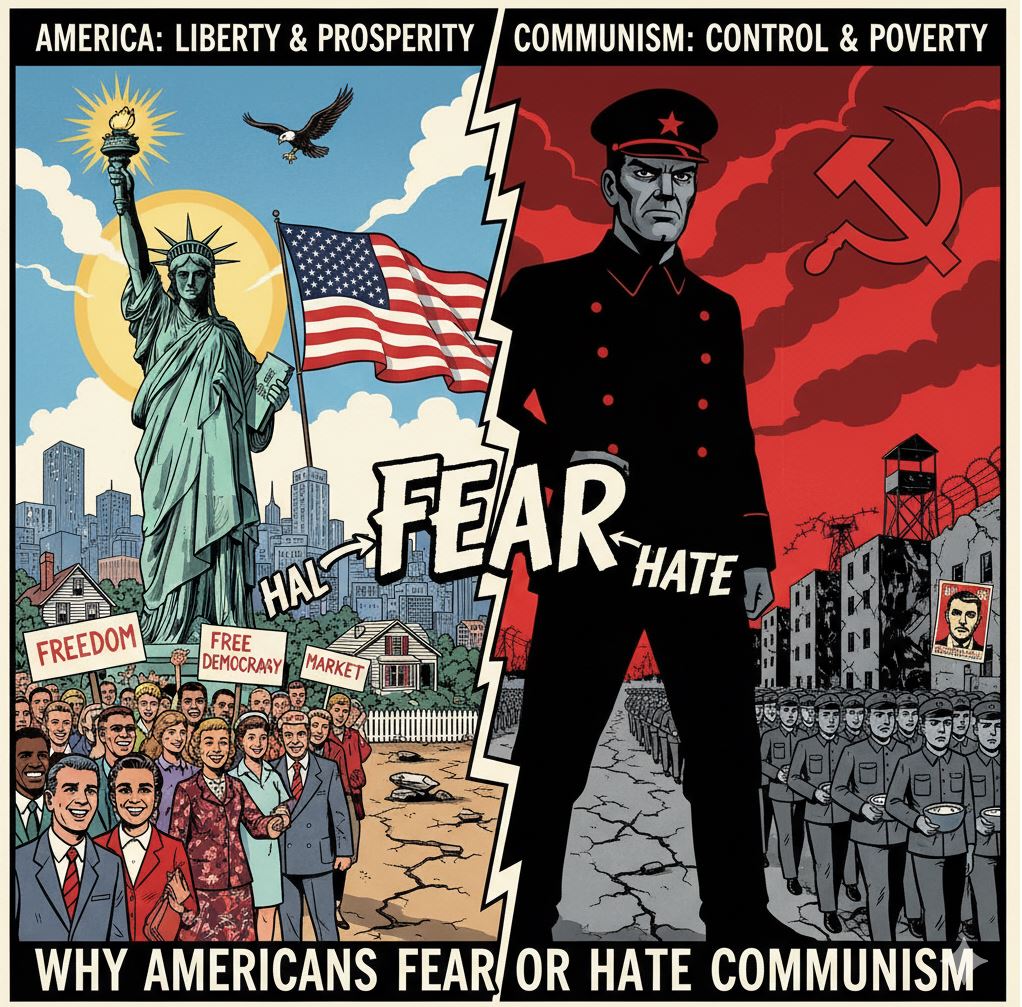
For many Americans, socialism and communism have been associated with authoritarian regimes, state control of the economy, and a loss of individual freedoms. This stems from the historical context of the Cold War, when the U.S. saw itself in a global struggle against the spread of communism, particularly through the Soviet Union and Maoist China. The U.S. government and media portrayed communism as a totalitarian system that not only stifled economic growth but also violated human rights.
However, there has been a shift in how Americans perceive socialism in recent years, particularly among younger generations. Democratic socialism, which emphasizes a mix of socialism and democracy (think Bernie Sanders or Alexandria Ocasio-Cortez), has gained popularity, especially in urban areas. This form of socialism does not advocate for the abolition of private property or authoritarian rule but calls for robust social safety nets, universal healthcare, and stronger labour rights. Socialism, in this context, is seen more as a reformist ideology that seeks to reduce income inequality and provide public goods.
Communism, on the other hand, still carries much more negative connotations in the U.S. due to its association with dictatorships like those of Joseph Stalin in the Soviet Union or Mao Zedong in China. In the American political sphere, “communist” is often a term used as a political attack to discredit opponents, invoking fears of an all-powerful state that suppresses freedom, property rights, and free markets.
The Case of Zohran Mamdani: Communist or Reformist?
When a candidate like Zohran Mamdani is labelled a communist by political opponents or critics, it doesn’t necessarily mean he advocates for the same kind of communism as the Chinese or Soviet systems. In fact, it’s important to differentiate between the labelling of political figures and the actual policies they espouse.
- Madani and the “Communist” Label: If Madani, a candidate running for mayor of New York, is being called a communist, the term likely refers to his advocacy for left-wing policies such as universal healthcare, wealth redistribution, or government intervention in certain industries (like housing, education, or energy). Critics may be using “communist” as a political scare tactic to associate Madani with totalitarian ideologies, even if his platform is centred on democratic socialism or progressive reforms.
- Misapplication of the Term “Communist”: In the U.S., especially in political debates, the term communist is sometimes used indiscriminately to attack politicians on the left, even when they don’t advocate for the abolition of private property or the creation of a one-party state. This reflects a misapplication of the term, where people confuse democratic socialist or progressive economic policies with the more extreme and authoritarian visions of Marxist-Leninist communism.
Does “Communism” Mean the Same as in China?
When Americans call someone like Madani a communist, it’s often a far cry from the reality of Chinese communism. The Chinese economic model, often referred to as “socialism with Chinese characteristics”, blends market-oriented reforms with state control over certain strategic industries. Under the leadership of the Chinese Communist Party (CCP), China has embraced aspects of capitalism, including private businesses, stock markets, and foreign investment, while maintaining an authoritarian political structure that suppresses political dissent and centralizes power.
China’s model is often described as authoritarian capitalism, with the government using its power to strategically guide economic growth. This is very different from what is typically understood by communism in the Marxist sense, which calls for the abolition of private property, class distinctions, and the state itself, eventually leading to a stateless, classless society. China’s system, while calling itself communist, operates on the basis of strong centralized control, with private enterprises coexisting alongside state-run sectors.
Argument: Is Calling Zohran Mamdani a Communist Misleading?
One could argue that labelling Zohran Mamdani as a communist—in the same way one would refer to China as a communist country—risks confusing the conversation and oversimplifying the issues at play. Here are some points to consider:
- Context Matters: In the American context, “communism” typically refers to authoritarian systems, like China’s, that centralise political and economic power in the hands of the state. Madani, if he advocates for progressive policies like universal healthcare, higher taxes on the wealthy, or increased social spending, is more likely aligned with democratic socialism, not the Marxist-Leninist principles that underpin the Chinese system.
- Communism vs. Authoritarianism: The distinction between communism as an ideology and authoritarianism as a system of governance is crucial. China, while nominally communist, is more accurately described as an autocratic state. In contrast, Madani’s policies would likely be situated within the realm of democratic socialism—emphasizing social welfare and equality within a democratic framework. Therefore, equating Madani’s progressive stance with China’s authoritarian system is misleading.
- Policy vs. Political System: The key difference between China and the U.S. is not simply the label of “communist” but the nature of their respective political systems. China’s one-party rule enables rapid decision-making and centralized economic planning. In contrast, a democratic socialist in the U.S., like Madani, would operate within a multi-party system, requiring political cooperation and checks on executive power.
- Economic Models: Even if Zohran Mamdani is labelled a communist for supporting extensive government intervention in the economy, his policies would not call for the same state-run economy as China’s. The Chinese model places a significant emphasis on state-owned enterprises and central economic planning, while a democratic socialist platform in the U.S. would focus more on regulation and redistribution within a predominantly market-driven economy.
Conclusion: How Can One Argue This?
To argue against the notion that calling Zohran Mamdani a communist is equivalent to labelling China as a communist state, one could make the following points:
- Clarify the Ideologies: Communism in the Marxist sense and democratic socialism are two different things. Madani’s proposals likely centre on social welfare and wealth redistribution through democratic means, not the state-controlled economy or one-party rule characteristic of China’s system.
- Highlight the Political Systems: The key distinction is not just the economic model, but the political system. China’s autocracy and lack of political freedoms is fundamentally different from the democratic system in the U.S., even if both systems advocate for significant state intervention in the economy.
- Focus on the Practical Differences: Even though Madani’s policies may lean left, they are unlikely to involve the totalitarian measures associated with traditional communist regimes. His platform would likely operate within a capitalist framework, where the market plays a major role, and the government’s role is more about redistribution and regulation than ownership of production.
In conclusion, while the label “communist” is often used as a political tool to discredit left-wing candidates, it does not mean the same thing when applied to someone like Madani as it does when describing China’s political system. To reduce the conversation to a mere semantic argument about labels misses the deeper, more complex differences in political structures and ideologies.