
Sweden’s police force is undergoing a significant transformation with a deliberate and strategic expansion of their drone programme. The growth is not only supported by internal investments but also by recent changes in the legal framework that have eased restrictions on surveillance technology. These developments are shaping the future of public safety, raising questions about privacy, civil liberties, and the increasing presence of surveillance in everyday life.
The Rise of Drones in Swedish Policing
The number of police drone flight hours in Sweden is expected to surge from 550 in 2018 to approximately 16,000 by 2025. This sharp increase reflects a systematic scaling-up of drone operations, with police forces now managing around 300-350 drones nationwide. With about 200 licensed drone pilots—roughly 1% of the entire police force—drones are becoming a staple in law enforcement practices.
Drones are used for various tasks, including monitoring high-crime areas, managing traffic, ensuring crowd control at major events, and aiding in searches for missing persons. They provide a cost-effective and agile alternative to traditional methods, such as helicopters.
A Changing Legal Landscape
The rapid growth of drone surveillance is directly linked to the Swedish government’s “video surveillance offensive.” This initiative has made it easier for police to deploy drones and Automatic Number Plate Recognition (ANPR) technology across the country. A significant legal shift will take place in May 2025, when new rules will come into force. These regulations will expand the use of surveillance cameras, including drones and those in unmarked vehicles, with fewer restrictions on informing the public. Moreover, the balancing test between privacy and crime-fighting interests, which previously governed such activities, will be relaxed.
Local Implementation: Västerås and Malmö
One of the regions leading the way in drone surveillance is Västerås, a city where surveillance drones have become a regular feature, particularly in high-crime areas known as utsatta områden (vulnerable areas). Districts such as Bäckby, Skallberget, Hammarby, Rocklunda, and central Västerås are seeing increasing drone activity. The decision to deploy drones in these areas is based on crime statistics and the risk of serious criminal activities.
For example, in Bäckby, a formal decision allows police to use drone-based camera surveillance from December 2025 to September 2027 to prevent and investigate serious crime. These drones are equipped with cameras that can capture footage potentially admissible in court as evidence.
Operational Use of Drones
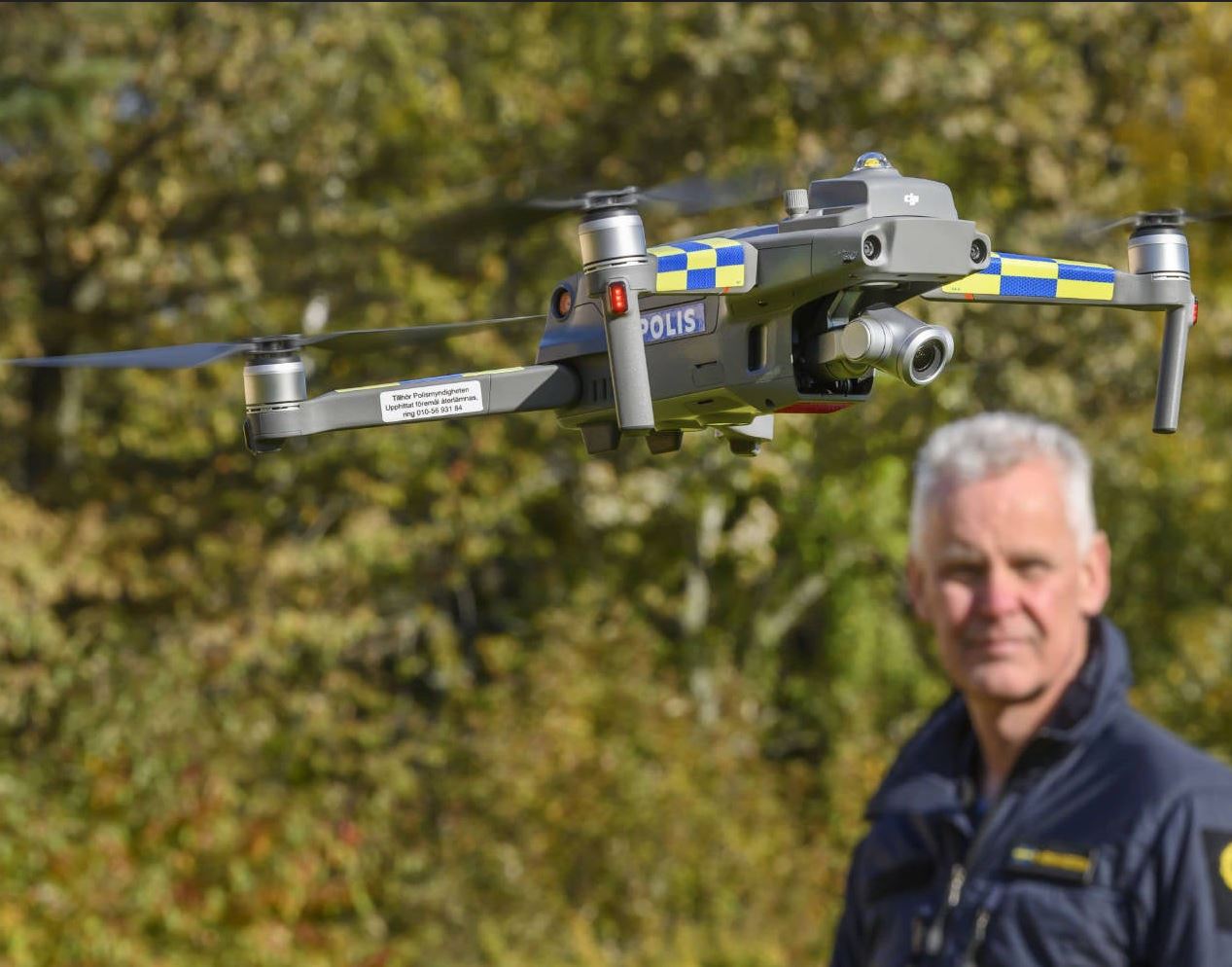
Swedish police use drones for real-time surveillance from strategic vantage points, often launching them from rooftops or other elevated positions. Equipped with high-definition visual and thermal cameras, drones are capable of monitoring vast areas day and night. The police assert that drones are typically flown at altitudes that prevent easy identification of individuals’ faces, while the surveillance is focused on public spaces. Drones are not permitted to film inside private homes, and any surveillance is carried out under the supervision of area commanders, ensuring that operational procedures adhere to legal and ethical standards.
Public Debate: Privacy vs. Public Safety
The expansion of drone surveillance in Sweden has sparked ongoing debate, particularly about the balance between security and privacy. In Västerås, residents express mixed feelings about the increased presence of drones in their neighbourhoods. While some appreciate the heightened sense of safety, others feel uncomfortable with the constant monitoring overhead.
Mammad Wallérion, a resident of Västerås, shares this ambivalence, describing the situation as “both reassuring and unsettling.” Local interviews have revealed a broader sentiment that, while some believe drones contribute to a safer environment, others lament the fact that such measures are even necessary.
The key concerns raised by civil liberties groups focus on the normalization of long-term aerial surveillance in urban areas, which was once unthinkable. The reduced requirement to notify the public about ongoing surveillance is also a major point of contention. Furthermore, as drone technology evolves, the potential for more invasive data analysis, such as facial recognition or pattern analysis, looms large. Critics worry that these technologies could gradually push Sweden toward a surveillance state, one that most citizens may not fully comprehend until it is too late.
Looking Ahead: The Future of Surveillance in Sweden
As drones become an increasingly integral part of Swedish policing, the balance between safety and privacy will be a defining issue. The easing of surveillance laws may be a necessary step in the face of rising crime rates, but it raises important questions about the long-term implications of mass surveillance.
As the Swedish police continue to expand their drone operations, they will need to address public concerns and ensure that the use of such technologies is both effective and responsible. The growing presence of drones in Swedish skies may be just the beginning of a broader trend toward increased surveillance across Europe, prompting citizens and lawmakers alike to consider how far the state should go in monitoring its citizens for the sake of public safety.
Conclusion
The expansion of drone surveillance in Sweden highlights a pivotal moment in the country’s approach to public safety and technology. While drones offer undeniable benefits in terms of operational efficiency and cost-effectiveness, they also raise significant ethical and legal challenges. As the legal landscape continues to evolve, the ongoing debate will shape the future of surveillance and privacy in Sweden for years to come.
The Nordic Business Journal is committed to providing accurate and fair reporting. If you spot an error or misleading information, please email us at info@Nordicbusinessjournal.com.