
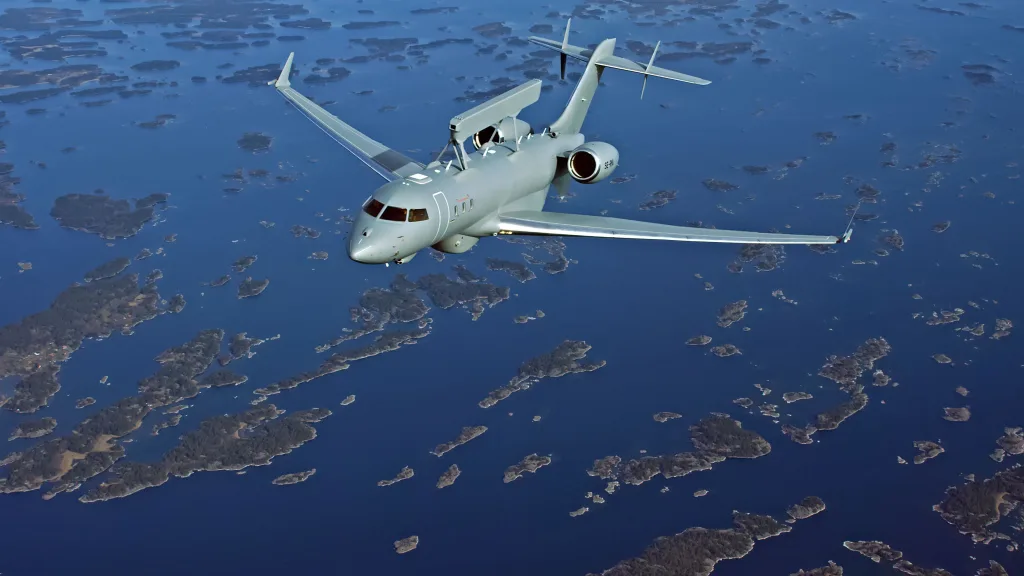
In a landmark move underscoring the strengthening of trans-European defence ties, France has finalised a deal to acquire two Saab GlobalEye airborne early warning and control (AEW&C) aircraft—a decision that analysts say reflects both strategic autonomy and deepening interoperability within NATO and EU defence frameworks. Announced on Tuesday, the agreement—valued at approximately SEK 12.3 billion (roughly €1.05 billion)—marks the first European export of the GlobalEye system outside Sweden and represents one of the most significant defence procurements between two EU member states in recent years.
A Strategic Milestone with Industrial and Geopolitical Implications
Under the contract signed with France’s Direction Générale de l’Armement (DGA)—the French equivalent of Sweden’s FMV—the acquisition includes not only two GlobalEye aircraft but also comprehensive ground support infrastructure, pilot and operator training, and a decade-long maintenance and sustainment package. Deliveries are scheduled between 2029 and 2032, with an option for France to procure two additional units, potentially doubling the initial commitment.
“This is more than a sale—it’s a strategic alignment,” said Saab spokesperson Mattias Rådström. “France is the first European nation outside Sweden to invest in GlobalEye, recognizing its unique ability to enhance national sovereignty while reinforcing collective European and NATO defence capabilities.”
The timing is particularly significant. With Russia’s war in Ukraine entering its fourth year and emerging threats in the Sahel and Eastern Mediterranean, France is actively modernizing its intelligence, surveillance, and reconnaissance (ISR) assets. The GlobalEye—based on the Bombardier Global 6000 business jet and equipped with Saab’s cutting-edge Erieye ER radar—provides persistent wide-area surveillance, maritime domain awareness, and command-and-control functions that complement France’s existing fleet of Rafale fighters and future FCAS (Future Combat Air System) ambitions.
Defence Minister Hails Industrial and Diplomatic Win
Swedish Defence Minister Pål Jonson (Moderates) welcomed the deal as a “great success for the Swedish defence industry,” emphasizing its dual impact on national security and high-value employment. “We are expanding our defence industrial footprint and showing that Sweden is an essential partner in making Europe safer,” Jonson told SVT. “This deal proves that Swedish innovation can compete—and win—on the global stage.”
Indeed, the ripple effects extend beyond Gothenburg and Linköping. Saab has confirmed that the program will generate skilled jobs in both Sweden and France, including partnerships with French defence firms for subsystem integration and maintenance—a model that aligns with the European Commission’s push for strategic autonomy and defence industrial consolidation under initiatives like the European Defence Fund (EDF).
A Catalyst for Broader European Adoption?
France’s endorsement could serve as a powerful validation for other NATO allies. Denmark and Germany have long expressed interest in upgrading their aging ISR fleets, and both nations are evaluating next-generation AEW&C solutions. With GlobalEye now battle-tested in the UAE (which has taken delivery of five units) and backed by a major European power, Saab may be well-positioned to capture additional orders—especially as the U.S. focuses its E-7 Wedgetail production on domestic and Five Eyes needs.
Moreover, the deal arrives just months after Sweden’s formal accession to NATO in March 2024—a milestone that has amplified Stockholm’s role as a defence technology hub. The GlobalEye, with its open architecture and compatibility with NATO C4ISR standards, exemplifies the kind of interoperable, sovereign-capable systems that the alliance increasingly prioritizes.
Looking Ahead: The Road to a European ISR Network?
As Europe grapples with fragmented defence procurement and overlapping capabilities, France’s investment in GlobalEye may signal the beginning of a more coordinated approach to airborne surveillance. Could we see joint operational concepts or even a multinational GlobalEye fleet in the future—akin to the European AWACS replacement program? With Sweden now fully integrated into NATO structures and France championing European defence sovereignty, such collaboration is no longer speculative.
What’s Next?
In our next feature, Nordic Business Journal will explore how Sweden’s defence-tech ecosystem—from Saab and BAE Systems Hägglunds to emerging AI and cyber startups—is becoming a cornerstone of Europe’s security architecture. We’ll also assess the economic spillover effects of defence exports on the Nordic innovation economy.
Stay Connected
Are you a defence industry professional, policy expert, or investor tracking Europe’s security transformation? We’d love to hear from you. Reach out to our editorial team at insights@nordicbusinessjournal.com or connect with us on LinkedIn for exclusive updates and roundtable discussions.