
As Sweden’s foreign-born population nears 2.2 million, the nation stands at a crossroads. The question is no longer simply how many have arrived, but how to effectively integrate a demographically and culturally diverse population into a high-skill, high-wage economy. This report from the Kunskapsverket (Swedish National Agency for Knowledge) provides the data-driven foundation for understanding the scale and complexity of the challenge.
By The Nordic Business Journal, in collaboration with the Swedish National Agency for Knowledge
In the two decades since 2005, Sweden has undergone a profound demographic transformation. Today, over one in five residents (21%) are foreign-born, a sharp increase from 12% in 2005. When including those with two foreign-born parents, this figure rises to 27% of the population. This shift represents not just a change in numbers, but a fundamental change in the composition of the country’s working-age population, with profound implications for the labour market, public finances, and the broader business landscape.
While the political debate often focuses on migration flows, a more critical question for business leaders and policymakers is this: How is this integration process actually unfolding, and what are its tangible economic impacts? A new compilation from the Swedish National Agency for Knowledge offers a fact-based answer.
1. A New Demographic Landscape: From Neighbourhood to Global
The nature of immigration to Sweden has changed dramatically over the last 20 years. In 2005, most foreign-born residents came from other European countries, with Finland and the former Yugoslavia being the largest source nations. Today, Syria and Iraq top the list, with significant populations also from Afghanistan, Somalia, and Eritrea.
Our analysis shows that half of Sweden’s foreign-born population now originates from what we term “typical refugee countries.” This group has grown by over 650,000 people since 2005—a staggering 130% increase. Crucially, this cohort is fundamentally different from the labour migrants who arrived in earlier decades. They come from nations with vastly different economic, political, and cultural profiles.
Key analytical insight: A comparison using the UN’s Human Development Index (HDI) reveals a stark shift. In 2005, only 17% of Sweden’s foreign-born came from countries with a low HDI (a value below 0.7). Today, that figure has more than doubled to 35%. These are nations like Syria, Iraq, and Somalia, where average education is half that of Sweden, gender equality metrics are significantly lower, and authoritarian governance is the norm.
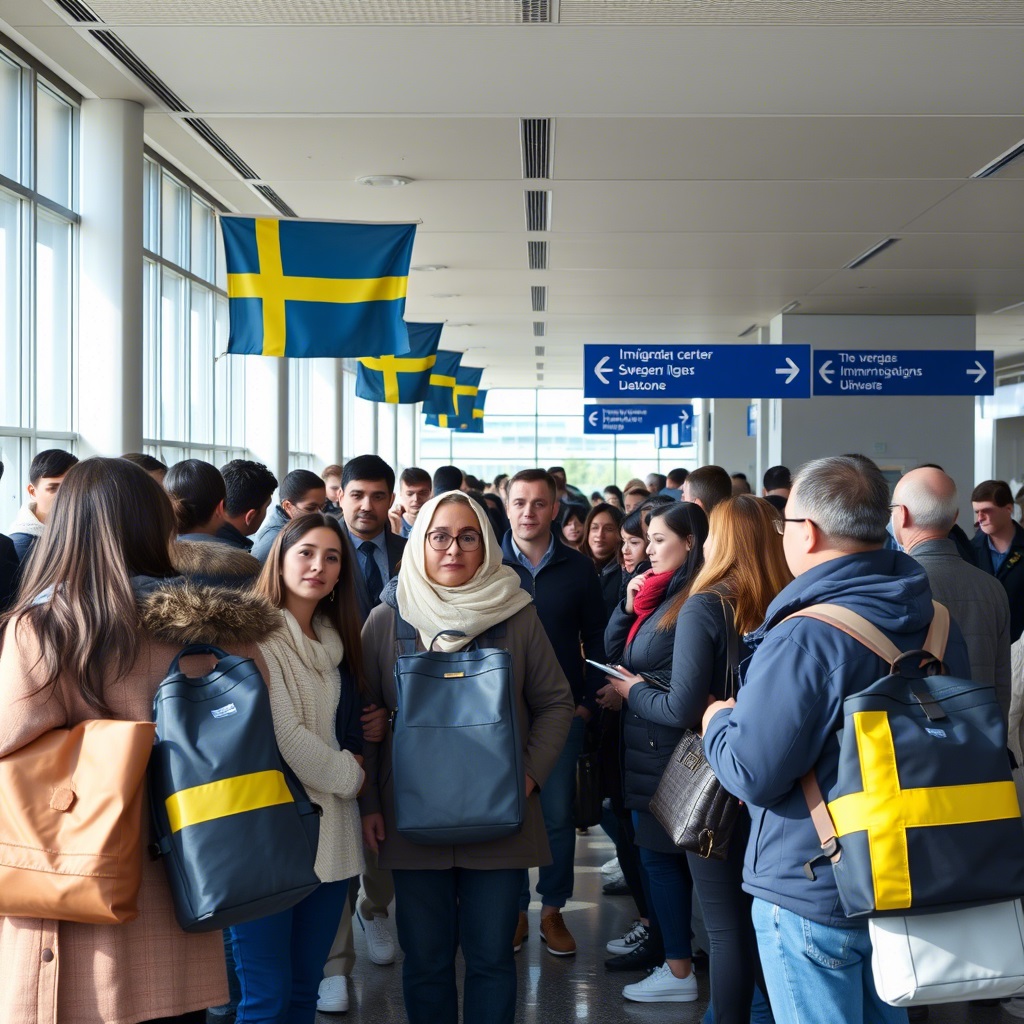
For the Nordic business community, this represents a workforce integration challenge unlike any faced before. The starting point for these new Swedes is not simply one of geography, but of structural disadvantage.
2. The Labour Market Paradox: Progress and Persistent Exclusion
The narrative on employment is one of progress and paradox. The share of working-age foreign-born individuals in employment has risen from 63% in 2005 to 70% in 2023. This is a positive trend, driven by a strong Swedish economy and targeted establishment programmes. However, the data reveals a more complex picture when we look at volumes and quality.
Despite rising employment rates, the number of foreign-born individuals without a job has increased from just over 300,000 to nearly 500,000 over the same period. This is partly due to population growth, but it also points to a hardening core of exclusion. Today, one in three foreign-born individuals of working age (33%) are not self-sufficient, meaning they lack sufficient income to support themselves.
This “economic exclusion” is not a uniform phenomenon. It manifests in three distinct ways:
1. Unemployment: The unemployment rate among foreign-born individuals is nearly four times higher than among native-born Swedes (8.9% vs. 2.3%). For individuals from low-HDI refugee countries, this rate soars to 17%.
2. Labour Market Inactivity: A staggering 13% of foreign-born individuals are neither working nor actively seeking employment—a group over three times larger than its native-born counterpart. A significant portion of this group are family members of labour migrants, highlighting a hidden layer of dependency.
3. In-Work Poverty: Even among those who do find employment, 14% earn too little to be considered self-sufficient. This rate is twice as high as for native-born workers. Notably, women from non-European countries are the most vulnerable, with 19% of those in employment still earning below the self-sufficiency threshold.
For our readers: This is a critical business intelligence point. The integration challenge is not just about getting people into jobs, but about ensuring those jobs lead to sustainable incomes. For employers, this signals a need for more nuanced retention and progression strategies, particularly for roles in the care and service sectors where many foreign-born workers are concentrated.
3. The Education and Language Gap: A Barrier to a High-Skill Economy
Sweden’s economic model relies on a highly skilled, educated, and digitally fluent workforce. This is where the integration process faces its most formidable barrier. The data shows a clear correlation between educational background, language proficiency, and labour market outcomes.
– Education: 19% of foreign-born individuals have only a pre-secondary education (compared to 13% of native-born). The number of people with only this basic level of schooling has grown from 214,000 in 2005 to 324,000 today.
– Language: Employers consistently cite poor Swedish language skills as a primary barrier to hiring. A full one-third of foreign-born individuals of working age—over 560,000 people—lack the reading skills in Swedish necessary to actively participate in the labour market, according to OECD’s PIAAC assessment.
The publicly funded language programme, Swedish for Immigrants (SFI), is a crucial entry point. However, our analysis reveals systemic flaws. Between 2017 and 2023, over 384,000 students began an SFI course, but only a third as many completed the final level, which is designed to signify functional independence in the language. Furthermore, only 3% of those who passed did so through courses designed for those with little prior education, suggesting the system is ill-equipped to support those who need it most.
Update to current times (2026): Since the original report’s data collection, recent government initiatives have focused on vocational SFI and mandatory civic orientation. However, early indicators suggest these reforms have yet to close the gap. A report from the Swedish National Audit Office earlier this year highlighted that while spending on integration has increased by over 30% since 2020, the long-term employment outcomes for the 2015-2017 cohort remain stubbornly below targets.
4. The Cultural and Democratic Divide
Integration extends beyond the labour market to social cohesion. The data points to a widening cultural gap that businesses and public institutions must navigate. According to the World Values Survey, Sweden’s combination of secular, liberal, and individualistic values is an outlier globally. The gap between these values and those prevalent in many of the major source countries for recent immigration is significant.
This cultural distance has tangible consequences. While the majority of foreign-born individuals become Swedish citizens (65%), democratic participation lags. In the 2022 general election, 89% of native-born Swedes voted, compared to just 67% of eligible foreign-born voters. This gap is larger than in previous elections. Similarly, representation in democratic assemblies has not kept pace with population growth. In municipalities, the gap between the share of foreign-born residents and the share of elected officials has doubled from 5 to 10 percentage points since 2006.
or business leaders, this signals a challenge for internal culture, leadership, and the long-term stability of the communities where they operate. A society with lower civic participation and persistent social divides is a less predictable and stable environment for investment.
5. The Way Forward: Questions for the Nordic Business and Policy Community
The Swedish National Agency for Knowledge’s compilation does not offer easy answers, but it clarifies the crucial questions. The demographic shift is permanent. The composition of the workforce has changed irrevocably. The core issue is no longer about borders, but about bridges: bridges to sustainable employment, to civic society, and to a shared cultural understanding. For example there are Swedish Africans (Specific cases that can be authenticated by the NBJ) who have PhD in Sweden, the UK and other EU countries but once back in Sweden are unemployed or at best under-employed.
Three key questions emerge for the Nordic Business Journal’s readership:
1. How do we adapt the labour market model?
For decades, Sweden’s model has relied on education as the primary pathway to employment. For a growing group of individuals with low prior education and limited language skills, this route is too slow and often fails. Should businesses and unions consider a more diversified model that includes more on-the-job training, subsidised employment, and a formal recognition of skills and experience gained outside traditional education systems?
2. Who is responsible for the whole?
Integration policy in Sweden has long been fragmented between the national government (responsible for establishment), municipalities (responsible for housing and SFI), and social partners (responsible for the labour market). With the arrival of a larger, more complex group of newcomers, who holds the overall accountability for ensuring that these different parts create a coherent and effective whole?
3. What is the role of the private sector?
With 1 in 4 foreign-born workers now employed in municipalities and regions, and a significant portion of new job creation for this group concentrated in care and service roles, the private sector remains an under-tapped engine for integration. How can businesses more systematically engage in “integration hiring”—not just as an act of social responsibility, but as a strategic imperative to address labour shortages in a demographically constrained Nordic region?
The integration of Sweden’s foreign-born population is one of the defining economic and social projects of our time. The data shows that while progress is being made for many, a significant and growing group is being left behind. For the Nordic business community, ignoring this challenge is not an option. The competitiveness of our economies and the stability of our societies depend on successfully turning this demographic shift into a source of strength.
About the Data
This article is based on a compilation by Kunskapsverket translated as “the Swedish National Agency for Knowledge”, a non-political, non-profit foundation dedicated to fact-based public discourse. The original report uses data from Statistics Sweden (SCB), the UNHCR, the OECD, and the World Values Survey. The analysis defines foreign-born individuals as those born outside Sweden, and uses the UN’s Human Development Index (HDI) to categorise countries of origin by standard of living.
Follow-Up and Connect with Us
This complex topic will be explored further in our upcoming issue, where we will interview business leaders and policymakers on practical strategies for integration. We will specifically examine case studies of companies in the Nordic region that are successfully integrating diverse workforces.
We invite our readers to join the conversation.
For questions, insights, or to suggest topics for our next article, please contact the Nordic Business Journal editorial team at editor@nordicbusinessjournal.com. You can also connect with us on LinkedIn, X, and Instagram for ongoing updates and analysis.
Copyright © 2026 The Nordic Business Journal & Kunskapsverket. All rights reserved.