
An analysis of digital influence operations surrounding one of the most consequential defence procurements in Canadian history
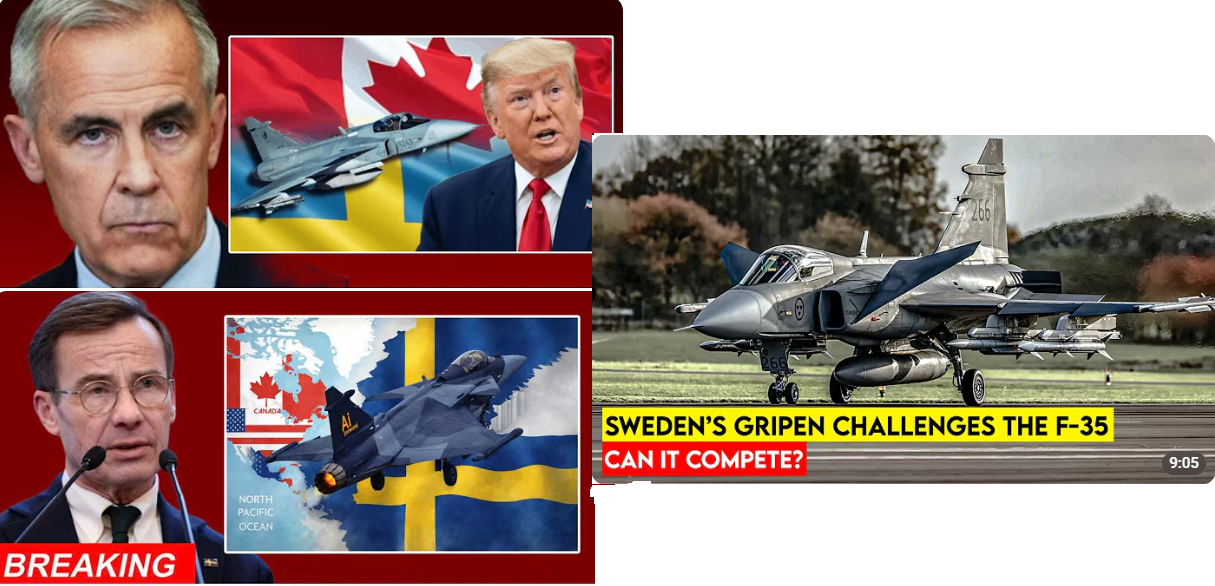
In the high-stakes contest for Canada’s next-generation fighter jet contract—a deal valued at approximately CAD $19 billion (USD $14 billion)—an unusual digital phenomenon has emerged that demands serious scrutiny from defence analysts and policymakers alike. Hundreds of mysteriously similar YouTube videos have flooded the platform, uniformly promoting Sweden’s JAS 39 Gripen while disparaging the American F-35 competitor. What began as curious internet ephemera has revealed itself to be something far more consequential: a sophisticated, likely state-affiliated influence operation with origins tracing back to Pakistan.
The Digital Campaign: Scale and Sophistication
The scope of this operation is remarkable. Since early 2025, YouTube channels—many created within days of each other—have published hundreds of videos featuring near-identical messaging: technical comparisons “proving” Gripen superiority, fabricated statements attributed to Canadian officials, and claims that Swedish Prime Minister Ulf Kristersson has already secured victory. The videos employ professional-grade graphics, consistent narrative frameworks, and strategic SEO optimization targeting Canadian defence procurement keywords.
This is not amateur enthusiasm. The operational security and coordination suggest professional backing. When SVT (Swedish Television) investigated whether Saab itself orchestrated the campaign—a logical first suspicion given the commercial stakes—the trail instead led eastward, not to Stockholm, but to South Asia.
The Pakistan Connection: Strategic Calculus
Why Pakistan? The answer lies in Islamabad’s complex defence relationships and strategic positioning. Pakistan operates a mixed fleet of Chinese JF-17s and American F-16s, with the latter subject to increasingly restrictive U.S. end-user agreements and maintenance dependencies. The F-35’s proliferation among Western allies—and its potential selection by India—threatens to degrade Pakistan’s aerial deterrence capabilities.
A Canadian F-35 purchase would deepen the Western alliance’s fifth-generation footprint, potentially accelerating F-35 adoption among NATO members and Commonwealth nations that Pakistan might face in any future conflict scenario. Conversely, a Gripen selection—built by non-aligned Sweden, with less restrictive technology transfer protocols—serves Pakistani interests by:
1. Delaying Western fifth-generation standardization, preserving Pakistan’s relative aerial competitiveness for an additional decade
2. Demonstrating viable alternatives to American defence dependency, a narrative Islamabad actively promotes to global south nations
3. Complicating U.S.-Canada defence integration, creating friction in NORAD modernisation at a moment of bilateral trade tension
The timing is not coincidental. The campaign intensified precisely as U.S.-Canada trade disputes created genuine political appetite in Ottawa for diversifying defence procurement away from American suppliers.
Current Context: Where the Competition Stands
As of April 2025, the procurement remains officially undecided, though dynamics have shifted meaningfully:
– Saab’s March 2025 delegation, led by CEO Micael Johansson, signalled unprecedented Swedish urgency. The visit coincided with Canada’s release of its final evaluation framework, with a contract decision expected by mid-2025.
– The F-35’s industrial offset controversy has created genuine political vulnerability. Lockheed Martin’s initial industrial participation commitments—critical for Canadian manufacturing votes—have faced scrutiny for undelivered promises in earlier F-35 partner nations.
– NORAD modernisation imperatives create countervailing pressure. The continental defence command’s requirement for seamless interoperability between Canadian and American fighter fleets technically favours the F-35, though Gripen’s recent NATO compatibility certifications have narrowed this gap.
– The Trump tariff factor cannot be overstated. The former president’s March 2025 threats of 25% automotive tariffs—subsequently partially suspended—transformed defence procurement into trade war leverage. Selecting Gripen would represent Canada’s most concrete retaliation against American economic pressure, a political calculation that Saab’s marketing explicitly emphasizes.
Critical Analysis: What This Means for Defence Procurement Integrity
This influence operation exposes vulnerabilities in how democratic nations evaluate major defence acquisitions. YouTube’s algorithmic amplification of emotionally resonant content—regardless of factual accuracy—has created an attack surface for foreign actors to manipulate public discourse and, potentially, political pressure on procurement officials.
The Pakistan-linked campaign demonstrates that defence influence operations have evolved beyond traditional lobbying and industrial espionage. In an era where procurement decisions are increasingly subject to public referendum via social media sentiment, sophisticated actors can manufacture apparent “grassroots” support or opposition to tilt political calculations.
For Canada specifically, this raises uncomfortable questions: Has public discourse on the fighter jet competition been authentically Canadian, or has a significant portion of apparent “public opinion” been algorithmically injected by foreign interests? How can procurement officials distinguish between legitimate domestic aerospace industry advocacy and coordinated foreign manipulation?
Strategic Implications for Nordic Defence Exporters
For Saab and Swedish defence interests, this incident presents both opportunity and peril. The manufactured enthusiasm could create false expectations of political support, while association—however undeserved—with foreign influence operations risks reputational damage in future NATO and Five Eyes competitions.
More broadly, the case suggests that non-American defence suppliers face asymmetric information warfare risks. As Western defence procurement increasingly fractures along geopolitical fault lines—American versus “sovereign” European alternatives—competitors to U.S. primes may find themselves unwitting beneficiaries or victims of third-party influence campaigns they neither requested nor control.
Looking Forward: The Integrity Question
Canada’s final decision, expected within 60-90 days, will reveal whether this influence operation achieved its apparent objective. More importantly, it will test whether Western defence procurement frameworks can insulate technical-military requirements from algorithmically amplified foreign manipulation.
For Nordic Business Journal readers, the critical follow-up question concerns accountability: Will Canadian or Swedish authorities formally investigate this influence operation’s funding and coordination mechanisms? And what regulatory frameworks—if any—can prevent similar campaigns from distorting future European defence competitions?
The Gripen-F-35 contest was already historically significant as a test of whether mid-tier European defence industries can compete with American primes for strategic NATO contracts. It has now become something equally important: a case study in how digital-age influence operations intersect with industrial policy and national security.
Next in Our Series: “The Algorithmic Battlefield: How Social Media Influence Operations Are Reshaping European Defence Procurement” — An exclusive investigation into coordinated digital campaigns targeting Germany’s FCAS program, Poland’s tank modernisation, and Nordic joint procurement initiatives.
Connect with Nordic Business Journal: Follow our defence and security coverage at Nordic Business Journal or contact our editorial team at insight@nordicbusinessjournal.com for exclusive briefings on Nordic industrial policy developments.