
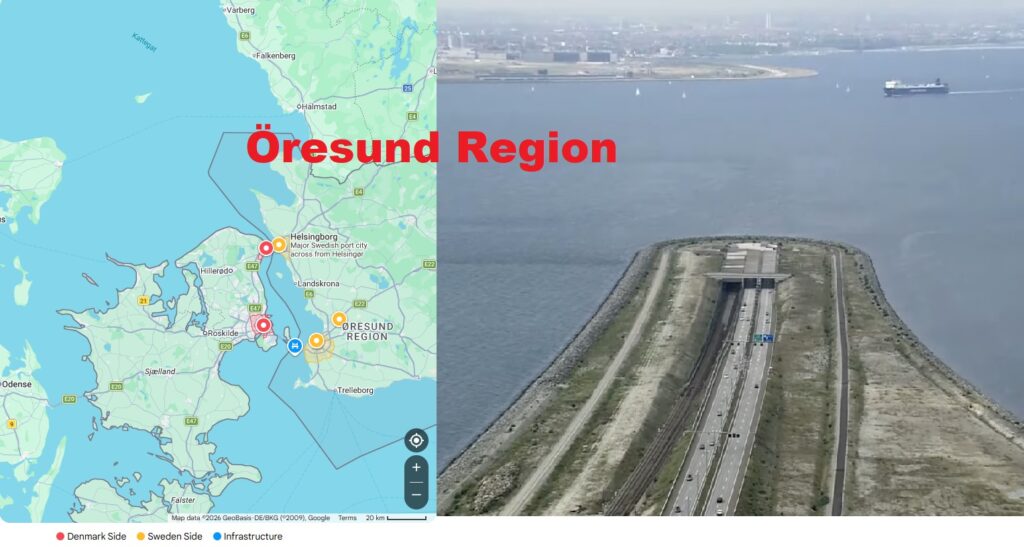
The Øresund region—one of Northern Europe’s most promising cross‑border economic areas—sits on a paradox: persistently high unemployment on the Swedish side and widening skills shortages in Greater Copenhagen. A new Greater Copenhagen analysis shows that targeted, cross‑border labour market integration could unlock significant socio‑economic value (estimated at up to SEK 13 billion, roughly EUR 1.0–1.1 billion), while easing recruitment pressures across sectors from healthcare to IT. Achieving that prize will require pragmatic, politically realistic reforms spanning transport, social security, immigration rules and digital matching platforms. For business leaders, investors and policymakers, the lesson is clear: the region’s competitive advantage lies less in new factories than in better moving people and skills across a border that is increasingly artificial for this functional labour market.
Why this matters now
Demographic ageing and the digital transformation have intensified skills mismatches across Europe. At the same time, post‑pandemic labour dynamics and supply chain recalibrations have exposed the limits of local talent pipelines. In the Øresund context, employers in Copenhagen report acute recruitment difficulties—one recent study found about 21.9 percent of roles could not be filled with the right skills—while many municipalities in Skåne still register elevated unemployment. The opportunity to reconcile these trends is timely: doing so would relieve near‑term labour bottlenecks, improve utilisation of trained workers, and strengthen the region’s medium‑term growth and resilience.
The problem in plain terms
Geography without integration: The Øresund bridge and well‑established commuter flows mask institutional friction. Workers and vacancies exist on both sides, but administrative and regulatory barriers limit effective matching.
Mismatched incentives and rules: Differences in social security, taxation, pension accrual and residence‑permit rules create financial, legal and behavioural disincentives for cross‑border commuting and hiring.
Transport constraints: Border controls introduced in 2015 and their operational effects have reduced the capacity and frequency of some rail services, increasing commuting time and weakening the catchment area of Copenhagen’s labour market.
Vulnerable cohorts: In border municipalities in Skåne there are roughly 37,000 people registered unemployed; of these, a substantial share are long‑term unemployed (42 percent), non‑EU nationals (19 percent) and young people aged 20–29 (19 percent). Non‑EU residence restrictions, in particular, can make cross‑border employment legally risky for individuals and employers alike.
Where matching can succeed: sectoral and policy priorities
The Greater Copenhagen report identifies eight sectors with clear cross‑border complementarities: construction, retail/sales, hospitality and kitchens, IT, administration, education/pedagogy and healthcare. Several practical levers could materially improve matching:
Digital vacancy interoperability: A shared, machine‑readable vacancy feed that automatically republishes Danish job openings in Swedish employment services (and vice versa) would dramatically reduce information frictions. This could be achieved through API integration between national job banks, EURES and regional portals.
Targeted skills pathways: Sectoral fast‑tracks for licensed professions (nursing, pedagogy) including joint credential recognition, short bridging courses and language modules would unlock supply quickly—particularly if coupled with employer‑led apprenticeships.
Transport and commuting optimisation: Restoring frequent, reliable rail links—unencumbered by operational constraints at the border—and aligning timetables with shift patterns in healthcare and construction would increase feasible commuting ranges and reduce the need for relocation.
Regulatory alignment: Bilateral agreements to clarify the social‑security and taxation implications of cross‑border work, portable pension contributions and rules that protect the residence status of non‑EU nationals who accept cross‑strait work are all necessary to remove legal uncertainty.
Digital credentials and verification: Employers need rapid verification of skills. Investment in verifiable digital credentials (blockchain or trusted‑ledger systems) would speed hiring and reduce assessment costs.
Risks and political considerations
Policymakers must navigate legitimate concerns: fears of wage competition, social‑benefit arbitrage, and political backlash against perceived “labour displacement.” For non‑EU residents, policymakers must ensure that mobility solutions respect immigration law while avoiding unintended penalties that lock people out of work. Any reform package should include safeguards—tapered benefit adjustments, employer contributions to local social systems, and monitoring—to minimise perverse incentives and preserve public support.
Comparative perspective
Regions that have successfully integrated cross‑border labour markets—such as the Basel metropolitan area straddling Switzerland, France and Germany, or the transatlantic San Diego–Tijuana corridor—combine strong transport links, interoperable public services and clear legal frameworks for social security. Øresund’s existing strengths (high productivity clusters, world‑class universities, and high infrastructure quality) give it a head start; what’s missing is coordination and pragmatic rule‑making.
What leaders should do next
For business executives and investors:
– Advocate for interoperable vacancy feeds and sponsor sectoral hiring pilots.
– Invest in cross‑border training and language programs tied to concrete hiring commitments.
– Consider commuter‑sensitive employment packages (shift timing, travel subsidies).
For policymakers:
– Prioritise a pilot “Öresund Matching Agency” or joint employment desk to test integrated vacancy publication, credential recognition and case handling for cross‑border hires.
– Negotiate narrow, enforceable bilateral accords on pensions, taxes and social security portability for cross‑border workers, informed by EU frameworks such as EURES and the Coordination of Social Security Systems.
– Use regional development funds to finance digital credential pilots and targeted upskilling for long‑term unemployed cohorts.
Conclusion: a pragmatic integration agenda with high returns
The Øresund region can convert an embarrassment of mismatches into a strategic asset. The economic upside—reduced unemployment, lower recruitment costs, higher productivity and an estimated SEK 13 billion in socio‑economic benefits—is substantial but not automatic. It requires a sequence of practical reforms: integrate information systems, align incentives, fix transport bottlenecks and clear legal ambiguities for non‑EU residents. For investors and firms, the message is actionable: partner with public authorities on pilots, back interoperable digital infrastructure, and lobby for pragmatic bilateral reforms. For policymakers, the imperative is political courage combined with granular, implementable policy design. In a globally competitive Europe, the easiest talent to mobilise may well be the neighbour on the other side of the bridge.