Executive summary
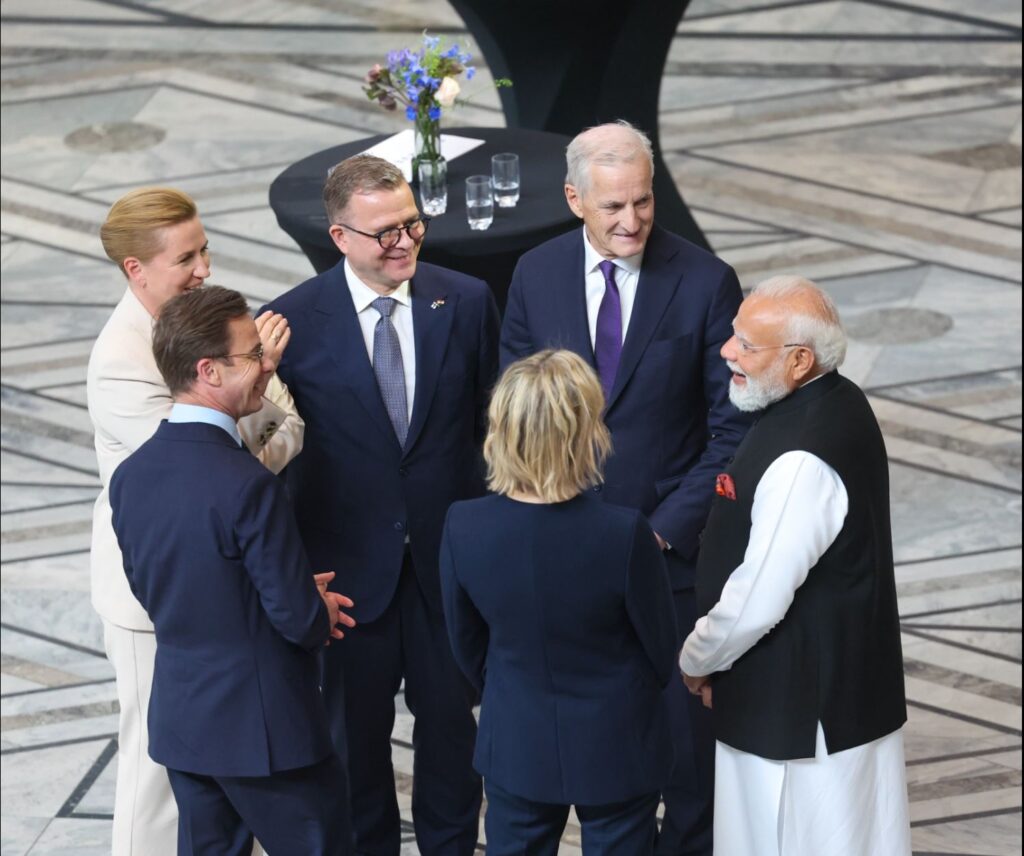
When India’s prime minister visited Oslo for a Nordic–India summit, the symbolism was audible: a Bollywood melody played on Oslo City Hall’s carillon. The music punctuated a deeper shift. Across the Nordic capitals, policymakers and business leaders are reframing ties with India from episodic engagement to a coordinated strategic partnership — driven by complementary strengths on green technology, digital services and innovation, and by shifting global geopolitics. For Nordic executives, investors and policymakers the moment poses a clear question: how to turn high-level political alignment into durable commercial advantage while managing regulatory, political and market risks?
This piece distils what happened, why it matters now, the concrete commercial opportunities and the strategic choices Nordic stakeholders face in partnering with one of the world’s fastest-growing major economies.
A new phase in Nordic–India relations
The recent summit in Oslo — the third Nordic–India leaders’ meeting in less than a decade — marked an acceleration rather than a departure. Nordic prime ministers presented a unified front on priorities: accelerating the green transition, deepening digitalisation and innovation links, and expanding two-way trade and investment.
India is no longer a distant, developing market to be approached on a sector-by-sector basis. With a population approaching 1.5 billion, sustained GDP growth and rising domestic demand, India represents scale, talent and a manufacturing pivot for firms seeking diversified supply chains. For the Nordics — economies with premium climate technologies, advanced services and global brands — India offers a large and fast-growing market, a deep technology talent pool and a partner for joint R&D and manufacturing.
Why this matters now: geopolitics, climate and supply-chain realignment
Three converging trends explain the urgency.
Geopolitical realignment. Strategic competition and trade frictions have made trade and investment hedging a political imperative. Europe’s desire to diversify dependencies, the United States’ changing trade posture, and India’s calibrated independent foreign policy all create space for deeper Nordic–India cooperation without forcing binary alignments.
Climate and industrial transition. Nordic nations lead in green-tech solutions — wind, grid integration, energy storage, green hydrogen, circular economy — while India needs rapid industrial decarbonisation at scale. This creates a natural market for Nordic technology and services, and opportunities for joint projects that can be financed through blended public–private vehicles.
Digital and innovation ecosystems. India’s large, cost-competitive tech talent pool and vibrant startup ecosystem make it an attractive partner for digital solutions, from cloud and AI services to fintech and health tech. Nordic firms can gain scale and cost efficiencies; Indian firms gain access to premium markets and governance standards.
Strategic opportunities for Nordic businesses and investors
1. Green hydrogen and renewables: Nordic firms can export know-how (electrolysis, project development, grid integration) and partner on India’s ambitious renewable rollout. There is scope for co-located manufacturing to reduce costs and secure supply chains for European markets.
2. Smart cities and infrastructure: Combining Nordic sustainable urban design, district heating/cooling and digital public services with India’s urbanisation needs creates near-term project pipelines and long-term urban platforms.
3. Digital services and scale-ups: Partnerships, M&A and captive development models can unlock India’s engineering talent for Nordic digital transformation, while Nordic brands can help Indian scale-ups access regulated European markets.
4. Advanced manufacturing and supply-chain reshoring: As companies diversify away from single-source suppliers, India is increasingly positioned as an alternative for electronics, pharmaceuticals and components — sectors where Nordic companies can move up the value chain through joint ventures or greenfield investments.
5. Climate finance and blended instruments: Given the capital intensity of large green projects, Nordic public finance institutions and private investors can collaborate with Indian counterparts on blended finance, risk-sharing and project pipelines that meet both climate and development objectives.
Risks and friction points
Opportunities are real but not automatic. Senior decision-makers must weigh several constraints:
Regulatory complexity and market access: India’s federal structure and evolving procurement policies can create inconsistent rules across states and sectors. Local content rules, licensing and bureaucratic practices increase transaction costs.
Intellectual property and standards: Nordic firms will demand robust IP protection and predictable contract enforcement — areas that require continued legal and institutional strengthening in India.
Political and supply-chain risk: India’s non-aligned geopolitical posture and continued engagement with a range of partners, including Russia and China, can create diplomatic sensitivities for Western firms.
Competition and scale challenges: Indian and global competitors (including Chinese firms) often compete aggressively on price, requiring Nordic entrants to prioritise high-value niches, service quality or premium sustainability credentials.
Financing gaps and cost of capital: Large projects in India may require blended public finance or guarantees to reach returns acceptable to Nordic institutional investors.
Practical implications for executives and policymakers
Prioritise sector focus. Nordic companies should select a small number of sectors (e.g., green hydrogen, grid tech, digital health) where technical leadership meets clear Indian demand, and align market-entry around projects with anchor buyers or public backing.
Use a joint Nordic approach. Pooling diplomatic engagement, export credits and IP protection can create scale advantages. A coordinated Nordic brand for sustainability and governance can differentiate offerings in India.
Build local partnerships and capability transfer. Joint ventures, R&D centres and training programmes reduce market friction and build political goodwill. Programmes that localise production while transferring know-how are politically attractive in India.
Leverage blended finance and public–private platforms. Nordic export credit agencies, development banks and private capital can de-risk early-stage projects and make bids competitive.
Mind regulatory and reputational risk. Robust compliance frameworks and active political risk analysis should be core to any expansion plan; sustainability credentials and labour standards will matter commercially and politically.
Comparative perspective: why the Nordics are well placed
Nordic economies are small but possess concentrated advantages: advanced climate technology, institutional stability, high per-capita purchasing power and a reputation for governance. These strengths create credibility in complex, partnership-driven markets like India. Conversely, Nordic firms must adapt to India’s scale, price sensitivity and regulatory complexity — a combination that rewards patience and local embedding.
Looking ahead: scenarios and strategic choices
Optimistic scenario: A sustained Nordic–India partnership delivers major win-wins — large-scale green projects, robust two-way investment, and new industrial linkages. Nordic firms capture first-mover advantages in high-value niches.
Base-case scenario: Cooperation deepens around selected projects and sectors, but progress is uneven due to regulatory hurdles and global economic cycles. Success requires public support and blended finance solutions.
Downside scenario: Geopolitical tensions or protectionist moves curb investment flows; competition from lower-cost providers limits Nordic penetration.
Conclusion: act strategically, not ceremonially
The Oslo summit’s optics — from carillon music to formal declarations — matter. But for executives and investors the question is execution. Nordic interests in India are timely and strategic: they align climate goals, industrial diversification and digital transformation. To convert political goodwill into economic outcomes, Nordic actors must combine focused sector strategies, local partnerships, pragmatic use of public finance and disciplined risk management.
For policymakers, the priority is clear: create predictable frameworks that support Nordic firms’ entry while protecting investor interests — through trade facilitation, export credit, legal cooperation and coordinated multilateral engagement. For business leaders, the imperative is equally straightforward: pick clear value propositions, localise where needed, and build partnerships that are commercially sustainable and politically resilient.
The music from Oslo’s towers signalled welcome. Now the region must translate melody into measurable projects, exports and jobs — and shape a partnership that endures in a volatile geopolitical landscape.