Denmark’s central bank warns that expectations-driven price surges in the capital are creating vulnerabilities that could ripple across the broader economy—and across the Øresund region.
In the autumn of 2025, Danmarks Nationalbank issued one of its most pointed warnings on the Danish housing market in years. While the broader economy showed resilience and most regional property markets moved at a measured pace, owner-occupied apartment prices in Copenhagen had surged by up to 20 percent year-over-year—a rate the central bank deemed incompatible with underlying wage growth and economic fundamentals. Governor Ulrik Nødgaard was characteristically direct: “What will be truly unfortunate is if people start buying owner-occupied flats in Copenhagen expecting them to increase by 15–20 per cent every year.” The implication was clear. When price momentum is driven more by the expectation of future gains than by income, supply, or credit conditions, the market becomes structurally fragile. And fragility, in a country where household debt levels rank among the highest in the OECD, is not a local concern—it is a systemic one.
The warning arrives at a delicate moment. Denmark’s economy has proven remarkably robust through a period of global trade disruption, energy market volatility, and geopolitical uncertainty. Mortgage rates have retreated from their 2022–2023 peaks, the labour market remains tight with unemployment near 3 percent, and tax relief measures introduced in 2026 have bolstered household disposable income. These conditions have naturally supported housing demand. Yet the Nationalbank’s analysis suggests that in Copenhagen—and increasingly in Aarhus—the market is beginning to decouple from these fundamentals. The result is a twin-speed market that poses distinct challenges for policymakers, investors, and financial institutions alike.
The Anatomy of a Twin-Speed Market
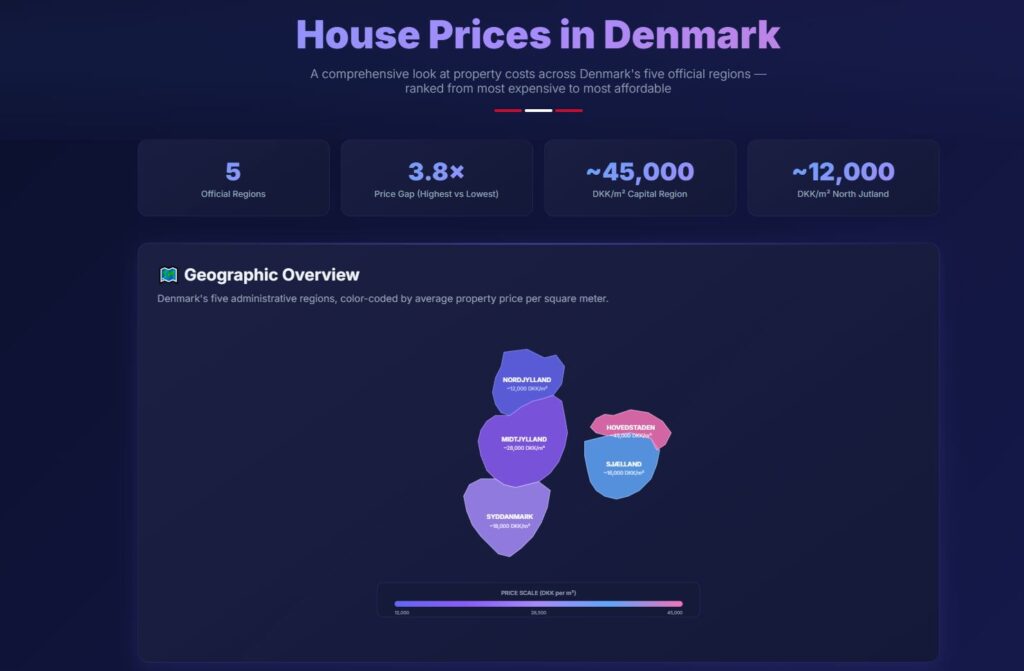
Denmark’s housing market is not overheating uniformly. Outside the capital region and Aarhus, price increases have been moderate—roughly 5–7 percent annually for single-family homes nationwide, a level that, while elevated by historical standards, remains broadly consistent with income growth and falling interest rates. The divergence is stark. In Copenhagen, apartment prices climbed 24 percent through 2025, fuelled by sustained in-migration, the lowest supply of flats for sale since the global financial crisis, and a construction pipeline that has failed to keep pace with population growth since 2009. In Aarhus, flat prices rose 13 percent over the same period, driven by similar dynamics of urban concentration and constrained supply.
This bifurcation is not unique to Denmark. Across Northern Europe, capital cities have experienced sharper price appreciation than national averages, reflecting a broader trend of urban agglomeration, knowledge-economy clustering, and infrastructure investment concentration. What distinguishes the Danish case is the speed of the divergence and the institutional context in which it is occurring. Denmark operates one of the world’s most tightly regulated mortgage markets, underpinned by the “balance principle”—a legal framework requiring mortgage loans to be funded by bonds of matching size, cash flow, and maturity. Maximum loan-to-value ratios are capped at 80 percent for residential properties, and in Copenhagen and Aarhus, additional “Growth Area Guidelines” impose debt-to-income limits, interest-rate stress tests, and minimum down-payment requirements of 5 percent. These rules were designed precisely to prevent the kind of speculative excess that preceded the 2008 crisis. That they are now being tested so severely in the capital is a signal that structural demand pressures—demographic shifts, supply rigidities, and urban policy choices—may be overwhelming even well-calibrated macroprudential defences.
The OECD, in its 2026 Economic Survey of Denmark, noted that housing supply elasticity in the capital region is “very low” compared to other Danish regions, a constraint exacerbated by coastal geography, protected green spaces, and fragmented municipal land-use regulation. The result is a market where price signals do not efficiently trigger new construction, and where the natural adjustment mechanism—more building—is politically and physically constrained. In Aalborg, by contrast, where construction has outpaced household formation, flat prices have trended weaker despite favourable macroeconomic conditions, illustrating how local supply dynamics can override national monetary and fiscal trends.
When Expectations Become the Engine
The Nationalbank’s core concern is not merely that prices are rising quickly, but that the driver of those prices has shifted. When buyers purchase property based on the assumption that prices will continue to rise at double-digit rates, they are effectively speculating on future sentiment rather than securing shelter against a stream of housing services. This dynamic—sometimes termed “momentum investing” in residential real estate—can become self-reinforcing for a time, as rising prices validate expectations, which in turn fuel further demand. But it also creates a precarious equilibrium. The moment expectations shift—triggered by an interest-rate surprise, an employment shock, or an external geopolitical event—the correction can be abrupt and disorderly.
Governor Nødgaard’s warning about “spread outside Copenhagen” adds another layer of complexity. As prices in the capital become prohibitive, buyers naturally migrate to surrounding municipalities—North Zealand, East Zealand, the suburban ring—where prices remain lower but are now accelerating as well. If this diffusion is driven by genuine affordability-seeking behaviour, it represents a healthy market adjustment. If, however, it is driven by the same expectations-driven psychology—buyers chasing the next “hot” area in the belief that prices there too will rise 15–20 percent annually—then the vulnerability is amplified. A correction in Copenhagen would no longer be a localised event; it would cascade through the Greater Copenhagen region, affecting a larger share of the national housing stock and, by extension, the mortgage-bond market that underpins Denmark’s financial architecture.
The historical precedent is instructive. Denmark experienced a severe housing correction in 2008–2009, when real house prices fell by approximately 20 percent nationwide, with steeper declines in Copenhagen. The recovery was prolonged, and the social and economic costs were significant. The current lending framework was constructed in direct response to that episode. Yet macroprudential tools, however well-designed, cannot eliminate market cycles; they can only dampen their amplitude. The Nationalbank’s insistence that lending rules “must not be relaxed” is therefore as much a political signal as an economic one, aimed at preempting pressure from industry lobbyists or populist politicians who might argue that tighter regulation is stifling homeownership.
The Geopolitical and Energy Dimension
The Nationalbank’s analysis also flagged an external risk that has grown more acute since the report’s publication: the war in the Middle East and its attendant energy price volatility. Denmark, despite its renewable-energy leadership and North Sea oil and gas production, remains integrated into European energy markets and exposed to price shocks. Higher energy costs feed into inflation, which could prompt a reversal in the European Central Bank’s monetary easing trajectory—or at least delay further rate cuts. For Danish mortgage borrowers, many of whom hold variable-rate or short-term fixed-rate loans, even a modest rise in funding costs could strain household budgets.
The banks, however, appear well-capitalised to absorb such shocks. The Nationalbank noted that Danish banks’ high earnings provide a “solid cushion” against potential losses, a finding consistent with the sector’s strong performance through the post-pandemic rate-hiking cycle. Denmark’s AAA sovereign credit rating, affirmed by all major agencies, further underpins confidence in the financial system’s stability. Yet bank resilience is not the same as household resilience. The Danish mortgage market’s unique structure—where borrowers can prepay bonds at par when rates fall, but face mark-to-market losses when rates rise—creates asymmetric risks that are poorly understood by many homeowners. A sudden rate reversal could expose vulnerabilities that balance-sheet aggregates obscure.
The geopolitical context extends beyond energy. Denmark’s strategic position in the Arctic and North Atlantic, its membership in NATO and the EU, and its role in transatlantic trade flows all expose the economy to external shocks that could affect consumer confidence and housing demand. The foreign-policy tensions around Greenland in early 2026, while ultimately contained, demonstrated how quickly geopolitical noise can unsettle domestic sentiment. The housing market, as the Nationalbank repeatedly emphasises, does not operate in a vacuum.
Comparative Perspectives: The Nordic and European Context
Denmark’s housing dynamics are not isolated. Sweden, Norway, and Finland have all experienced post-pandemic housing market corrections, though the timing and severity have varied. Sweden’s market, heavily reliant on variable-rate mortgages, saw sharp price declines in 2022–2023 as the Riksbank raised rates aggressively. Norway’s market, supported by oil wealth and a more regulated banking sector, proved more resilient. Finland’s market, tied to the eurozone’s slower growth trajectory, has seen only modest price appreciation. Within this Nordic landscape, Denmark occupies a middle ground: more financially sophisticated than Finland, less rate-sensitive than Sweden, but with a capital-city market that is now exhibiting some of the same momentum-driven characteristics that preceded corrections elsewhere.
Internationally, the comparison with other European capitals is revealing. While Copenhagen apartment prices surged 20 percent year-over-year, price growth in Berlin, Paris, and Amsterdam remained in the low single digits or turned negative, reflecting higher interest rates, weaker labour markets, or regulatory constraints on foreign investment. Copenhagen’s outperformance suggests that local factors—demographics, supply constraints, and perhaps a perception of Denmark as a safe haven in an uncertain world—are outweighing the common European monetary policy stance. For international investors, this presents both opportunity and risk: the Danish market offers yield and stability, but at valuations that increasingly assume the best-case scenario.
The Policy Dilemma
For Danish policymakers, the challenge is to cool the capital’s housing market without triggering a hard landing. The toolkit is familiar but blunt. Tightening lending rules further in Copenhagen and Aarhus could choke off legitimate demand and push activity into less regulated segments of the market. Loosening supply constraints—accelerating zoning reform, streamlining building permits, investing in transport infrastructure to unlock peripheral land—would address the root cause but requires political capital and long-term commitment that exceeds electoral cycles. Tax policy, including the possibility of adjusting property taxation or capital gains treatment, remains politically sensitive in a country where homeownership is culturally entrenched and wealth inequality, while lower than in many OECD peers, is a growing concern.
The Nationalbank’s recommendation to hold the line on lending standards is the least controversial and most immediately actionable measure. But it is also insufficient on its own. If expectations have indeed become the primary driver of prices, then macroprudential tools designed to constrain credit may have limited effect on cash-rich buyers—domestic savers, equity-rich downsizers, or foreign investors—who can transact with minimal leverage. The Danish mortgage system’s 80 percent LTV cap already ensures substantial equity cushions; the problem is not that buyers are over-leveraged, but that they may be overpaying.
This distinction matters for financial stability. A market correction in which prices fall 15–20 percent but borrowers remain solvent—because they have substantial equity and stable employment—is painful but manageable. A correction in which falling prices trigger forced sales, negative equity, and a credit crunch is systemic. The Nationalbank’s analysis suggests Denmark is closer to the first scenario than the second, but the margin of safety is narrowing.
What Comes Next
Looking ahead, the most likely trajectory for the Danish housing market is a gradual cooling rather than a sharp correction. Nykredit, Denmark’s largest mortgage bank, forecasts that Copenhagen flat price growth will slow from 17.4 percent in 2026 to 3.1 percent in 2027 and 2.7 percent in 2028, as affordability constraints bite and construction activity gradually picks up. National house prices are expected to rise 4.9 percent in 2026, 2.7 percent in 2027, and 2.0 percent in 2028—a normalisation that would align with long-term trends.
But forecasts are not destiny. The risks are skewed to the downside. A re-acceleration of inflation in Europe, a disorderly escalation in the Middle East, or a sharp deterioration in the Danish labour market could all disrupt the soft-landing scenario. The Nationalbank’s warning should be read not as a prediction of imminent crisis, but as a reminder that markets driven by expectations are inherently unstable—and that the time to reinforce defences is before the storm, not during it.
For business leaders and investors, the implications are clear. Real estate portfolios concentrated in Copenhagen’s owner-occupied apartment segment carry elevated valuation risk. Construction and development firms should anticipate regulatory pressure to accelerate supply in the capital region. Financial institutions must stress-test their mortgage books against scenarios that include both rate shocks and price corrections, even if the probability of either remains low in the near term. And policymakers must resist the temptation to treat housing affordability as a problem to be solved through credit expansion—a lesson that Denmark, with its post-2008 regulatory architecture, should have learned more thoroughly than most.
Editorial Outlook
A compelling follow-up to this analysis would examine the political economy of Danish housing supply reform. Why, despite decades of consensus on the need for more construction in Copenhagen, has supply remained so chronically constrained? The answer lies at the intersection of municipal autonomy, green-space protection, NIMBYism, and the electoral arithmetic of a country where homeowning voters dominate the political centre. An investigative feature exploring which municipalities have successfully reformed zoning and building codes to accommodate growth—and which have used planning powers to preserve scarcity—would illuminate the structural barriers that macroprudential policy alone cannot overcome. It would also speak directly to Nordic Business Journal’s audience of executives and policymakers who must navigate these constraints in their own investment and operational decisions. The angle: Denmark’s housing crisis is not a market failure; it is a governance failure dressed in environmental virtue.
This article was prepared for Nordic Business Journal. For further analysis, partnership inquiries, or editorial discussion, readers are invited to contact the editorial team. We welcome contributions from senior executives, institutional investors, and policy professionals engaged with the Nordic and international business landscape.
Source: Statistic Denmark, Finans Denmark